


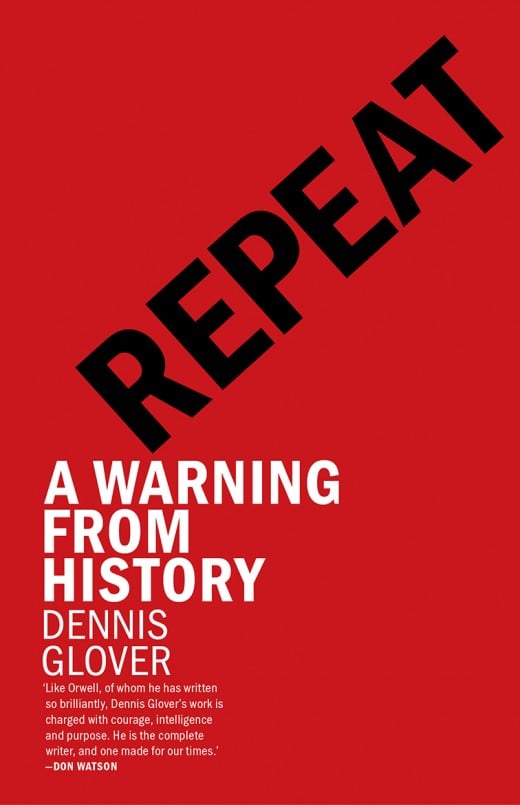
The world needs to learn the lessons of the 1920s and ’30s, and fast. In Dennis Glover’s Repeat: Warnings from history he retells the story of the inter-war years in a series of lessons drawn from unfolding events and the unheeded omens of those who spoke out but were ignored.
In his introduction to the book he gives us a taste of what has been.
INTRODUCTION
Switch on the news channel right now. Does it all look somehow familiar? Ranting populists. Phoney elections. Politicised courts. Attempted putsches. Assassinations. Bullets to the back of the head. Wars. Tank battles. Cities bombed flat. Calls for caution and non-intervention. Angry mobs coming for the Jews, for the Muslims and for sundry “others”. Facts that are difficult to distinguish from lies. A world of unthinkable savagery. If it looks familiar, it’s because you read about such things at school. In history class.
On January 6, 2021, a thought occurred to me while watching Donald Trump’s right-wing vigilantes storm the Capitol building in Washington, DC: perhaps history really does repeat. A clock started ticking in my mind.
Let’s go back. It’s 1923, and in Munich, a nascent political party, led by a ridiculous street corner agitator named Adolf Hitler, attempts a putsch against the Weimar Republic. It fails. Hitler is arrested and jailed but released soon after by sympathetic judges and politicians, enabling him to run again when the times suit him better. Sound familiar?
Fast-forward 10 years. It’s now 1933, the height of a global economic depression, and that same easily dismissed nobody has taken power and started dismantling German democracy. The first concentration camp opens, in Dachau. Laughed at and disregarded by all upstanding people, Hitler has the last laugh. The clock ticks on . . .
In the Soviet Union, a dictator named Joseph Stalin is busy wiping out all who might one day oppose him. His favoured method: a single pistol shot to the back of the head – fully reported in the press, as a warning to all who might consider crossing him in future. Familiar?
Over the next six years, populism and extremism spread across Europe. Hitler, Stalin, Benito Mussolini and Francisco Franco preach hatred and consolidate their power. The term “propaganda” begins to take on its now familiar meaning and a young political writer, George Orwell, realises that facts are not only being disputed, they are also being invented. News is becoming fake. The populist dictators become commonplace, accepted, respectable. When they ask for national boundaries to be revised and treaties to be abandoned, many see the logic of their case and negotiate with them. And then, when they break their word, their opponents do nothing. Tick, tick, tick . . .
By 1936, the first battles of the new age start in Europe – in Spain. The open-air massacres of thousands of innocent people – in town squares and bullfighting rings – begin. The first cities are terror-bombed. In Guernica, where hundreds are killed, the German perpetrators fabricate fantastic evidence that the Basques destroyed their own city to embarrass the Luftwaffe. The world looks on, horrified, but does little to intervene. It is just a local war, the nervous statesmen say. Not our fight. And anyway, what can we do? Tick, tick, tick . . .
More camps open. In 1935 Germany begins openly to re-arm. The democracies do nothing . . . In 1938 Germany annexes Austria, claiming to return it to the Fatherland. Nothing . . . Six months later, Hitler demands that the German-speaking regions of Czechoslovakia be ceded to Germany as well. The democracies help him, but at least this time they have qualms. They are slowly waking up . . . Then, in November 1938, the sound of breaking glass heralds the beginning of the end for European Jewry. The time to take preventive action has run out.
We all know what happened after 1939. The big tank battles began. Cities were razed. Concentration camps became extermination camps. All those reasons for not acting earlier suddenly sounded like moral cowardice. Something to regret. Midnight approached . . .
We can discern five stages from the 1920s and ’30s that we must not allow to repeat:
Sowing the wind – we created the economic conditions that made it difficult to maintain social harmony and political stability.
Populism – we allowed those willing to exploit hatred to take power and claim legitimacy.
Savagery – animated by culture wars and political intolerance, we saw our world descend into a new era of murder and violence that targeted political opponents, journalists, artists and “the other”.
Preliminary war – we let the populists plan and win early wars when standing up to them might have ended their threat.
Consequences – we awoke at last to the reality of massacres and world war.
Is the pattern repeating? In this short book – short because we need to digest its message quickly and respond immediately – I set out to show the uncanny similarities between then and now: our unwillingness to see things until it’s too late; our vulnerability to demagogues; the anger of our “betrayed” electorate; the hate-laden speeches of our populist leaders; their shocking brutality towards opponents; the ugliness of our cultural battles; the spreading poison of racism; the steady disappearance of the concept of the truth; the return of war with its medieval massacres and mass bombing of cities. Ultimately, I want people to grasp just how extraordinary and ugly current events are compared to those of just a couple of decades ago, and how totally inadequate our responses. I want the world to recognise that in many crucial ways, the big failures of the 1920s and ’30s are already upon us, and that we have to act now on the lessons of those failures to prevent the greater horror of the 1940s also repeating. I provide no step-by-step program of action; action must respond to fast-changing events. Instead, I sound an alarm. Because before we can save our world from the savage triumph of the populists, we need to wake from our slumbers and recognise the dangerous reality we now inhabit: a world edging ever closer to repeating 1939.
My story concentrates on the patterns of politics observable in the West, mostly in Russia, Ukraine, the rest of Europe and the United States. But readers will recognise where the lessons of the 1920s and ’30 have relevance across the world, where nationalist strongmen with nativist agendas are entrenching their long-term power: in the religious exclusivism of Narendra Modi’s right-wing Hindu nationalist Bharatiya Janata Party (BJP); in the aggressive territorial revanchism of Xi Jinping’s determination to absorb Taiwan and restore China’s past greatness; in Recep Tayyip Erdoğan’s authoritarian presidential rule in Turkey; and in Indonesia, where the newly elected former military officer Prabowo Subianto is entering the presidency with a notorious record of human rights abuse. All will be watching to see whether, in such an unpropitious environment, democracies have the resolve to defend their liberal values or surrender them to populist challengers.
So let’s observe events as they unfolded, using, where we can, the insights of the people who saw it all going wrong and tried to stop what followed. And let’s commence where it all started to go wrong: when the young began to die.
ABOUT THE AUTHOR
 Dennis Glover is an Australian writer and novelist. The son of factory workers, Dennis grew up in the working class Melbourne suburb of Doveton before studying at Monash University and King’s College Cambridge where he was awarded a PhD in history. He has worked for two decades as an academic, newspaper columnist, policy adviser and speechwriter to Australia’s most senior political, business and community leaders.
An often outspoken political commentator, his books include An Economy is not a Society, The Art of Great Speeches and Orwell’s Australia. His debut novel The Last Man in Europe tells the dramatic story of how George Orwell wrote Nineteen Eighty-Four. His second novel, Factory 19, is an Arcadian story about the factory world and how we lived before the invention of the mobile phone and the computer. And his most recent novel Thaw retells the Scott of the Antarctic story for the age of climate change.


0 Comments