


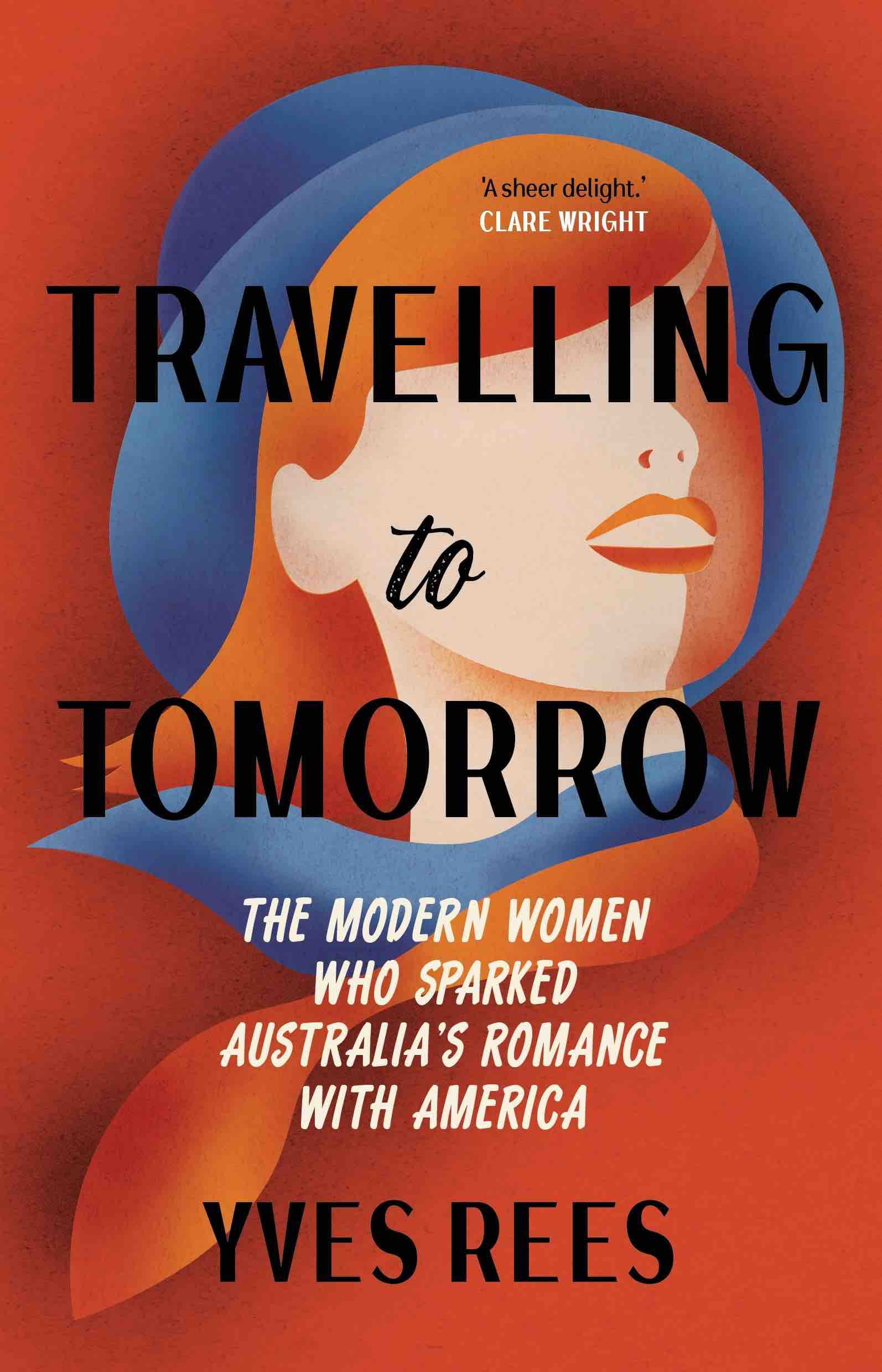
In YVES REES book Travelling to Tomorrow she rewrites the story of Australian/US relations by spotlighting 10 trailblazing women whose extraordinary lives have largely been forgotten.
In this extract we hit the surf in Honolulu with a famous surf-board rider.
FRESHWATER MERMAID DOES HOLLYWOOD
The swimmer, Honolulu, 1918
Isabel stepped off the gangplank, clutching her towel and bathers. The Niagara would only be in Honolulu for the day; there was no time to waste. She was determined to taste those famed waves – the ones Duke had raved about.
Down on the dock, a reporter rushed forward.
‘Miss Letham! Miss Letham!’
He announced himself as Mike Jay from the Honolulu Star-Bulletin. Could Australia’s famous surfboard rider spare a moment?
She could. A taxi was booked to drive her down to Waikiki, but until it arrived, she was happy to talk to the press. Who knew, a Hawai‘i news clipping might come in handy in Hollywood, help get her foot in the door.
Isabel smiled at the reporter, turning on the charm.
‘Yes, this is my first visit here and I’m just dying to get into this bathing suit and have a plunge at Waikiki.’
The reporter ran his eyes along Isabel’s person. The young Australian was dressed all in white: ankle-length dress, light coat, gloves, low heels and stockings, topped with a cylindrical hat. Tall for a woman, she had an athletic build that commanded attention. Beneath the hat’s brim was a guileless oval face, with round cheeks and a mouth built for laughing.
Mike Jay liked what he saw. He declared her the prettiest swimmer to come out of Australia. Isabel smiled even harder. She was 19 and didn’t mind a bit of flirtation.
‘I guess I’m going to have a harder job of it in your waves here,’ she continued. ‘Our waves are long rolling combers but these are short snappy breakers.’
The taxi was pulling in, time to wrap things up.
Yes, she was headed for New York; yes, she hoped to crack into the movies; yes, she planned to stay in America at least six months.
With that, Isabel ducked into the taxi, leaving a smitten reporter in her wake.
Down at Waikiki, Duke’s board would be waiting for her.
He’d promised. Duke himself was away on the mainland; they’d missed each other due to rotten timing, but at least she could ride his board on the beach where he learnt to surf.
Almost four years earlier, in January 1915, Duke Kahanamoku had lifted Isabel onto his longboard at Sydney’s Freshwater Beach and transformed her into a surfer. Kahanamoku was a native Hawai‘ian, nine years her senior, and one of the world’s top
swimmers. He swam for the United States at the 1912 Olympics, winning gold in the 100 metre freestyle. In the summer spanning 1914 and 1915, Duke toured Australia to test his swimming skills against local talent, but it was his surfing prowess that really got the punters excited.
Back then, barely anyone in Sydney had encountered a surfboard. At that point, even taking a dip was a novelty; only several years earlier, public bathing was illegal. In 1915, there were only a handful of surfboards around – souvenirs from Hawai‘i, where the sport was invented. Most beachgoers, Isabel included, entertained themselves with surf shooting (later known as body surfing) – the fine art of throwing their bodies into the waves.
Every summer, she’d spend long days at Freshwater Beach, down the road from her family home.
When Duke plucked her out of the beachside crowd, and she surfed in his muscled arms before hundreds of spectators, Isabel was hailed the ‘Freshwater mermaid’. The pair were a sensation.
Overnight, she went from ordinary schoolgirl to ‘surf queen’. She got used to reporters’ questions and the flash of cameras. That’s when Isabel acquired a taste for celebrity. That’s when she got serious about saving for America.
Down at Waikiki, Duke’s board was there as promised, but there were no decent waves to be seen. The water was flat as a pancake. Isabel paddled out and waited, hoping the breakers would pick up.
Hours later, when she finally paddled back in, defeated by the calm swell, there was a familiar figure on the shore.
It was that reporter again, Mike Jay from the Honolulu Star- Bulletin. This time he’d brought a photographer to snap a few pics for the paper.
She posed standing in front of the board, still in her bathers and swimming cap, squinting into the sun, with Duke’s name emblazoned on the wood above her head.
Jay peppered her with questions, trying to prolong their encounter. What did she think of Honolulu? Why had she come to America?
‘If Honolulu is a sample of America, I am going to like America. My, I do admire the Americans,’ Isabel said agreeably.
‘While we Australians talk and talk and talk about what we are going to do, you Americans talk and do things. That’s what I love about the Americans.’
Ever since that Freshwater summer with Duke, Isabel knew America was the place for her. The Hawai‘ian didn’t inspire her American dreams – Hollywood had already done that – but meeting real Americans made the dream seem possible. Now, she was determined to make a go of life across the Pacific. Even though the Niagara was still days away from the mainland, she was already considering US citizenship.
‘You know you Americans are awful boasters,’ Isabel continued. ‘You boast you can do the impossible, and then you go out and do it. That’s what makes you such wonderful people.’
By now Isabel and Jay were getting along famously. She sparkled with energy, and he couldn’t take his eyes off what he called her ‘pretty face’ and ‘well proportioned’ figure. Her ship was leaving that same day, but could he write to her? Why, sure, Isabel replied, thinking nothing of it. The day was getting away, and she still needed to visit Diamond Head (or Lē‘ahi) and the Nuʻuanu Pali lookout. It was only later, when Jay’s epistles kept finding her, that she realised he was serious. But Isabel wasn’t interested; she had bigger fish to fry.
ABOUT THE AUTHOR
 Dr Yves Rees is a writer, historian and podcaster living on stolen and unceded Wurundjeri land. At present, Yves is a Senior Lecturer in History at La Trobe University in Naarm/Melbourne, and co-host of Archive Fever podcast. Yves’ next book Travelling to Tomorrow: the modern women who sparked Australia’s romance with America will be published by NewSouth in September 2024.
Yves was the recipient of the 2020 Calibre Essay Prize, awarded for their essay ‘Reading the Mess Backwards’. Their memoir All About Yves: Notes from a Transition was published in 2021. Alongside Bobuq Sayed, Sam Elkin and Alex Gallagher, Yves is co-editor of the anthology Nothing to Hide: Voices of Trans and Gender Diverse Australia.
Yves is a frequent contributor to ABC radio, and has appeared on ABC TV’s The Drum and Queerstralia, as well as Channel 10’s The Project. Yves has published widely across Australian gender, transnational and economic history. At present, Yves is working on a history of Australian drag.
Yves is trans and uses they/them pronouns. They write on transgender history and politics. Alongside Sam Elkin, Yves is the co-founder of Spilling the T trans writing collective, which was a finalist for Artist of the Year at the 2021 Globe Awards. Sam and Yves guest co-edited Bent Street 5.1 — Hard Borders, Soft Edges, published in June 2021.
When not reading or writing, Yves enjoys running, hiking and ocean swimming.


0 Comments