



Kathy Weeden is a Canberra-based music and learning support teacher. Good Reading for Kids caught up with Kathy to ask her about her new book Phonobet.
ABOUT THE BOOK
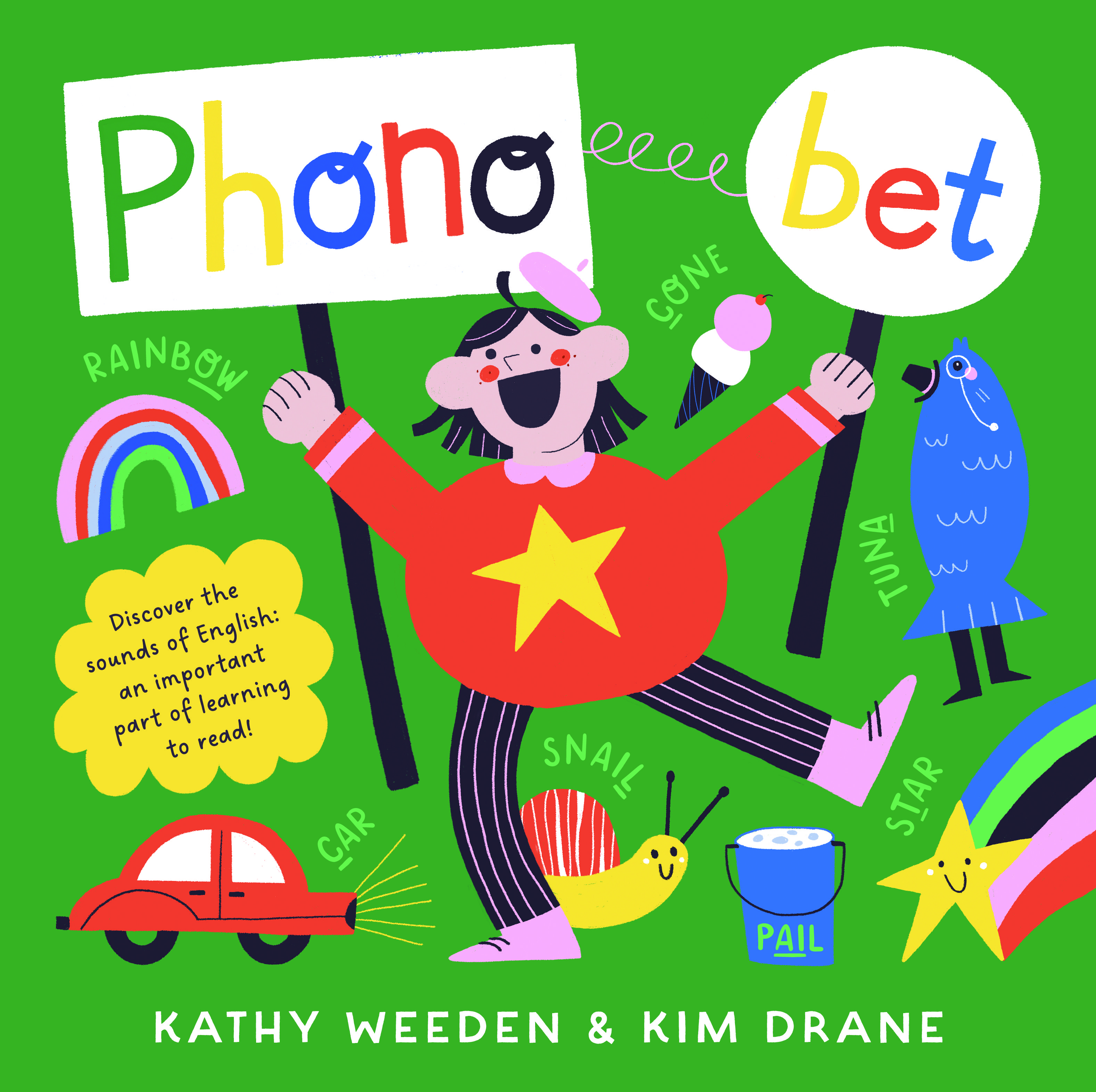 Come and meet the Phonobet, old Alpha Betty’s twin,
The set of all the sounds you use when waggling your chin.
Phonobet is a modern-day, Australian answer to Dr Seuss’s ABC. This very clever rhyming text takes an onomatopoeic romp through the 44 phonemes of Australian (and British) English, comparing sounds to trees, bees, trains, robots, monkeys, pirates and more. The text aligns with primary-school phonics programs and could be used by educators in this field, but is equally successful as a fun read-aloud book for parents of 4- to 6-year-olds.
Children will enjoy Kim Drane’s bold, colourful and fun-filled illustrations, which pop on the page.
Q&A WITH KATHY WEEDEN
Why did you want to write your book Phonobet?
There are many beautiful alphabet books on the market, but the alphabet alone only gives a partial picture of how our writing system works. We have 26 letters, but around 44 sounds to convey using those letters. I wanted to create a book that mapped out those sounds in a fun and memorable way.
Can you tell us what a phoneme is?
Phonemes are the building blocks, the smallest parts of our speech that distinguish words from one another. We can see that ‘p’ is a different phoneme from ‘b’ because pit is a different word to bit. A phoneme might sound different depending on where it appears in a word, and what other phonemes are around it. For example, the ‘p’ in pit is breathier than the one in spit, but they still count as the same phoneme. Counting phonemes can get confusing, since they really don’t match up with the number of letters. ‘Fix’ has four phonemes, while ‘though’ has only two.
What is your favourite part of the book, and why?
I love the zany character that Kim has given to the Phonobet girl, so that page is a strong contender, but I also love the bees! I think, though, that my very favourite spread is the second last of the text – the wacky world of wonder words. It is my favourite to say, and the illustration really gives a sense of endless fun and possibility.
What are some of your favourite sounds and why?
I don’t have any one favourite sound, but there are several sound combinations which I love for their symbolism: the stern ‘gr’ in growl, grumble and grouchy; the smooth, wet ‘sl’ in slick, slippery, slobber and slime. I am also particularly fond of the ‘qu’ in quince, cumquat, aquatic and loquacious. So many scrumptious words to play with!
Why is it important to sound out your words?
For beginning readers, sounding out the words allows them to work out which word they have come across. But it also lets them map each sound in the spoken word onto the letters on the page, so they can (after several encounters) remember the word by sight, without needing to sound it out.
As readers advance, sounding out takes on an exciting new role: adding to vocabulary. When we see a word we have never heard or seen before, we are able to use our knowledge of different sound-letter patterns to come up with a likely pronunciation. We then use the context to work out what the word might mean. From about Year 3 onwards, this is the biggest way we build our vocabulary.
Do you have any good tips for remembering sounds?
Lots of play, lots of repetition, and ideally, only focusing on a few new sounds at a time. Thinking about which part of the mouth is making the sound can help, as well as coming up with ridiculous images that each sound reminds you of, the sillier the better. I’m also a big fan of embedded picture mnemonics, where the picture is in the shape of the letter. In the set I use, ‘v’ is a vase and ‘m’ is a very cute monster.
0 Comments