


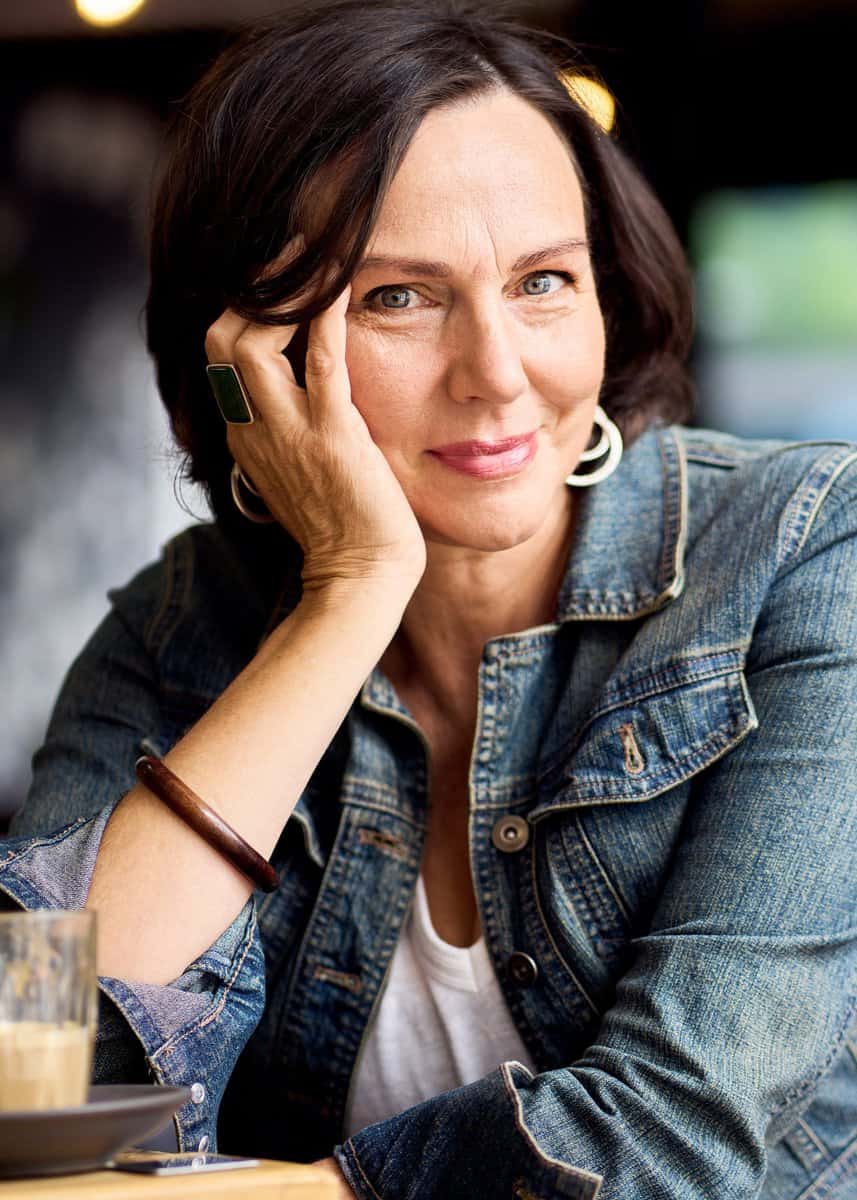
PIP WILLIAMS is the internationally bestselling author of her 2020 debut novel The Dictionary of Lost Words. She returns to the same world in her latest companion book The Bookbinder of Jericho, which is a powerful and moving novel about bindery women at the Oxford University Press during World War I.
As AKINA HANSEN writes, it’s a fascinating story of knowledge, class and gender.
Access to information and basic education is deemed a fundamental human right and yet for millennia access to knowledge has been restricted and denied to certain groups in society. It’s within this space that author Pip Williams began asking herself, ‘Who gets to make knowledge? Who gets to access it? And what happens when knowledge is denied?’
The Bookbinder of Jericho is Pip’s second novel, and a companion story to her beloved and internationally acclaimed novel, The Dictionary of Lost Words, which tells the story of the making of the first edition of the Oxford English Dictionary and the gendered nature of language.
Her second novel returns to the same world of The Dictionary of Lost Words. Instead of focusing on the dictionary and the middle-class editors behind its inception, The Bookbinder of Jericho is centred around the Oxford Dictionary Press and the working-class women in the bindery during World War I.
‘Before The Dictionary of Lost Words was even published, I’d started writing The Bookbinder of Jericho,’ Pip tells me.
While Pip was researching for her first novel in the archives of Oxford University Press, she came across a short silent film from 1925 about book binding.
‘There was a minute or so of footage of women in the bindery, folding the pages and gathering the sections. And that’s all I had. I had no kind of reminiscences about the job, I had no biographies of the women.’
This short clip ultimately sowed the seed for The Bookbinder of Jericho. ‘
As I was watching the film, I wondered if she ever stops to read it.’
Despite approximately 100 women working at the press at the time, their stories are largely missing from the archives.
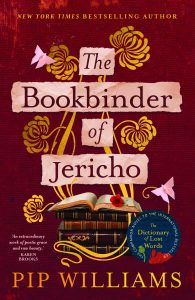 Pip’s novel The Bookbinder of Jericho provides a fascinating glimpse into the world of the bindery and sheds light onto the lives of these women. Her story is set on a backdrop of immense social and political change as women took on men’s jobs when they went off to war.
‘So suddenly, this notion that women weren’t contributing to society, that women weren’t capable, that women didn’t have what it took to be a voting member of the community – that had to be completely dismissed – because women had stepped up, and they were stepping into the jobs of men and doing them very, very capably and keeping the country running,’ says Pip.
Two of these women are twin sisters, Peggy and Maude, who work at the bindery at Oxford University Press during World War I. We quickly learn that Peggy is bright and curious and takes any opportunity to read the books she binds.
‘It occurred to me that they have more access to knowledge in some ways, than anybody else in the world, because the books come through their hands. And yet, because of the process, because of the industrialisation of their job, because of their class, and because of their gender, they are denied access to the very knowledge they are helping to produce, that they are helping to make accessible to other people, people who have been granted the privilege of knowledge.’
Indeed, Peggy dreams of attending Sommerville College, and yet, because of her class and gender, she feels trapped in her job at the bindery.
Pip expertly explores how one’s gender and class can ultimately dictate access to education. Up until the 19th century, Oxford and Cambridge had been male only colleges. When female arms of the colleges opened, women studied and sat the same exams as men, but could not get a degree.
It becomes highly obvious then, what structural challenges Peggy is up against as a working-class woman. Interestingly, Pip drew from her own experiences to capture this.
‘While none of the fiction I’ve written is autobiographical in any way, with all of it, and every character, I draw on my experience, to some extent. But with Peggy, I think it’s probably a little bit more direct.
‘I didn’t come from a wealthy family, and university was free. I was curious, I loved reading, but I was also dyslexic. I had never been told at school that university was a pathway that I should pursue. And yet, I had always loved learning. So even though it wasn’t something that was pointedly encouraged in my case, it wasn’t discouraged, either. I wasn’t told I couldn’t do it,’ Pip shares.
Like Peggy, Pip loves learning and, in turn, she pursued an education after high school, going on to gain a PhD and eventually working as an academic and lecturer.
‘In some ways, up until very recently, I never left university, I was so enamoured by it,’ she tells me.
Over the course of the novel, broader issues and themes outside of the bindery are explored.
These include the arrival of Belgian refugees, the Spanish flu, censorship, and the different experiences of war through class, disability and gender.
We see many parallels between the period of World War I and recent times. This enabled Pip to write from her own observations and experiences on top of her meticulous research.
‘I was writing about Germany invading Belgium. And Russia invaded Ukraine. I was writing about Belgian refugees fleeing to England and Ukrainian refugees were fleeing to Europe. Then I was writing about the Spanish flu. And hundreds of thousands of people around the world were dying from COVID. At the same time, around the world, there are places where women are being denied access to education because of their gender.
‘I think when you do tap into the parallels, that’s when readers become engaged, because suddenly they are part of the history, because they can understand Peggy’s desire for something different.’
When Peggy begins volunteering at the local hospital she befriends Gwen, a privileged and educated woman. Their friendship ultimately encourages Peggy to pursue an education, but she in turn faces many challenges and obstacles in pursuit of this dream.
‘Whether they’re men or women, they can understand the feeling of being excluded from something based on some characteristic; it could be the colour of their skin, it could be their ability to walk or to communicate in a particular way. It could be their gender, it could be their class, but we are all subject to discrimination or exclusion, based on sometimes very minor things, sometimes very major things,’ says Pip.
The Bookbinder of Jericho is a compelling book, made even more so by Pip’s extraordinary research. She liaised with the bookbinder at The State Library of South Australia who gave her access to rare research about women’s roles in binderies across the US. This gave her a lot of insight into the conditions and work that women did at those times. She also visited London and Oxford last year where she was able to access rare archival material and immerse herself in the streets of Jericho, where Peggy lives in the novel.
While Pip’s novel is a work of fiction, it’s a compelling feminist tale brought to life by her rigorous research and thoughtful writing. Importantly, it’s a moving story that allows us to examine our own humanity through historical parallels.
‘I always think history is never just in the past,’ Pip tells me. ‘We as humans haven’t evolved for millennia. We are exactly the same internally now, as we were 100 years ago, or 1000 years ago. Our hopes and dreams and desires, in some ways, are fundamentally similar to what they have always been, and history is such a wonderful way to reflect on not just who we have been, but also who we still are, and who we are always going to be.’
If you were a fan of Pip’s first novel, then The Bookbinder of Jericho will not disappoint. And luckily for fans, they will be welcomed back to the world of her debut novel with a limited television series adaptation. I know I can’t wait to return to her world.

0 Comments