


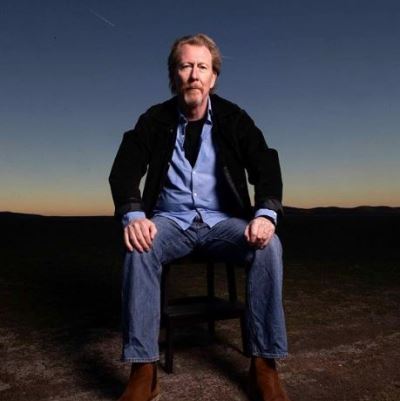
Veteran journalist and foreign correspondent CHRIS HAMMER hits shelves this month with his hotly anticipated debut crime-thriller novel, Scrublands. ANGUS DALTON asks the author about the moments in his career, from Texas to Gaza, that informed parts of his epic story.
Byron Swift is a well-liked young priest in the drought-stricken town of Riversend, before he shoulders a high-powered hunting rifle at Sunday mass and murders five men. He kills the first man at point-blank; the last he shoots through the neck over a hundred metres away. An off-duty constable, barely past teenagehood, brings the massacre to an end by killing the priest with a handgun.
So goes the opening of Scrublands by Chris Hammer. When I call the journalist and former foreign correspondent a few weeks before the release of his debut novel, he’s holed up in Guthega, a skiing village in the Perisher Valley. It’s a world away from the parched landscape of central New South Wales that serves as the setting of his book.
Riversend is a fictional Riverina town on the cracked banks of a waterless Murray River, surrounded by red earth and flat mulga scrub more kindling than foliage. Dead kangaroos bake on the side of the highway, untouched by scavengers reluctant to brave the heat of the day and tar turned sticky by the sun.
Chris became acquainted with such landscapes when he travelled through the Murray-Darling Basin for his 2010 non-fiction book, The River.
‘There were times that were really fiercely hot,’ says Chris. ‘That summer I remember there were temperatures getting up to 48 degrees. That would be very recognisable for anyone who lives out past the mountains.’
After working as chief political correspondent for The Bulletin until the publication closed in 2007, Chris joined the Melbourne Age in the Canberra press gallery. One of the biggest stories of the time was the Murray Darling, Basin Plan.
‘Eastern Australia was very much in the grip of the great Millennium drought. In writing for the paper about it, I saw that a lot of the arguments were about water allocations and gigalitres and licences; arguments between interest groups and politicians,’ Chris says. As politicians and industry figures quarrelled, Chris felt an urge to go out to the families directly affected by the drought, whose livelihoods and drinking water were drying up by the day.
‘I wanted to find out what was really happening out there,’ says Chris. ‘As I travelled around, it became much more than simply an environment book. It became about communities, culture, history, and the Indigenous side of things.’
That story had a lot to do with race, it was a very racially divided Southern town.
The fraught management of the basin is a story that continues today, as a South Australian Royal Commission hears that the $13 billion Murray-Darling Basin Plan is a ‘fraud on the environment’ that has failed to save enough water to ensure the sustainability of the river system. Landowners are now being prosecuted for illegally harvesting water following a Four Corners investigation into the mismanagement of the Basin last year. Since 2000, lower reaches of the Murray-Darling river system have completely dried up three times.
‘The connection to Scrublands is mainly the setting, that very flat part of the country out near Hay,’ says Chris. ‘But also, the desperation of people out there comes through too.’
Scrublands centres on Martin Scarsden, a journalist for The Sydney Morning Herald sent to Riversend to write a profile of the town one year on from the church shooting. Martin’s in the shadow of one of his colleagues, D’Arcy Defoe, whose coverage of the shooting and revelation that the priest, Byron Swift, was a paedophile, earned him a Walkley Award.
Keen to prove himself, Martin is dismayed to find the local pub closed. His hopes of staying in the centre of town and acquainting himself with the bar staff and locals are dashed. Instead he ends up at the Black Dog Motel, a scummy edge-of-town affair with no leads. Most businesses in town are boarded up. The only figures populating the streets are a bronze statue of an ANZAC soldier in the town centre, and a shuffling old man clutching a bottle wrapped in a paper bag who’s not interested in talk. Riversend has been sucked dry of personality and people by the unrelenting drought and the murders that marked the town forever.
The Oasis bookstore, though, is open. It’s run by a young mother named Mandalay Blonde. She’s accommodating of Martin, but tells him the story run by Defoe was wrong – Byron Swift was no child abuser. This sentiment is even echoed by Robbie Haus-Jones, the young constable who killed the priest; he and Swift were friends before the shooting. Is the case truly closed, or did the Walkley Award-winning D’Arcy Defoe fail to uncover the whole story?
Chris has undertaken assignments similar to the one his character embarks on. While working as a foreign correspondent for Dateline on SBS, he visited the town of Jasper, Texas, in the late 1990s.
‘Jasper is notorious for a murder that happened 20 years ago, where some white extremists got hold of an African American man, tied him to the back of their pickup truck, and dragged him to death,’ says Chris. ‘It was a crime that horrified America, and the world, for that matter. There was no mystery to it – the police immediately caught the perpetrators and at least one of them has been executed. I went to Jasper as a reporter maybe six months after the event. Not to do a story on the murder, but to do a story on the town, and how it was coping with the trauma.
‘That story had a lot to do with race, it was a very racially divided Southern town. There’s none of that in Scrublands. But I think that’s where the idea of a journalist going to write a story with the assumption that the murder is all settled came from.’
The challenge Martin faces of winning over grief-stricken locals is also one Chris is familiar with.
‘There’s certainly a lot of places where you’re not welcome as a journalist, absolutely,’ he says. ‘But in Australia you do have a remarkable amount of freedom to work as a journalist. In a lot of other countries, you’ve got goons following you around, people that threaten you, and it can be quite dangerous. There are a lot of foreign correspondents that have been in hairier places than I have.’
As Martin reckons with the dying town and its desperate residents, he’s also grappling with his own trauma from reporting in the Middle East. In the mornings, he wakes dehydrated and terrified in the pitch-black of his motel room, shaken by nightmares about a botched assignment in Gaza a year earlier. While trying to escape Gaza City as conflict flared, Martin had been locked in the boot of a car for three days while militia swarmed the streets. All he could hear was shouting and the burst of AK-47 gunfire.
‘Martin’s not sure why being locked in the boot of a car for three days has just so utterly shaken him,’ says Chris. ‘He’s experienced much more horrific things, but that event brought it all crashing down.’
Chris, like Martin, reported from Gaza in the 2000s, as Hamas took over amid Israeli air-strikes and heavy shelling.
‘It wasn’t that dangerous, but I did have a driver in a beaten-up yellow Mercedes, a French journalist, who at one point was almost kidnapped. I also met the English journalist Brian Johnson who not long after, was held hostage by Islamic Jihad for months before being killed. Those events informed that part of Martin’s story.’
Martin makes headway in earning the locals’ trust when he’s recruited to help fight a bushfire that flares up in the bone-dry scrublands. Martin ends up charging straight towards the fire front with Constable Haus-Jones and risking his life to save the house of a reclusive Riversend resident directly in the path of the flames. He begins to regret his efforts, however, when in the days after the fire, skeletal remains of two backpackers are discovered in the muddy depths of the man’s dam.
Much like the bushfire that flares up in the mulga, Scrublands quickly builds in intensity until it’s charging along with multiple storylines, unanswered questions and uncovered truths. It is a truly epic read. Chris, however, admits he has some ground to cover when it comes to acquainting himself with other crime writers.
‘Most of your readers are probably better read than I am,’ he laughs. ‘I’m pretty eclectic and erratic when it comes to reading. I do very much admire Peter Temple. I really thought The Broken Shore and particularly Truth were a real step above the typical police procedural. I think that helped me realise that in a crime story, the plot is very important – if you don’t have a good plot, nothing really works. But there’s also room for psychology, asking why people have committed crimes, there’s room for good characters, there’s room for good settings and good writing. You can build a lot into a crime story, and that’s what attracted me.’


0 Comments