



CHRISTIAN WHITE’s The Nowhere Child became the fastest selling Australian debut in history.
EMMA HARVEY interviewed the award-winning author about tourist towns, taxidermy, and his latest crime-thriller The Wife and the Widow.
When Christian White was a teenager growing up in Mornington, Victoria, a woman and her child went missing from the town of less than 24 000 residents. White can still recall the media coverage from the time.
‘Her husband went on the news and made this really passionate plea, you know: “Wherever you are just come home, please. I love you, we can work it out.” And of course, it turned out that he had murdered them both and cut up their bodies and dumped them at the local tip. I remember being scared, but also riding my bike past the house where it happened, nearly every day.’
There’s something about the isolation and relative comfort of a small community that makes events like these so absorbing. It’s a shock to the system, a disruption of routine, the meeting of the mundane and macabre. White has always found fascination in these things.
Now in his late thirties, he is a voracious consumer of crime content all forms: books, TV shows and podcasts (the latter he often listens to while washing dishes; a disturbing, gritty world unfolding in his ears, while he rinses soap suds off tupperware containers). Out and about, White even finds himself inadvertently profiling ordinary passers-by, on the off-chance he may need to relay the information back to police.
‘I’ll see a completely normal, innocent man but there’ll be something slightly off about him and, in my head, I’ll say, okay he’s about six-foot, white, grey hair, stubble.’
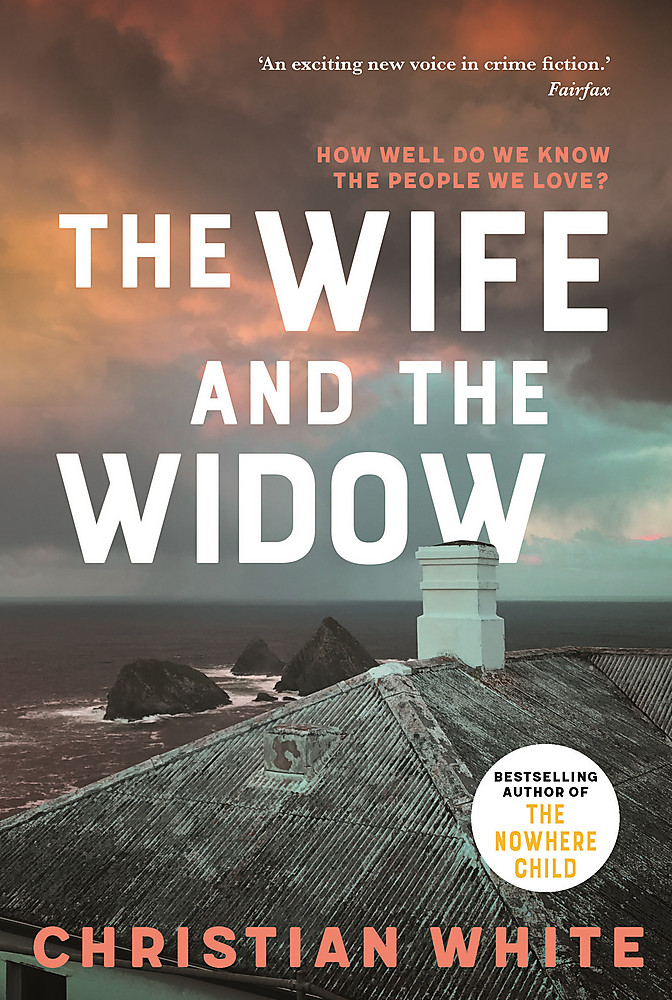 In keeping with this, White’s first novel, The Nowhere Child was characteristically creepy and cult-y, masterfully dodging the tenets and trappings of conventional crime storytelling. But if The Nowhere Child was a mere flirtation with crime fiction tradition, then his latest book, The Wife and the Widow, is a full-blown affair.
‘This is definitely a lean-in [to the genre]. I really wanted to write a good old murder mystery.’
Belport, the heart and the hub of the novel, is a small island town inspired by Christian’s current home in Ocean Grove on Victoria’s Bellarine Peninsula.
‘In summer it’s super busy, of course, but during the winter all of the tourists sort of go away and suddenly it’s quiet and desolate and empty. There’s something so inherently spooky about it.’
Belport is not just isolated from civilisation, but entirely separated from it, connected only by a daily ferry service. It is at the site of the town’s old ferry terminal that a man is found dead in his car, his throat slit, the car half-submerged in water at the bottom of the boat ramp.
The novel is told from the alternating perspectives of two women, each intimately affected by the event. Upon receiving the news of her husband’s murder, inner-city mum Kate discovers that her husband has been concealing many secrets. Her search for answers unravels more questions and, in her grief, she travels to their holiday home in Belport to unearth the truth. Abby, a suburban mother, is a permanent resident on the island. After the murder, she is forced to confront mounting evidence that implicates her husband in the crime.
The novel’s title, White says, came from society’s constant need to define women in relation to the men in their life, particularly when it comes to high profile cases.
‘When women are thrown into the court of public opinion, they very much become a singular thing. The Wife. The Widow. There’s something dehumanising about that.
‘So much of this story is finding out who these men were and realising neither of them were anything they thought. [The women] are almost reduced and defined by those men, but they emerge and break free of that.’
White is no stranger to strong women. He directly credits his own wife, Summer DeRoche, with the design of the novel’s final, thrilling twist.
‘We go on these walks and I say, “Okay this walk is just going to be dominated by my bullshit. How do I solve this problem? What do I do?” Nine times out of 10 the conversation will end with her saying, “Well, how about this?” And it’s the perfect answer. So there’s a lot of her in this book. If she ever divorces me she’ll sue me for all I’ve got!’
White and DeRoche had been dating for a while when he learned that she was a hobby taxidermist. He jokes at the parallels to his novel’s tagline: How well do we really know the people that we love?
‘I thought, Who the hell is this I’m living with? You know, there’s a dead, skinned rat on the kitchen table and she’s sitting there with these tools and these gloves and I’m thinking, who is this person? She’s terrifying me!’
Abby’s character is also an amateur taxidermist, her freezer stocked with roadkill, ready to be stuffed and stitched over a glass of wine in the Gilpin family garage.
As for the murder in White’s hometown of Mornington, when the house came up for sale years later, he immediately found himself pulled back in.
‘This is really weird, but I called them up and asked them about [the house] as if I was a person interested in buying it. I must have sounded young, but they were obligated to tell me that a murder had happened in the house. And I knew that, of course, but I played dumb and I pretended not to. And – God, I don’t know why I did this – but I was single at the time, I probably hadn’t had a girlfriend for years, and I said, “Oh well, I’m okay with that but I’d better check with the fiancée.”’
White chuckles to himself. ‘I was still interested after all those years.’


0 Comments