


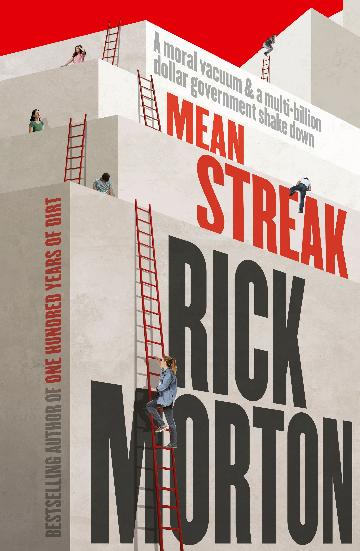
In the first blush of Tony Abbott’s time as Prime Minister, all departments were on the lookout for cost savings. As was entirely predictable, the welfare sector became the easiest target. The ensuing program known as ‘Robodebt’ became arguably the single greatest policy disaster in Australia’s history.
Due to this level of catastrophe, this book could easily have fallen into one of two categories: either a mouth frothingly angry diatribe, or a mind-numbing statistical breakdown of a policy document. It is, however, neither of those. The anger is still there, as are the stats, but Morton’s skill as a writer makes this book entirely readable. This is particularly due to introducing a human element into a dehumanising debacle. It’s also partly due to his incredulity that this error-ridden policy ever got past the discussion stage, and his own humility in not having twigged as to what was going on despite having a mother who had been suffocated by the bureaucracy of the welfare system. This particular incarnation of bureaucracy saw people as no more than numbers and treated with callous disregard.
In an era when the public service’s ‘frank and fearless advice’ has devolved into appeasement of political desires, warnings from several sources were ignored. Multiple members of the ATO highlighted the inconsistency of averaging income to assess a claim, but their objections were softened by superiors. Not all DHS officers were obliging, either, but their concerns were muted by Kathryn Campbell, whose unfettered ambition matched that of her incoming minister, Scott Morrison.
The book grounds itself in the Royal Commission into Robodebt. The detail is admittedly heavy going. To help with understanding, Morton uses analogies to demystify the density of the policy. More than once, his analogies utilise cartoon characters: this emphasises the ridiculousness of government and public service actions; there was certainly nothing funny about it. The names of those involved should be familiar to readers. Morton uses direct quotes delivered to the Royal Commission and tendered email chains. Their own words condemn them.
Catherine Holmes AC SC headed the Royal Commission. Her findings cite ‘venality, incompetence and cowardice’ as drivers of this disaster. For Morton, he’s not sure which was worse: ‘mendacity or incompetence’. Personally, I’m split between the illegality and the immorality of it all. There was to be no happy ending for the many people whose lives had been destroyed by the actions of an uncaring government. Morton gives them a voice, although for some it’s posthumous.
This book is weirdly both too long and too short. Being a precis of the build-up and delivery of this policy, along with edited portions of the Royal Commission and interviews with some of those involved, it has a lot of ground to cover. And yet, there is no absolute ending here. The major players’ reputations are bruised. Some have been removed from their positions. All of them retain their freedom. The author cannot offer a suitable finality by prosecuting and jailing the guilty himself – as much as he might like to. Rather, this book concerns the people who were victims/survivors of Robodebt. To them he says:
‘You deserved, and deserve, the elemental dignity of your personhood.
No shame is too great for the people who tried to take that away from you and then cried unfairness when you demanded to be seen; to have them answer for their actions.’
Morton shines a very bright light on this dismally dark period of Australian political history but does it such a way as to make it page-turningly interesting. This book deserves to be read by all. It should be mandatory reading for all past, present and soon-to-be parliamentarians and public service personnel as a warning of the dangers of the formulation of unprincipled and inhumane policy.
Reviewed by Bob Moore
ABOUT THE AUTHOR

Rick Morton is an award-winning journalist and the author of three non-fiction books. My Year of Living Vulnerably launched in 2021.
Morton is also the author of One Hundred Years of Dirt (2018) and the extended essay On Money (Hachette, 2020).
Dirt is part family memoir, part book of essays about growing up on the outside in Australia. It explores intergenerational trauma, poverty, addiction and mental health and the role of a mother who tried to love enough for the failures of everyone else around her. He is the Senior Reporter for The Saturday Paper.
Originally from Queensland, Rick worked in Sydney, Hobart, Melbourne and Canberra as the social affairs writer for The Australian with a particular focus on social policy including the National Disability Insurance Scheme, aged care, the welfare system, religion and employment services. Rick is the winner of the 2013 Kennedy Award for Young Journalist of the Year and the 2017 Kennedy Award for Outstanding Columnist. He appears regularly on television, radio and panels discussing politics, the media, writing and social policy.
One Hundred Years of Dirt was shortlisted for the 2019 Victorian Premier’s Literary Awards, longlisted for the 2018 Walkley Book of the Year, and longlisted for both Biography Book of the Year and the Matt Richell Award for New Writer of the Year for the 2019 ABIA Awards. Dirt was also shortlisted for the National Biography Award.


0 Comments