


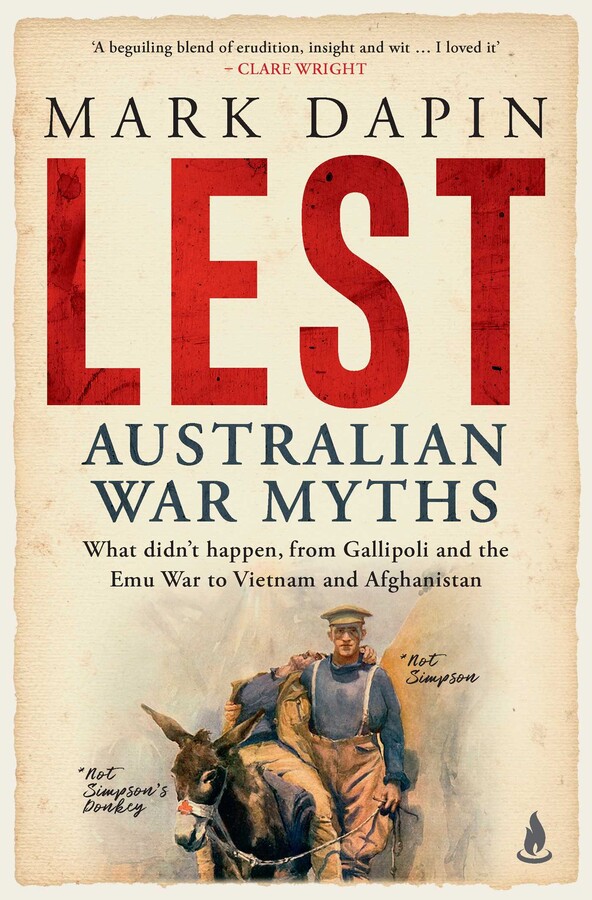
When I started teaching Year 9 History classes I used to start with what are myths and legends and how they can impact our understanding of history. I would point out to the class that the first casualties of the Gallipoli campaign did not occur on the shores of the Dardanelles but in Egypt where several men were sent home in disgrace with VD (which I then had to explain).
Likewise, there was a belief that when the ANZACs landed on the shores of what was to become Anzac Cove, they faced heavy machine gun fire (like the opening scenes of Saving Private Ryan) when in fact they were opposed by a Turkish company who fired their rifles and then bolted. Neither of these two incidents are remembered because they do not fit into the optics that make up the ANZAC Legend. This is what Mark Dapin explores in Lest. How did these wartime myths arise and develop over time and what do the facts state?
Dapin investigates the first ANZAC days and shows that they commemorated those who had fallen but it was also a celebration. Along with the returning servicemen, there were parades including people in fancy dress (the most popular being the characters from Dad and Dave).
While Gallipoli figures feature largely in his analysis, Dapin also looks at the role of Monash (the famous general who won World War I), POWs under the Japanese and the comments of Bruce Ruxton, who was an Australian ex-serviceman and President of the Victorian Returned and Services League from 1979 to 2002, that there were no ‘poofters’ in the Australian army, especially during the Vietnam War. The Vietnam War is put under the microscope by Dapin, especially the belief (which is still held by veterans) that their contribution was not recognised, that they were despised, spat upon, and generally hated. Lastly, he looks at our most recent war, the campaign in Afghanistan, and how that conflict is being mythologised.
While Lest is a book for the historian in you, it is not just limited to that audience. In fact, it is a book which all Australians should read to help us understand our past and try to separate fact from fiction. Lastly, if you read it for nothing more than an account of the Emu War (which took place in WA during the 1930’s) you will be amazed and entertained.
Reviewed by Anthony Llewellyn-Evans

ABOUT THE AUTHOR
Mark Dapin is the author of the novels King of the Cross and Spirit House. King of the Cross won the Ned Kelly Award for Best First Fiction, and Spirit House was long listed for the Miles Franklin Literary Award and shortlisted for the Age Book of the Year and the Royal Society for Literature’s Ondaatje Prize. His recent work of military history, The Nashos’ War, has been widely acclaimed. He is a PhD candidate at the Australian Defence Force Academy.



0 Comments