


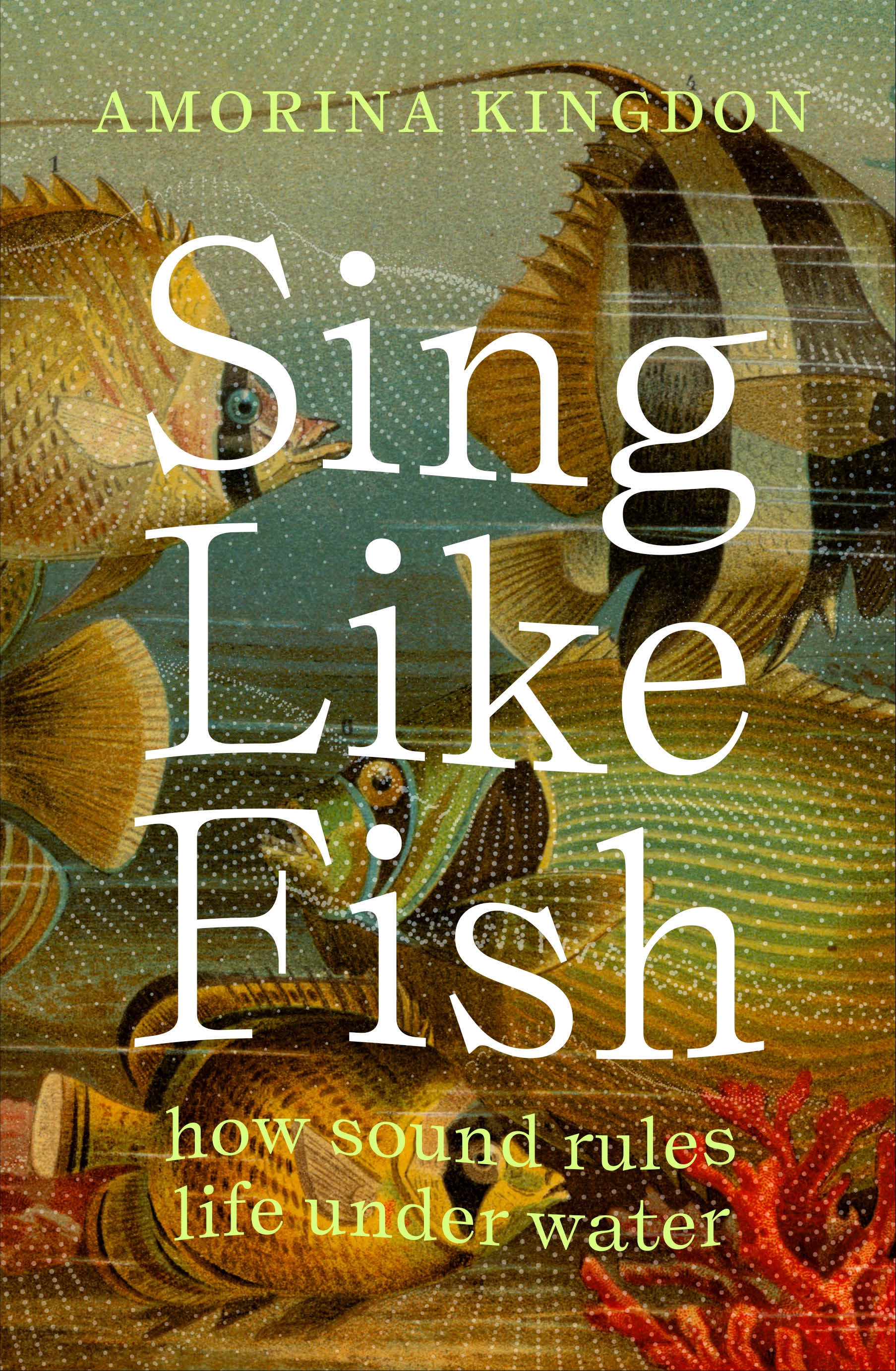
In 1956, when Jacques Cousteau filmed divers in what he called ‘the silent world’ under the sea, there was a general presumption that the underwater world had no sound.
Even the author, now a science writer, and her brother spent time as children playing with their trucks underwater in a lake . . . with gulps of air . . . but could not hear nor communicate with each other.
In introducing readers to the scientists working on the mysteries of underwater sound, she outlines research showing that fish not only make sounds, they can chorus in some places. But rather than saying that fish ‘sing like birds’, because fish evolved millions of years before birds, one researcher claims that ‘birds sing like fish’.
Hydrophones reveal that there IS sound underwater, not only of the ocean itself. One researcher described more than 150 soniferous fish from Canada to Brazil. They scrape and stridulate; drum on their swim bladders with special muscles or tendons, making hums, moans or boops; grind special teeth in their throats; burp or fart.
Development of ASDIC and SONAR in world wars and during the Cold War opened the ocean to human ears, and to biological sounds few knew existed.
Some of the most fascinating information gathered by Kingdon concerns the ‘songs’ of humpback whales. Those of the west and east coasts of Australia sing different songs. When researchers started listening in 1995, all the eastern whales sang the same song. In 1996, two out of the 82 recorded as they swam north to their Queensland breeding grounds sang a different song. In 1997, more than half had switched to the new song, and by 1998, all those recorded sang the new song . . . which was that of the western humpbacks, some of whom had moved east.
While studying a female beluga whale at a Canadian research lab, one scientist recorded how a baby beluga learnt to communicate, starting before he was an hour old, and increasing to gargling, or babbling, like a human toddler.
The effects of noise underwater have been studied on marine life, leaving lobsters dizzy, scallops bruised and marine mammals confused, so that scientists are working on what sounds matter, measuring particle motion of sound, and seabed vibrations.
While sonar, seismic and pile-driving are dramatic underwater, global shipping is the main noise offender. Loud, inescapable, constant, close and incessant noise hurts marine life, and Kingdon advocates good regulation for regions such as the Arctic and the deep sea before greater moves start to explore and exploit them.
Reviewed by Jennifer Somerville
ABOUT THE AUTHOR
 I’m a writer in Victoria, British Columbia.
At the moment, I’m working on a book about the role of sound in the lives of animals under water, which will be published by Crown.
Until 2021 I was the staff writer for Hakai Magazine. My work at Hakai has been anthologised in Best Canadian Essays 2020 (Biblioasis). I have received honours including a Digital Publishing Award, a Jack Webster Award, and Best New Magazine Writer from the National Magazine Awards.
Previously I was a science writer for the University of Victoria and the Science Media Center of Canada.
You can read my fiction in PRISM Magazine, Flash Fiction Magazine, and forthcoming in Speculative North.
I have a diploma in journalism from Concordia University and a bachelor’s degree in biology from Carleton University.



0 Comments