


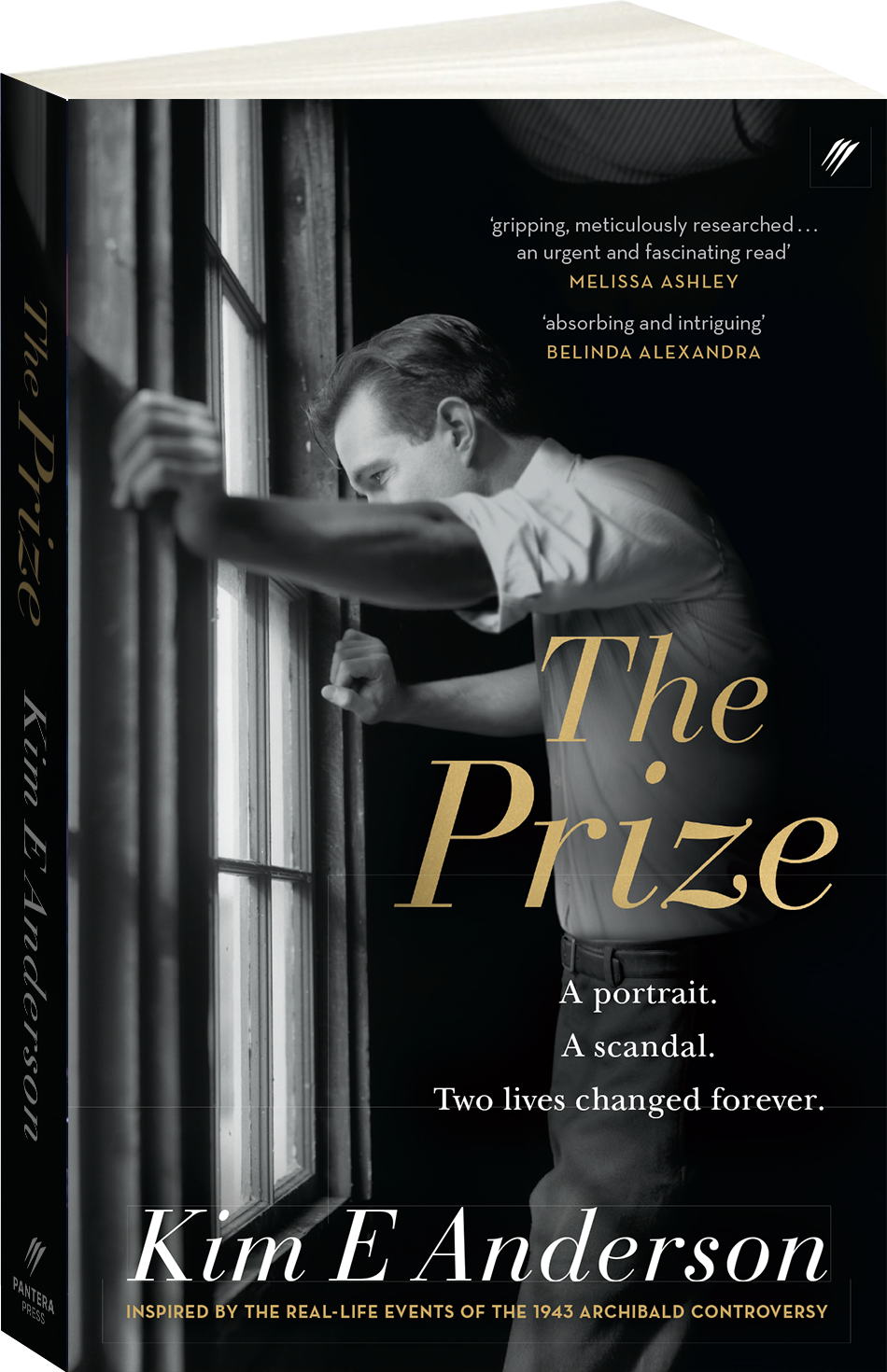
Before opening The Prize, it would be wise to refamiliarise yourself with William Dobell’s 1943 Archibald Prize-winning portrait of Joshua Smith. The relationship between the artist and sitter, the portrait itself, and the aftermath of its success are the basis of this novel.
The relationship between Dobell (called Bill here, except for formal occasions) and Smith is an attraction of opposites. Bill has spent 10 years in London; Joshua still lives with his parents. Bill paints quickly; Joshua is fastidious. Bill is outgoing, Joshua is timid. Their friendship blossomed before WWII and the time they spent time together painting camouflage for the Allied Works Council cemented their closeness. (Anderson strongly hints at them being lovers but doesn’t fully commit to it.)
Bill is close to his sister, Alice, who also befriends Joshua. Bill feels that Joshua’s mother, Louisa doesn’t accept him. Louisa has Joshua lined up to marry another artist, Mary Edwards. She and Louisa are Bill’s main antagonists. Tensions rise when Bill’s portrait is awarded the prize. Mary, among others, believes it to be a caricature. A court case bought by Mary seeks to invalidate Bill’s entry (in which case, Joshua’s second-placed portrait would win).
Unfortunately, both Mary and Louisa are two-dimensional. They’re solely negative characters and their lack of depth gives rise to flat dialogue. That, and the lack of bravery over Bill and Joshua’s relationship, aren’t helpful.
The Archibald Prize is known for its contentiousness and the furore over Dobell’s portrait seems quaint now. Anderson notes that Dobell didn’t touch a brush for years afterwards but fails to mention that he won the Archibald twice more (1948 and 1959) along with the Wynne Prize in 1948.
Reviewed by Bob Moore
ABOUT THE AUTHOR
Kim E Anderson is one of eight children and the youngest of the first five. She grew up on 35 acres south of Sydney before she moved to Sydney. As a young girl, she had some big dreams. I wanted to be a writer, a journalist, maybe a music programmer, the radio kind, or a music producer.
her first writing job was when I was 12 years old. A friend, Gretel Souter, and she began writing a column for our local newspaper called Pet of the Week. liked the people she met and the stories they told, most of which didn’t make it to the press. She also published a brief article in The Sydney Morning Herald about the Dharug people, the indigenous people that had once lived on the land where I grew up.
In the early 1990s, she moved to New York, as a publisher in new media for HarperCollins. The web had just been invented, and CD-ROMs and Laserdiscs were still a thing.
She returned to Australia to start a family and her relationship with storytellers expanded from books, newspapers and the internet, to television and radio, which taught her a lot about working with engineers, the odd narcissist and well just some very highly talented people.



0 Comments