


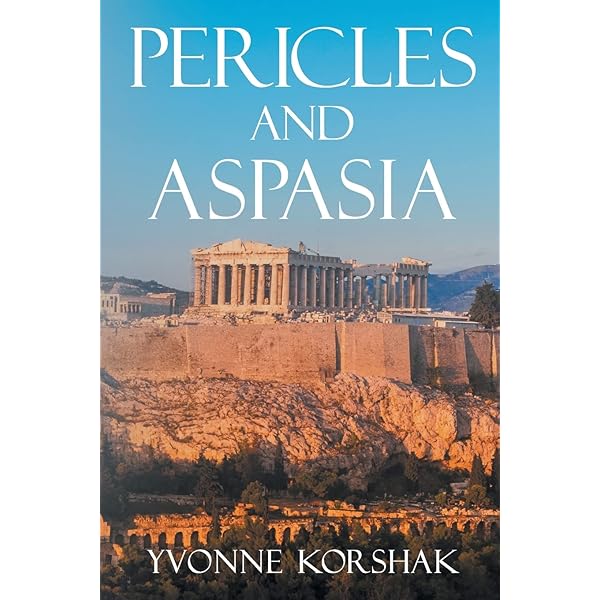
This is the love story of Pericles and Aspasia.
About Pericles we know a great deal. He was born in 495 BCE and was to play a significant role in the rebuilding of Athens after its destruction by the Persians in 480/79 BCE. The monuments we see on the Acropolis today are a result of Pericles, he was also instrumental in making Athens a superpower of the 5th century BCE with an extensive maritime empire and completed what was known as the ‘long walls’ which connected Athens with its port of Piraeus (around 12 kilometres) effectively making Athens an island.
Pericles was elected strategos (which is defined as general, but Pericles turned it into the equivalent of PM) consecutively for 29 years. The Athenian historian Thucydides called him ‘the first citizen of Athens’.
On the other hand, we know very little about Aspasia. She was born in Miletus (a town in Asia Minor modern-day Turkey), came to Athens (how we do not know) was educated, possibly started her career as a prostitute and later became a Hetaira courtesan, a group of women who came to symposiums (drinking parties) and entertained the men with their wit and intelligence.
She entered into a relationship with Pericles as his mistress and had one (possibly two children) which Pericles acknowledged (this caused quite a scandal as Aspasia was a metic – foreigner and the Athenians were quite xenophobic). She outlived Pericles and tradition has her marrying later in life.
What made Aspasia unique was her education, her ability to carry conversations on politics, arts, or philosophy. This was in an age where Athenian women of the upper classes were rarely seen and hardly heard. Unfortunately we have few primary sources. Aspasia was portrayed in ‘Old Comedy’ as a prostitute and madam, and in ancient philosophy as a teacher and rhetorician.
Aspasia’s fame seems to have outlasted her suitor Pericles. She has appeared in the 2018 version of Assassins Creed where she is depicted as using her femininity to gain political power by manipulating men and through her connections to other women across the Greek world.
This novel about Aspasia and Pericles allows the author great scope for the historical imagination. The author’s knowledge of Athenian life, politics and the arts are extensive and impressive. Alas, despite all of this I found the novel a little slow at times. However, the novel does give a great insight into what became known as ‘Periclean Athens’ whose influence is still felt around the western world today.
Reviewed by Anthony Llewellyn-Evans
ABOUT THE BOOK
 Yvonne Korshak received her BA with honors from Harvard, and her MA in Classics and Classical Archaeology and PhD in Art History from the University of California, Berkeley.
As a professor at Adelphi University, she has taught Art History and topics in the Humanities, served as Chair of the Department of Art and Art History, Director of the Honors Program in Liberal Studies, and Director of a National Endowment for the Humanities Summer Institute. She has written and spoken widely on topics of Greek art and archaeology and on European painting, particularly on van Gogh, Courbet, and David. Her blog, Let’s Talk Off-Broadway, focuses on art and theatre.
She has excavated at Old Corinth, Greece, and has visited almost all the cities, towns, landscapes, and seascapes in Greece—and what today is Turkey – that figure in Pericles and Aspasia



0 Comments