


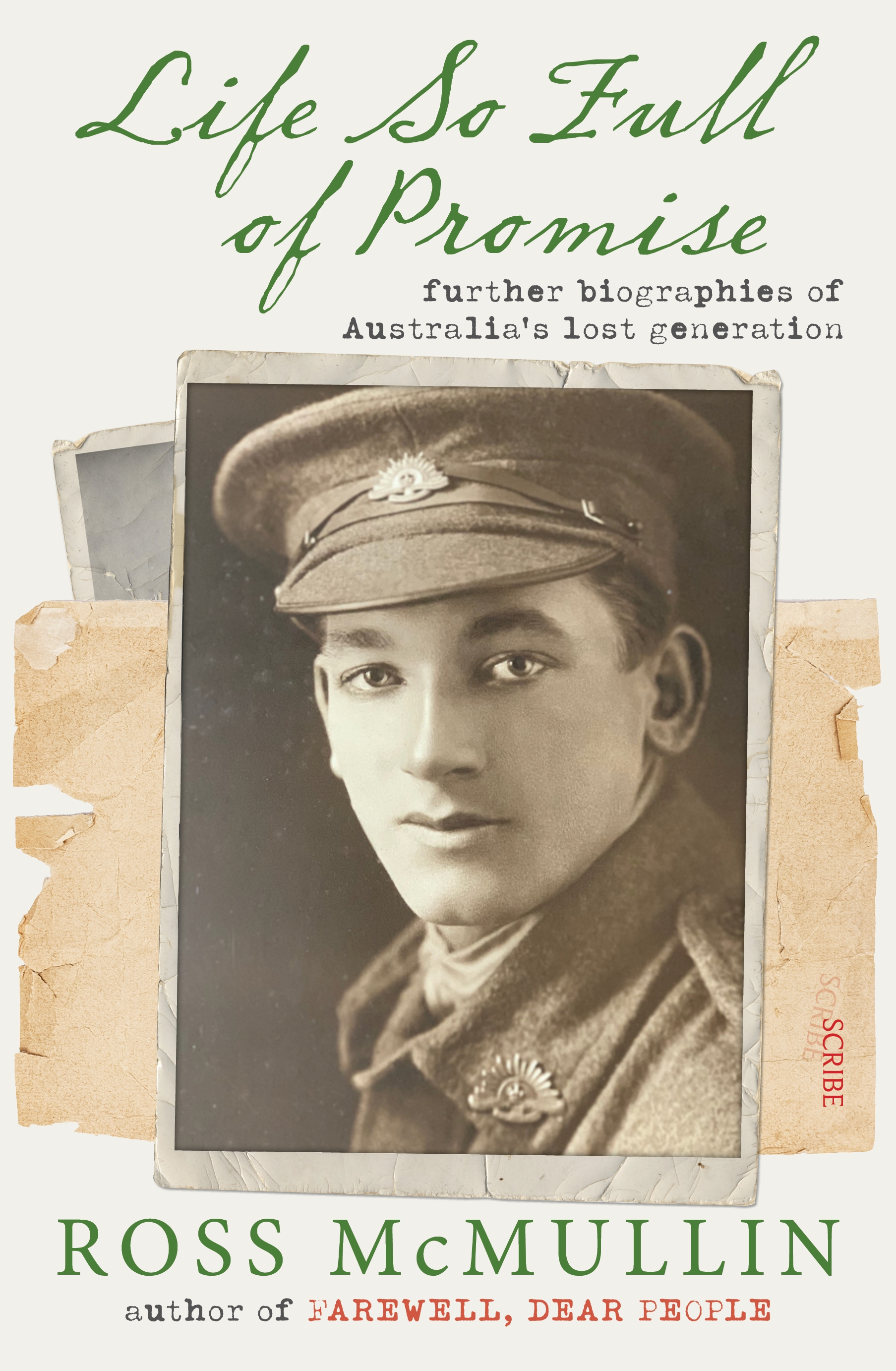
I must confess to not having read Ross McMullin’s Farewell Dear People, his first and highly acclaimed multi-biography about Australia’s ‘lost generation’ of World War I. At first glance therefore, this recently published sequel Life So Full of Promise, gives the appearance of being perhaps, a military history of Australia’s war seen through the biographical lens of the soldiers whose lives were lost.
That would have been, in itself, a worthy endeavour, given that politicians and generals tend to attract biographers’ attention more readily than the ordinary soldiers in war who do the fighting and the dying.
McMullin however, has dug much deeper to reveal in fascinating detail, not just the lives of his three main soldier subjects, but also the lives of their friends and families and how the devastating consequences of the war impacted individuals and communities across the nation.
There has clearly been an enormous amount of research done in bringing these stories to life, and yet McMullin writes with remarkable style and clarity. With a storyteller’s gift he takes the reader from the homes, schools, sporting clubs and workplaces of Australia to the frontlines in German New Guinea, Gallipoli and the Western Front and back again.
In the course of the book we are introduced to three remarkable young Australians; Brian Pockley an outstanding student and all-round sportsman, Norman Callaway; a brilliant young cricketer and Murdoch (Doch) Mackay; another talented cricketer and barrister.
There is of course an inevitable sadness to all their stories. Brian Pockley was one of Australia’s earliest casualties, killed in action in New Britain, German New Guinea in 1914 aged 24. Major Doch Mackay fell at Pozieres in August 1916 aged 25 and Norman Callaway died the following year in the Second Battle of Bullecourt at just 21.
The great Soviet writer and war correspondent Vasily Grossman believed the loss of a single life could never be overshadowed, even by the death of millions.
Ross McMullin has done an admirable job of resurrecting these Australian lives and recognising the contribution they had, and could have made.
Reviewed by Jack Francis



0 Comments