


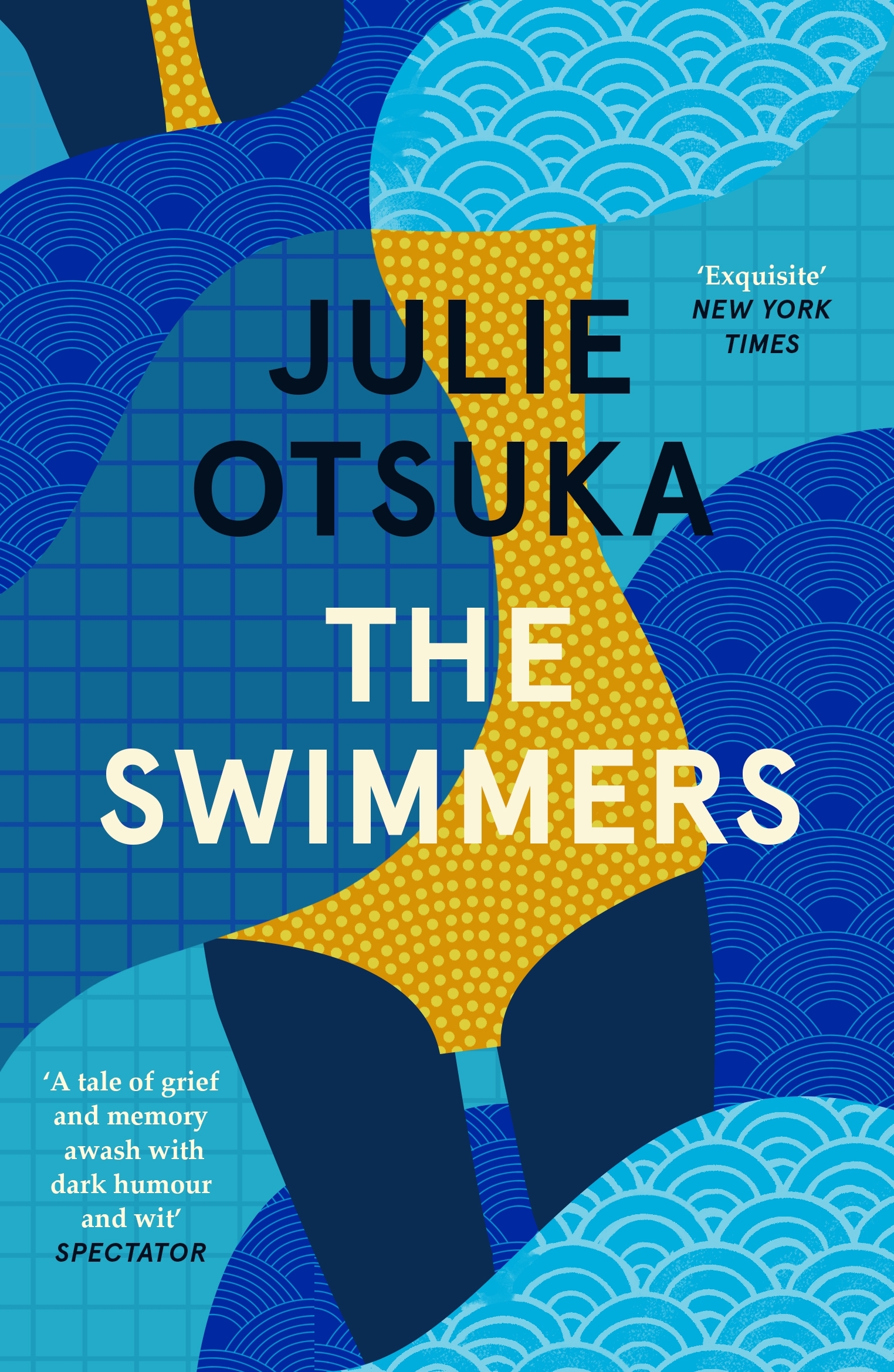
Anyone who has been a regular swimmer at a public pool will recognise themselves and/ or their fellow swimmers in this magnificently constructed novel. People have their special swimming days at regular times, their favourite lane, lane buddy and routine for number of laps swum. Other swimmers come to know each others’ routines and a tight-knit community forms. Within this novel’s community one swimmer has a special place.
Alice is a regular and others watch out for her. She has a form of dementia, but it doesn’t stop her from swimming, not even when a crack develops in the pool floor. Other swimmers have varying levels of concern. As the pool is located underground, a leak in their ‘secret Valhalla’ is particularly troublesome. The crack can be seen as a metaphor for the structural changes in Alice’s brain tissue and also foreshadowing her decline. Sadly – unavoidably – the pool closes.
The Swimmers is broken into five parts. The first two deal with the pool and its community; the final three focus on Alice. The third part, ‘Diem Perdidi’(Latin for ‘I have lost a day’) cleverly uses repetition, detailing things which Alice remembers or doesn’t … and then those memories which eventually vanish. The fourth part, ‘Belavista’ is told in the second person from the perspective of a dementia unit’s staff member to a patient. It’s brutal in its honesty. The final section is told from the perspective of Alice’s daughter, who remembers her mother’s memories for her, following the inexorable path of the disease. Thankfully there is humour (in the form of asides and exclamations!) to break the pathos.
This is an excellent novel, rendered with love and empathy.
Reviewed by Bob Moore
ABOUT THE AUTHOR
 Julie Otsuka was born and raised in California. After studying art as an undergraduate at Yale University she pursued a career as a painter for several years before later turning to writing. She received her MFA from Columbia University. Her first novel, When the Emperor Was Divine (2002), is about the incarceration of a Japanese-American family during World War II. The book is based on Otsuka’s own family history: her grandfather was arrested by the FBI as a suspected spy for Japan the day after Pearl Harbor was bombed, and her mother, uncle and grandmother spent three years in a prison camp in Topaz, Utah.
Her second novel, The Buddha in the Attic (2011), is about a group of young Japanese ‘picture brides’ who sailed to America in the early 1900s to become the wives of men they had never met and knew only by their photographs.
Her third novel was The Swimmers (2022), is about a group of obsessed recreational swimmers and what happens to them when a crack appears at the bottom of their local pool.
Otsuka is the recipient of a Guggenheim Fellowship and an Arts and Letters Award in Literature from the American Academy of Arts and Letters. Her writing has appeared in Granta, Harper’s, Newsweek, 100 Years of The Best American Short Stories, The Penguin Book of the Modern American Short Story, The Best American Short Stories 2012, The Best American Nonrequired Reading 2012, and has been read aloud on PRI’s “Selected Shorts” and BBC Radio 4’s ‘Book at Bedtime’. She lives in New York City, where she writes every afternoon in her neighborhood café.



0 Comments