


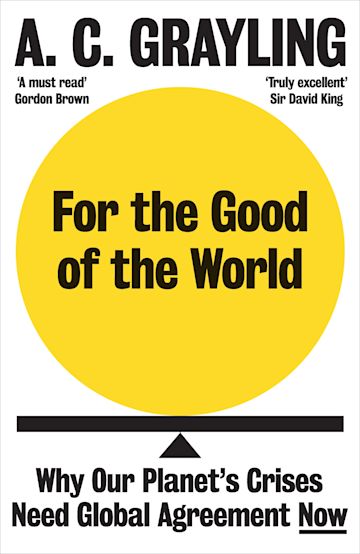
The good intentions of For the Good of the World cannot be overstated. Grayling is a philosopher and like any thinker worth their salt, questions humanity’s place in the world … and its (uncertain) future. This book outlines four significant obstacles to humanity’s survival. Central to the solution is the newly minted ‘Grayling’s Law’: ‘Anything that CAN be done WILL be done if it brings advantage or profit to those who can do it.’ Here Grayling suggests that global cooperation to alter the course of current and impending disasters is possible if all players see the upsides of action.
Of the four, global warming is the most immediate. Solutions have received little more than lip service since 1824 and the Industrial Revolution. Grayling recognises that good policy is difficult to implement, but easy to dismantle (Abbott, Trump …). His greatest hope lies with today’s youth.
Technology surges ahead. Can it be controlled by those producing it? Cyberwarfare is rife; genetic enhancement has already been attempted; robotic soldiers are mooted and human-AI interfaces may forever change human evolution. Equality of justice and human rights looks backwards to the still-lingering stain of colonialism and patriarchal hegemony. (How will those wielding power voluntarily relinquish it?) The fourth obstacle, relativism, relates to competing interests: someone’s access to rights shouldn’t impinge on another’s (equal) rights.
Grayling’s solutions come in two parts. The first is to voluntarily agree to change. (Unlikely.) The other is having change forced upon us because the cost of inaction is unbearable. Grayling’s corollary is apt: ‘What CAN be done will NOT be done if it brings costs, economic or otherwise, to those who can stop it.’ With self-interested humans in charge, what hope do we have?
Reviewed by Bob Moore



0 Comments