


Sounds Wild & Broken is a sensory extravaganza. Haskell invites us to listen closely to – and actually hear – the world around us. Animals with hearing are surrounded by sound, but this is a relatively recent phenomenon. Haskell states that the world was ‘silent’ for its first three billion years – because sound only exists if it’s perceived and no animal had any organ of hearing. For the next three million years, hearing was rudimentary. Crickets, who evolved as the first known hearing beings, ‘listen’ with their legs, sensing the movement of prey. The earth itself makes sound, but we are oblivious as the majority of it is outside our frequency range.
Sound is not just for communication in the natural world. It can be used for warning of danger, identifying location and attracting a mate. Making a sound can be dangerous in itself, which is why slow-moving creatures (worms, snails) are silent.
Hearing is a two-part process: it must be produced as well as heard, and Haskell describes how different environments affect production. In dense rain forests, being heard can be difficult. Similarly, the background noise of a city alters the volume of a sparrow’s song. Birds’ songs are detailed and compared with the production of music, describing both in terms of pitch, timbre and modulation.
Not all of this is positive, however. Humans are destroying species and habitats at an increasing rate. Some sounds will be forever lost. Haskell decries this as the ‘great silencing’.
Haskell – whose own hearing is diminishing – writes with a sense of awe in natural world. His writing is descriptive without becoming flowery and his enthusiasm is infectious. A visual treat for the aural senses.
Reviewed by Bob Moore
ABOUT THE AUTHOR
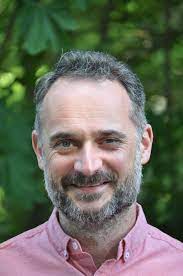 David Haskell is a writer and biologist. His latest book, Sounds Wild and Broken (Viking), is an Editor’s Choice at the New York Times and explores the story of sound on Earth. Starting with the origins of animal song and traversing the whole arc of Earth history, he illuminates and celebrates the emergence, diversification, and loss of the sounds of our world, including human music and language.
Haskell holds degrees from the University of Oxford (BA) and from Cornell University (PhD). He is William R. Kenan Jr. Professor of Biology and Environmental Studies at the University of the South, where he served as Chair of Biology. He is a Fellow of the Linnean Society of London, a 2014-2015 Fellow of the John Simon Guggenheim Memorial Foundation, a Fellow of the American Council of Learned Societies, and an Elective Member of the American Ornithologists’ Union.
His scientific research on animal ecology, evolution, and conservation has been sponsored by the National Science Foundation, the Environmental Protection Agency, the Fish and Wildlife Service, the World Wildlife Fund, among others. He has served on the boards and advisory committees of local and national land conservation groups. Haskell’s classes have received national attention for the innovative ways they combine action in the community with contemplative practice.
In 2009, the Carnegie and CASE Foundations named him Professor of the Year for Tennessee, an award given to college professors who have achieved national distinction and whose work shows “extraordinary dedication to undergraduate teaching.” The Oxford American featured him in 2011 as one of the southern U.S.’s most creative teachers. His teaching has been profiled in USA Today, The Tennesseean, and other newspapers.



0 Comments