


Younger readers, anyone under about 50, won’t remember how eagerly anticipated was the coming of Bob Hawke. After the bruising politics of the mid ’70s Hawke promised to govern by consensus while delivering root and branch reform.
Assisted by a talented front bench and an alliance with the Union movement, Hawke won four elections on the trot (Keating winning a fifth). In 1984 his approval rating reached 74 per cent. It is easy to forget what a different country Australia was in 1983. The population was overwhelmingly European; the currency was managed; Telecom, Qantas, TAA and the CBA were government owned; business lunches were tax deductable. There were four major car manufacturers and about half of the workforce were unionised. Both unemployment and inflation were high by contemporary standards. Medicare and Super did not exist. A lot of this was about to change.
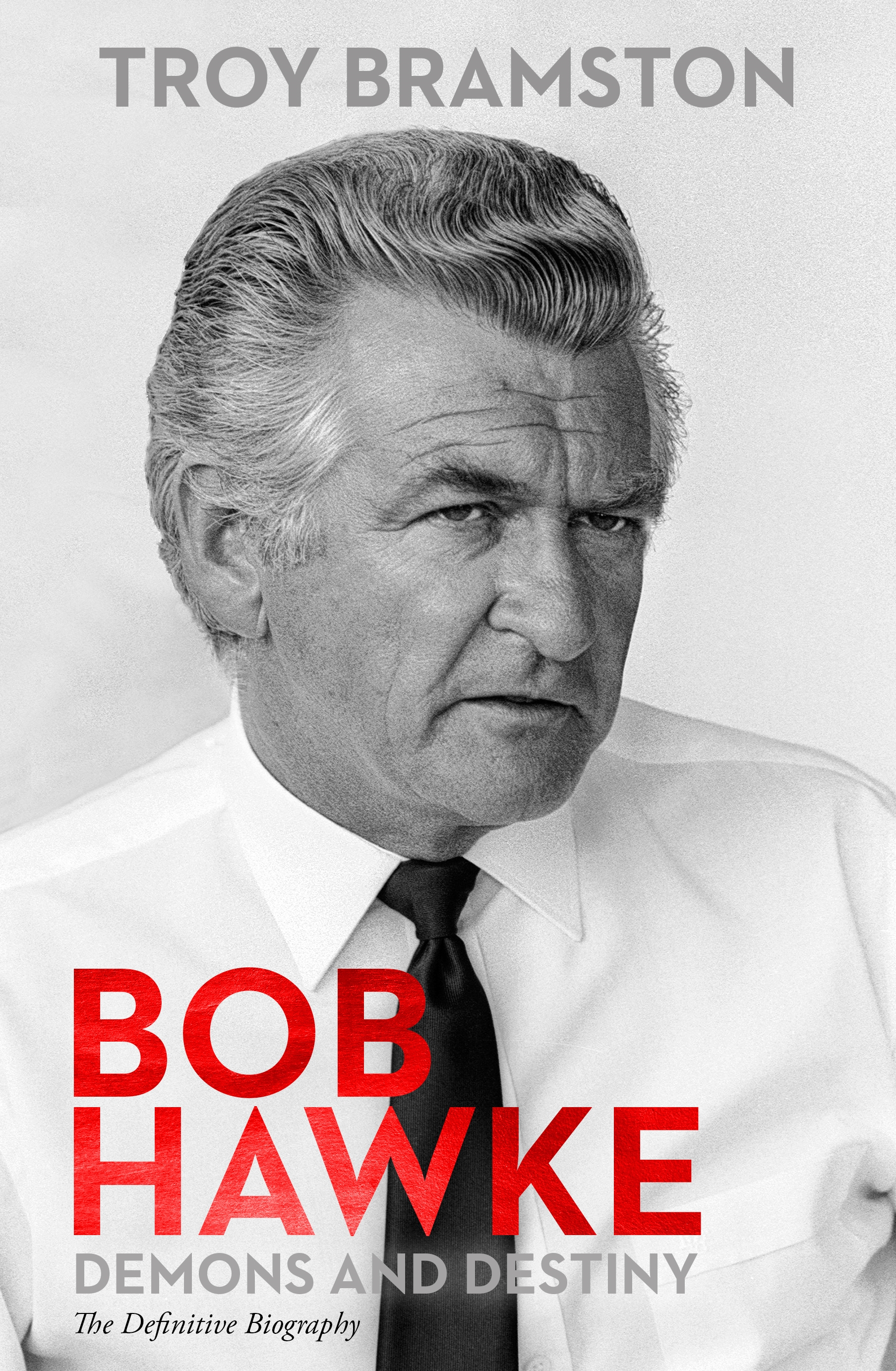
Bramston delivers a well-researched conventional biography, methodically working through childhood, education, the ACTU years and then Government. There is a wealth of anecdote and yes, plenty of this is about Hawke’s boozing and womanising. While there is some passing interest in such matters, what really deserves closer study is why the Hawke Government was so successful.
And this is where the biography form necessarily has its limitations. Bramston is a journalist by training and his interest is very much in the daily cut and thrust of political life as it affected Hawke. But this is not where the distinctive policy ideas of the Hawke Government were formulated. Hawke was a natural chairman and was comfortable with his ministers developing their own ideas, but if you want to understand the peculiar mix of neo-liberal and social democratic ideas that defined his government you won’t find it in Hawke’s biography because his government was not a one-man band.
Hawke’s main contribution to the policy debate was the emphasis on, and the method of, delivering consensus. It was an approach that proved fruitful. The National Economic Summit delivered real tax reform (including a capital gains tax, removing a massive loophole in the Australian tax system) and the Prices and Incomes Accord under which unions accepted limits on pay rises in return for centralised wage fixing and social benefits such as Medicare and Superannuation.
In his fourth government Hawke was pursuing a range of micro-economic reforms and internal conflicts began to develop. Then there was the recession we had to have; Hawke’s approval rating was down to 40 per cent but Keating was also unpopular. Bramston gives us the leadership challenges in excruciating detail and in the end, Hawke lost narrowly, and Keating went on to win the 1993 election against John Hewson.
Hawke died in 2019, just before the last Federal Election. With another Federal Election in the offing, Bramston gives us what may well be the last word on Hawke in Bob Hawke – and an opportunity to contemplate what the past can teach us about the future.
Reviewed by Grant Hansen
ABOUT THE AUTHOR
 Troy Bramston is a senior writer and columnist with The Australian. He has interviewed politicians, presidents and prime ministers from multiple countries along with writers, actors, directors, producers and several pop-culture icons. He is an award-winning and best-selling author or editor of 11 books, including Bob Hawke: Demons and Destiny, Paul Keating: The Big-Picture Leader and Robert Menzies: The Art of Politics. He co-authored The Truth of the Palace Letters and The Dismissal with Paul Kelly.



0 Comments