


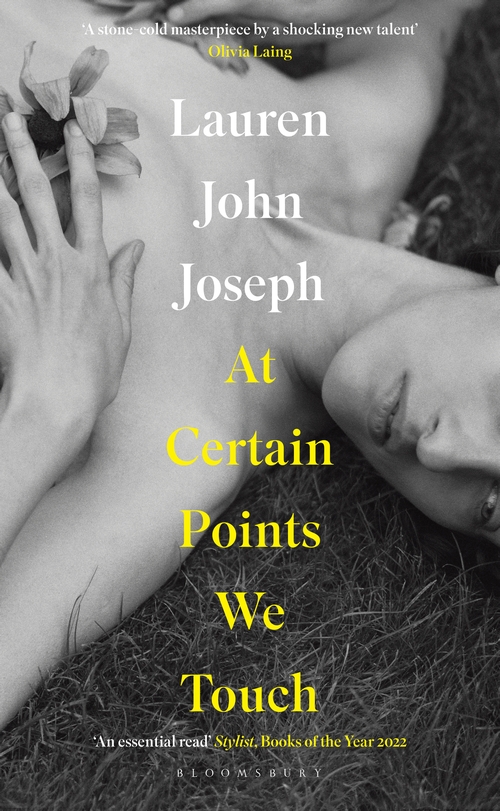
It’s difficult to pin down exactly where At Certain Points We Touch sits. Is it an insider’s exposé of the art and queer scenes in London and the US, or is it graphic homoerotica? It’s neither fully one, nor the other. In this manner, it matches the narrator’s – and author’s – disavowal of binary genders and consequent refusal to be put into neatly labelled boxes (indeed, like ‘queer’: not a term the narrator feels comfortable with).
The narrator – named as JJ by some, and Bibby or Liza by others – is distraught in finding that the day’s date is their ex-lover’s birthday. It’s also four years since his death. JJ hadn’t seen their lover for six years but feels impelled to write of their time together.
JJ is non-binary. They dress in women’s clothes but have fully functioning (and frequently performing) male genitalia. They’re aware of a charismatic reader of poetry, Thomas James. This character is also difficult to pin down: arrogant yet giving; self-avowed racist yet gracious. They become lovers but split when JJ travels to America, resuming their affair on return. However JJ discovers that Thomas is now in a relationship. JJ has tighter morals than Thomas and this friction begins to drive them apart.
The author displays a wide vocabulary. The novel is said to be a ‘panegyric’ to Thomas, yet this eulogy centres itself on JJ, and there’s more criticism than praise for Thomas. (And who, in the breathlessness of sex, would have the presence of mind to describe their lover’s bedroom as ‘caliginous’, rather than just ‘dark’?)
The author has talent. Their next book will be better (and better still if the extravagant language is reined in).
Reviewed by Bob Moore
ABOUT THE AUTHOR
 Lauren John Joseph (formerly know as La JohnJoseph) is an artist and writer, working across the page, the stage and the screen.
As a writer, LJJ has authored a series of solo plays, a volume of prose fiction, and a libretto, they have contributed to newspapers, magazines, and journals internationally for the past decade.
Lauren’s performance work includes theatre, film, opera and pop music. They have presented this performance work across the UK including the Royal Opera House, The Bristol Old Vic, HOME, and the Southbank Centre, as well as internationally, at MoMA (SF), Deutsche Oper and Martin-Gropius-Bau (Berlin), Fancy Him (Tokyo), La Java (Paris) and the Museu de Arte Contemporânea de Niterói (Rio). For seven years they performed as their “identical twin brother”, Alexander Geist, generating a parallel body of work through this autonomous persona.



0 Comments