


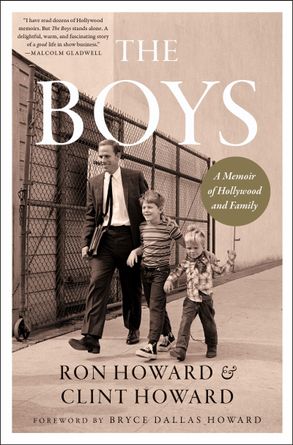
The Boys is told from the combined perspectives of actor Clint Howard and his better known older brother, Academy Award winning director, Ron. It looks at their life growing up in the entertainment business and how their parents’ frank, loving, simple Oklahoma upbringing shepherded them through the excesses, temptations and dangers the industry exerts on most people. Ron is quite frank about how lucky he is to have grown up with his soul intact after being a working actor since before he could even write his name and, even though Clint battled years of addiction, his parents’ example seems mostly to have rubbed off on him too.
The pair talk about their lives up until the years when Ron became a truly successful Hollywood player behind the camera – from the ‘Andy Griffith Show’ (Ron) and various bit parts (Clint) through to American Graffiti and ‘Happy Days’.
If you’re curious about the Howard brothers’ young life and what it was like for kids their age in the movie capital of the world, then you’re in the right place. Unfortunately, though, The Boys is not outstanding quality writing. For all the great stories they have, the Howards aren’t writers, and their turn of phrase is often very flat.
But, as with many Hollywood biographies, the better material is in the showbiz anecdotes. For example, after Yul Brynner bites into a vodka glass for the 1958 thriller The Journey, he sits the fascinated and slightly horrified Ron on his lap and shows him how it’s made of harmless sugar glass.
Reviewed by Drew Turney
ABOUT THE AUTHOR
 Ron Howard is an American filmmaker and actor. Howard first came to prominence as a child actor, guest-starring in several television series, including an episode of ‘The Twilight Zone.’ He gained national attention for playing young Opie Taylor, the son of Sheriff Andy Taylor (played by Andy Griffith) in the sitcom ‘The Andy Griffith Show’ from 1960 through 1968. During this time, he also appeared in the musical film ‘The Music Man’ (1962), a critical and commercial success. He was credited as Ronny Howard in his film and television appearances from 1959 to 1973.
Howard was cast in one of the lead roles in the coming-of-age film American Graffiti (1973), which received widespread acclaim and became one of the most profitable films in history. The following year, Howard became a household name for playing Richie Cunningham in the sitcom ‘Happy Days’, a role he would play from 1974 through 1984. Howard continued appearing in films during this time, such as the western film The Shootist (1976) and the comedy film Grand Theft Auto (1977), which also marked his directorial debut.
In 1984, Howard left ‘Happy Days’ to focus on directing, producing and occasionally writing variety films and television series. His films include the science-fiction/fantasy Cocoon (1985), the fantasy Willow (1988), the thriller Backdraft (1991), the historical docudrama Apollo 13 (1995), the Christmas comedy How the Grinch Stole Christmas (2000), the biographical drama A Beautiful Mind (2001), the biographical sports drama Cinderella Man (2005), the thriller The Da Vinci Code (2006), the historical drama Frost/Nixon (2008), Solo: A Star Wars Story (2018), and the documentary Pavarotti (2019). For A Beautiful Mind, Howard won the Academy Award for Best Director and Academy Award for Best Picture. He was nominated again for the same awards for Frost/Nixon.
In 2003, Howard was awarded the National Medal of Arts. He was inducted into the Television Hall of Fame in 2013. Howard has two stars on the Hollywood Walk of Fame for his contributions in the television and motion pictures industries.



0 Comments