


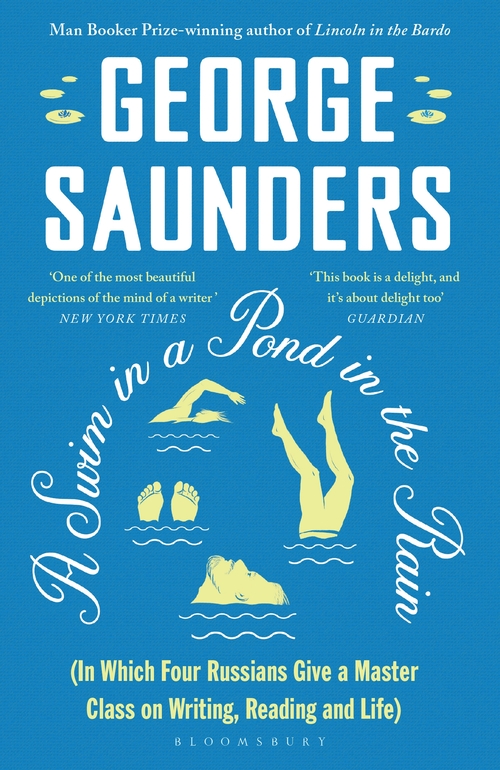
Somewhere in the expansive library of books on writing there’s a top shelf. On it – alone – is this book. George Saunders is a modern master of the short story. In his latest book, he provides us with seven short stories by some of the greatest Russian writers – Chekhov, Tolstoy, Turgenev and Gogol – along with his dissection of each, revealing techniques and nuances not immediately obvious to the reader.
Saunders has been teaching the works of Russian writers at Syracuse for 20 years and yet he discovers something new from them on each subsequent reading. His incisive assessments tend to make both the stories and the authors greater. He’s a consummate teacher, willing to take his students into unfamiliar territory and lead them out again.
In all of his deliberations, two traits shine: generosity and humility. It’s not self-deprecating false modesty, but the acknowledgement that Saunders doesn’t know everything. Nor does anyone else, because Saunders knows that fiction is difficult to quantify: ‘…whatever fiction does to or for us, it’s not simple’.
Discussions on the craft of writing are central, but Saunders wants writers to ask more of themselves: how should I write? How should I read? How has what I’ve read changed my attitude to life? This approach is far from prescriptive: ‘God save us from manifestos.’ Throughout, he urges writers to respect ‘the little tussle’ between them and the reader. A strong connection is essential. So is finding and trusting the writer’s own voice.
This may be targeted at prospective writers, but its appeal will be universal. Early in the book Saunders wishes that we, the readers, were actually in his class. This reader wishes precisely the same thing and is extremely jealous of those who are.
Reviewed by Bob Moore
ABOUT GEORGE SAUNDERS
 George Saunders is the author of twelve books, including Lincoln in the Bardo, which won the 2017 Man Booker Prize for best work of fiction in English, and was a finalist for the Golden Man Booker, in which one Booker winner was selected to represent each decade, from the fifty years since the Prize’s inception. The audiobook for Lincoln in the Bardo, which featured a cast of 166 actors, was the 2018 Audie Award for best audiobook.
The short story collection Tenth of December was a finalist for the National Book Award, and won the inaugural Folio Prize in 2013 (for the best work of fiction in English) and the Story Prize (best short story collection).
He has received MacArthur and Guggenheim Fellowships, the PEN/Malamud Prize for excellence in the short story, and is a member of the American Academy of Arts and Letters, and the American Academy of Arts and Sciences. In 2013, he was named one of the world’s 100 most influential people in the world by Time magazine.
He was born in Amarillo, Texas and raised in Oak Forest, Illinois. He has a degree in Geophysics from the Colorado School of Mines and has worked as a geophysical prospector in Indonesia, a roofer in Chicago, a doorman in Beverly Hills, and a technical writer in Rochester, New York. He has taught, since 1997, in the Creative Writing Program at Syracuse University


0 Comments