


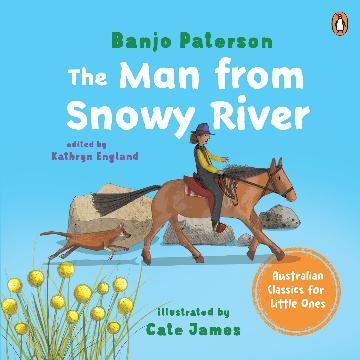
Edited for younger readers, this book brings to life the iconic poem of the colt from old Regret who got away.
Each spread reveals a new, exciting moment in the story, as the colt joins the wild brumbies – paired with objects to count and colours to discover.
…so all the cracks had gathered to the fray.
3 THREE purple akubra hats.
The items to find are delightfully Australian – 6 SIXs black grass trees, 10 TEN yellow billy button daisies – adding a playful and distinctly Australian charm.
The language is poetry in motion, capturing the thrill of the chase as the rider urges his horse down the mountain, chasing tthe horses, the excitement almost tangible on the page.
A great book to read aloud, it gently builds early counting and colour recognition skills. As a sturdy board book, it’s made for repeated readings, with bright pages and increasingly engaging details to spot as the numbers grow.
Reviewed by Jane Stephens
Age Guide 2+
ABOUT THE AUTHOR & EDITOR
Andrew Barton ‘Banjo’ Paterson (1864–1941) was born near Orange, in the Central West region of NSW. He practised as a solicitor from 1886 and began to submit verse to The Bulletin. He exchanged law for journalism in 1901 and subsequently worked as a newspaper correspondent and editor in Australia and abroad. He wrote prolifically, producing four books of verse, two novels and several collections of sketches and reminiscences, and his war dispatches were highly acclaimed. Banjo is Australia’s most famous poet. Known as a poet of the bush, his iconic verse captures the landscape, hardship, resilience and humour of Australian life at the turn of the 19th century. Ballads such as ‘The Man from Snowy River’, ‘Clancy of the Overflow’, ‘The Man from Ironbark’, ‘Mulga Bill’s Bicycle’ and ‘Waltzing Matilda’ have become a legendary part of our Australian heritage. In 1939, two years before his death, he was appointed a Commander of the British Empire for his contribution to Australian literature.
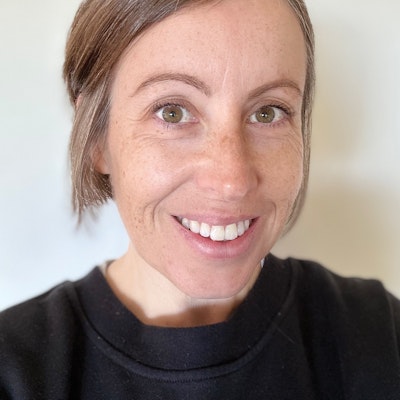 Cate James is an illustrator and printmaker from Sydney. Originally from Scotland, she now lives in the Northern Beaches of the city with her two miniature dachshunds, and works mainly from her studio at home amongst gum trees full of wildlife, close to the ocean. Cate is happy drawing in any setting, as long as there aren’t any snakes, and is very proud of a pen drawing of a crocodile she drew when she was 2 years old. Cate studied printmaking BA (hons) and illustration MDes at Edinburgh College of Art, where she went on to work as studio assistant and Illustrator in Residence. Most of her work as a freelance illustrator is in children’s publishing. She has worked on about 40 illustrated books and publications to date, in Australia, the UK and the US. Cate is also a lecturer at UNSW and a printmaking technician, and visits schools and libraries to run workshops and talks to encourage young artists. She mentors emerging illustrators, and designs for Edinburgh Children’s Hospital Charity and the Scottish Book Trust.
0 Comments