


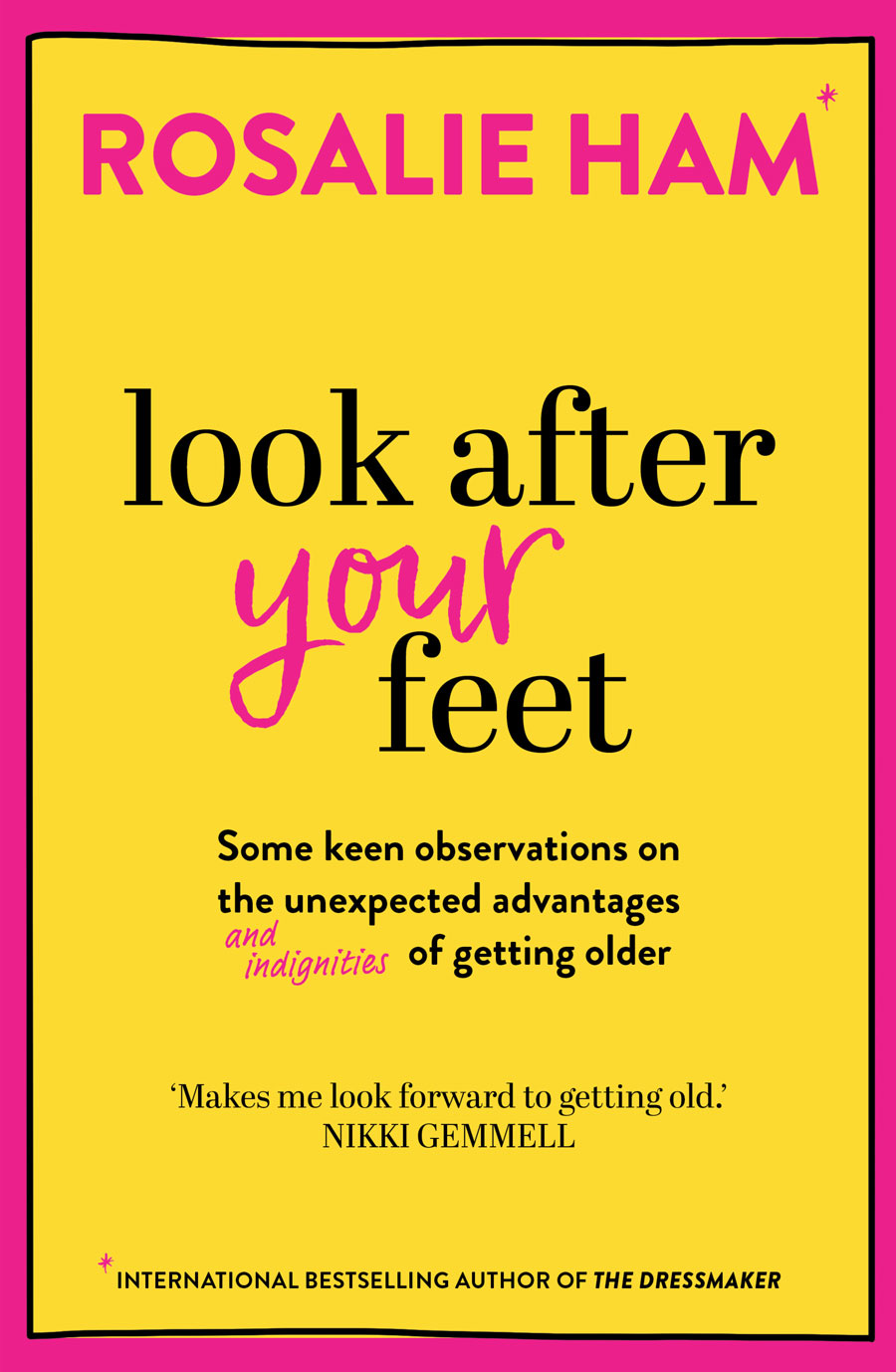

From ROSAILIE HAM, author of the best-selling drama The Dressmaker, comes a hilarious look at the process of getting older. Look After Your Feet covers everything from aging gracefully to gum recession, all written with Rosalie’s irreverent wit.
Read an extract here.
ABOUT THE BOOK
 This book is dedicated to feet, much maligned and underappreciated, but without which we would travel far less.
Rosalie Ham, the international bestselling author, burst onto the literary scene in 2000 with her novel The Dressmaker. After years of entertaining us with weird and wonderful older women characters adored by her readers, Rosalie now turns her trademark wit and shrewd observations to life itself.
Peppered with practical advice about all manner of things – cheese and wine for dinner is welcome and acceptable – Look After Your Feet is a brilliantly funny, painfully honest and insightful celebration of the wisdom that seems to accelerate as body parts deteriorate, and life* falls into place.
* Often just a little bit too late.
**********
EXTRACT
In exercise class I discovered that I had very little range in many places, including my toes, and this brings me to ambulation and, more importantly, feet. The bones, tendons and ligaments in each foot – 100 tendons and ligaments, 26 bones and 33 joints – let us move, and they support our entire bodies. I love my feet; they are essential to my full and adventurous life, so I care for them. For some, feet fail; they destroy the life we had and, even worse, become an unattractive appendage. It’s their own fault, to a degree, since they’re a long way from one’s eyes and hands, yet they require those two essential things to keep them being reliable and effective.
It starts in childhood. Shoes must fit properly. Happily, my father (drawing on shadows cast by the Depression and two wars) made his children buy shoes a size too big, so we have unscarred feet, generally. Being the youngest, and wearing shoes made pliable by at least one other sibling, my seventy-year-old feet are still mostly easy on the eye and, advantageously, I’m still able to choreograph my own pedicure. The very last time I splurged on one of those foot spa places, I saw a man of dubious personal hygiene arrive on the feet of a two-toed ostrich – deformed with calloused edges ringing his fleshy pedes, the texture of vanilla slice filling – and his fat, green corrugated toenails curling over and into the soles of his thongs. They were worse than my father’s feet after a childhood of wearing ill-fitting boots, the second toe piggybacking the first and third, on the end of a foot shaped like the Bungle Bungles. My father also did his own pedicure: cut his toenails at the wood heap, his foot resting on the chopping block and crunching away at them with a pair of clippers strong enough to dehorn a bull.
Despite their difficult start, my father’s feet carried him for seventy-six years, and explain his appreciation of Aspros and strong, sweet tea. He could never have worn sandals in public, and I think about how lovely his feet must have been as a five-year-old.
Thus, I have mixed feelings about people who fail to honour a good shoe. You’ve seen those women at weddings or race meetings trying to carry off a nice shoe on unqualified feet, the flesh pressing from between the straps of a snappy smart sandal? Loved feet will keep you striding through life like an athletic twenty-year-old, dignified, with neither limp nor the facial expression that goes with painful shoes.
I’m going hiking this weekend because I have never endured high heels for more than a few hours at a time. Stilettos, any kind of shoes, reflect social structure, and they’re deeply gendered. When men wear a suit they are considered powerful, handsome, at the very least, appropriate. Little boys look good in a suit – think pageboy – as do nonagenarians: ‘Oh, don’t you look dapper.’ But it seems, if women want to appear dignified, they should only wear heels, ‘power symbols’, in the years they are deemed attractive to others. So, can we only be powerful in the years we can wear heels? The irony here is that if that’s the case, then our feet might be somewhat saved, though I have a friend who wore them only to work and her back is ruined and she has tendon problems. On that point of physical ruin, in my years of hiking I have not met one hiking ballerina, or ex-ballerina. They are, rightfully, at home with their feet up after a lifetime gracefully jumping and contorting on their toes.
A long career in aged care exposed me to a lot of old feet. Most of them ruined. Margery Blandon’s elderly heart, as you’d expect, is located a long way from her feet, so the round trip for nutritious blood to pump to her feet and back was made even more sluggish by clogged veins and arteries, which in turn left her feet undernourished and vulnerable. As the skin thins, any injury that happens below the knee is life-threatening, especially if the home carer misses a week and the bandaid stays on for a fortnight (I’ve seen longer) before it’s peeled away. If Margery had spent her life wearing well-fitting, good-quality shoes, her mornings would have been much more pleasant. Hence, I’m fonder of my own feet than Margery was of hers.
I appreciate that my feet cheerfully indicate what sort of day I’ll have.
Sometimes it’s the joint between the second or third phalange and metatarsal that objects, or my plantar ligament, but Birkenstocks fix that more often than not. My knee sometimes lets me know it’s unhappy but that’s rare, and it’s not that unhappy. Of late it’s a ping from my right glute and across my lower back – nurse’s back – and I regret again the day I failed to use the lifting machine for a patient. Whenever I performed my lumbar-stretching folds on her aqua nylon carpet, my mother, a lifetime rheumatoid arthritis sufferer – mostly in silence – would say, ‘You’ll get arthritis in that back of yours.’ I cope with the back thing (it’s out of my reach); it’s my feet I care for tenderly – supportive shoes and insoles, moisturiser and placation . . . and I am not Robinson Crusoe in that.
Over the course of the first cold week of winter a couple of years back, I discovered my boots weren’t comfy anymore: my toes couldn’t spread out and the ball of my foot hurt. I consoled myself with, ‘Goody, new boots for Rosalie!’, and off I went to the shop that sells comfy shoes. But something had happened. All their boots were big chunky things with thick soles and bulbous toes. Young people liked them, but they reminded me of extrovert orthotic shoes . . . the shoes my mother wore, only psychedelic. Just not me. The alternative were orthotic shoes . . . not me, not yet. Over the course of the next couple of weeks I tried out all of my shoes and gradually most of them were classified ‘footwear to wear to places where I can sit down a lot’, and began to yearn for summer when I could wear Birkenstocks everywhere again.
And now my friends are complaining. My friend Sarah announced she had plantar fasciitis and needed to buy new shoes and would anyone like a pair of her perfectly good cast-offs? Then Louise started offering me her shoes, and Nanette announced she was only ever comfortable wearing Campers, walking shoes or sneakers.
‘These used to be comfortable, but now they rub my left toe.’
You’re size 40, aren’t you?’
‘Size 41 now, sometimes 42.’
I’m told you can tell a lot about a person by the shoes they wear. It’s not true.
I am not solely a Birkenstock sort of person, though I have never acquired the talent for walking easily in heels. We like Birkenstocks because they seem to be the only shoes we can find that keep us ambulant and smiling. So shoes, like eyesight and hearing, are an important part of conversation for my friends and me. Our texting stream often offers advice regarding brands and location of shops for comfortable but stylish shoes. We noted Helen Mirren wore sneakers with her gown to a film premiere and, happily, serious shoe-searching has come to us at a stage when we can afford the time and the money to find shoes that are not deceitful: that is, they appear stylish but are torturous. The word ‘orthotics’ has become part of our discussion (I’ve had my orthotics for decades, as have all of my flat-footed siblings), so I was quietly pleased when I discovered my friends required special insoles, or one of those ‘gloves’ for a bunion or toe separator for wandering tarsals.
It’s a question about wastefulness. I have two sets of orthotics and, to accommodate them, I have replaced most of my shoes over the years. I manage swapping the orthotics around though it saves time and effort if you isolate the shoes they were last in. Google tells me I should have my feet reassessed, and I realise that ten years, at least, have passed since someone other than me has assessed my feet. That might explain why my feet aren’t as happy as they’ve been in past history.
Though I’m merely seventy, I’m pondering if paying a thousand bucks for a couple of sets of new orthotics is worthwhile. Common sense dictates that I should make up my mind sooner rather than later to get my money’s worth and so I can stride, smiling, through crowded wedding venues and dance all night.
ABOUT THE AUTHOR
 Rosalie Ham is the author of six novels, including ‘The Dressmaker’ trilogy – The Dressmaker, The Dressmaker’s Secret and Molly. The Dressmaker was adapted to film in 2015, and starred Kate Winslet, Judy Davis, Hugo Weaving and Liam Hemsworth. Rosalie holds a Master of Arts in creative writing and, after many years as an aged-care nurse, then teacher, Rosalie now writes full time from her home in Melbourne, Australia. Look After Your Feet is Rosalie’s seventh book, and her first non-fiction book.
Follow Rosalie Ham on Instagram
Visit the Allen and Unwin website

0 Comments