


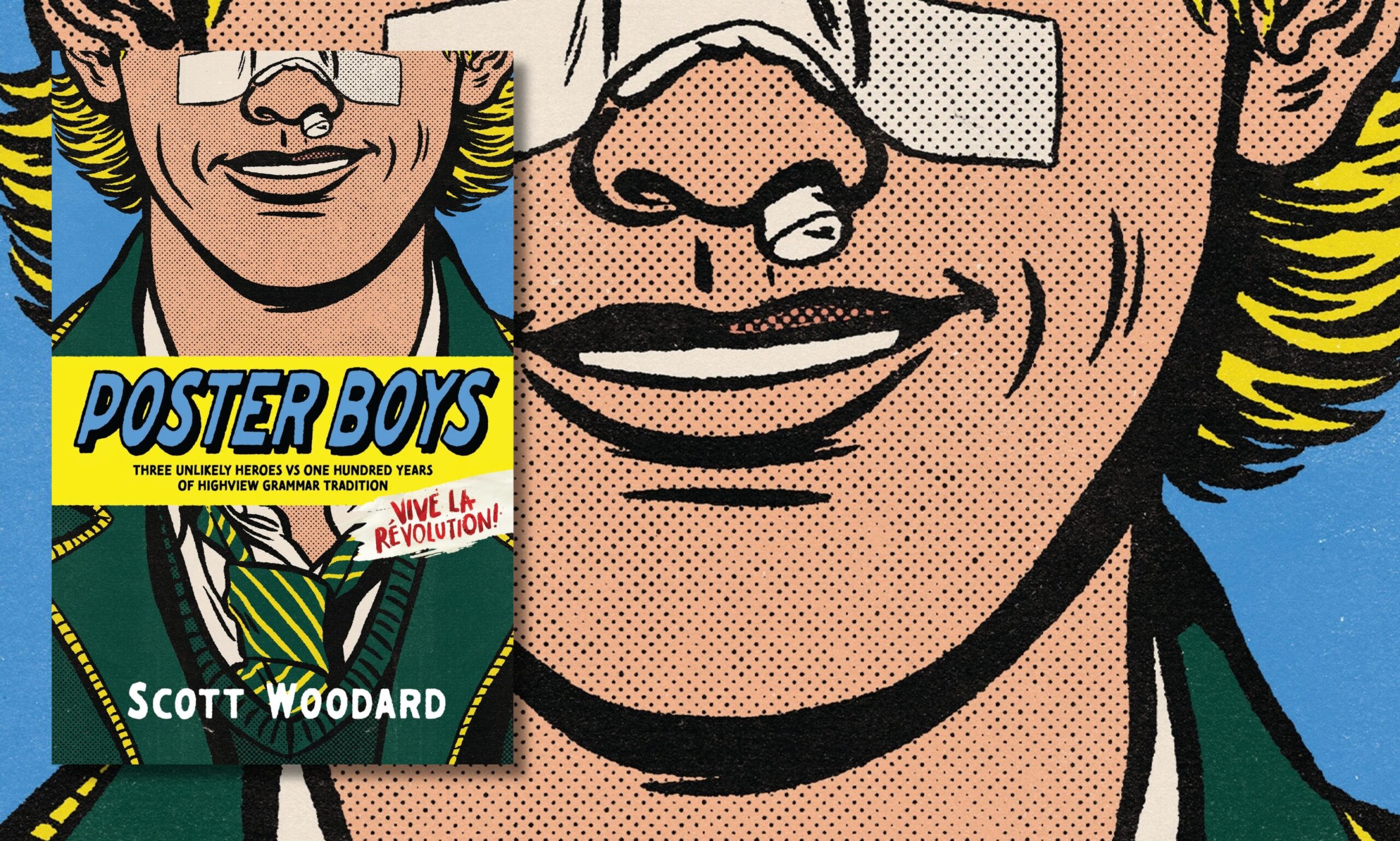
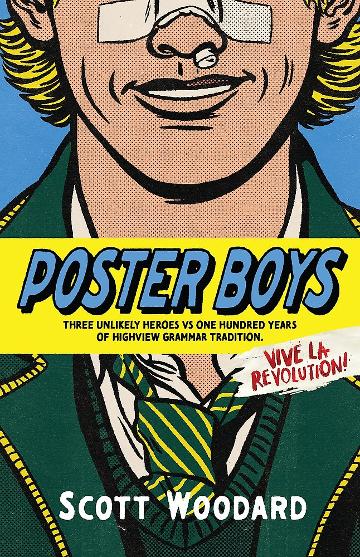
Poster Boys by SCOTT WOODARD is a laugh-out-loud debut novel about accepting yourself just as you are.
Read on for a Q&A with the author.

MEET SCOTT WOODARD
What inspired you to write Poster Boys?
Poster Boys started from a bizarre what-if situation (the best kind!): how would Winnie-the-Pooh survive in high school?
I love Pooh as a literary character. He’s kind-hearted yet completely self-absorbed. He makes ridiculous decisions, but to ‘a bear of very little brain’, they made complete and logical sense. This was the nexus for the character of Nolan – and Edward (my narrator) became his foil.
Edward and Nolan have changed a lot from those first character sketches (they’re now rounded people instead of stuffed toys), but look closely and you’ll still see a little of the Hundred-Acre-Wood in Poster Boys.
Did your own school experience shape Highview Grammar or any of the characters?
Absolutely! And I think that’s really important.
We can all think of a million horrible stereotypes about private schools and schoolboys – entitled, chauvinistic, arrogant, self-absorbed – but people aren’t stereotypes, and the more you treat them as if they are, the more you push them away.
Unfortunately a lot of critics – public figures, newspaper op-eds, keyboard warriors, that guy who’d shout at me as I walked home from school – still treat private schools and their students as stereotypes. And while we should absolutely discuss the issues with private schools (this book certainly does!), we can’t forget these schools are attended by children – and they’re going through one of the most vulnerable periods of their lives.
Poster Boys is ultimately a book about empathy and compassion, because that’s often missing when we critique private schools.
I drew elements from my own experience (particularly my interpretation of the school’s culture at the time) to hopefully make teens feel seen and understood, and to know that I’m on their side.
That being said, this is absolutely a work of fiction. I’d never have the guts to do the things my characters try in Poster Boys, and I hope no school would react to them in the way that Highview does!
Edward, Nolan and James are all very distinct personalities. Which character came to you first, and which was the hardest to write?
I started with Edward and Nolan because they’re basically two sides of me.
Edward is who I was at school: a self-conscious nobody who yearns to be cool. Nolan is who I wish I was: happy just being his oddball self.
Then into this dysfunctional friendship comes James. James is sporty, slick and popular – and he’s just had his nose flattened in a softball accident. I can’t vouch for any of these experiences myself, so he was definitely the hardest to write. But fleshing him out into a living, breathing person was also the most rewarding experience.
Poster Boys explores identity, belonging and masculinity in school culture. What conversations did you want this book to start?
I hope Poster Boys helps us ask what really makes a good school – because I don’t think it’s ATARs, state-of-the-art facilities, a distinguished history or a full trophy cabinet. For me, a good school is one where every kid feels seen, safe and supported to be themselves.
I’d love for Poster Boys to encourage schools to look at themselves in the mirror – at their culture, values, traditions and goals – and ask if they best serve their students. Or if some of these traits should be left in the past.
Better yet, I’d love if it sparked a conversation between schools and their students to ask and answer these questions, and to work collaboratively to create their school culture.
Did anything surprise you as the story developed?
Poster Boys was meant to be a three-minute spoken word piece about two schoolboys trying to avoid cross-country. I’d perform it at our local reading night in Ballarat, hopefully get a few laughs, then move on to something else.
That was seven years and 80,000 words ago.
I lucked out with Poster Boys. I had characters I loved, an intriguing setup, and a burning desire to know what happened next (which turned out to be a lot more than I expected) – and that encouraged me to keep writing to the end, even as the dishes stacked up in the sink.
What do you hope young readers walk away feeling or thinking about after finishing the book?
This was actually a really important question that I had for myself while writing. In fact, I kept the answer in two dot points at the top of my manuscript so I could refer back to them constantly. If any part of the book didn’t meet these points, it was cut.
Here’s what they said verbatim:
Be yourself – think for yourself and love yourself. Embrace who you are, not who you think you should be.
History and truth are never objective. There’s an enormous amount of power in controlling a narrative.
But above everything, I hope readers walk away entertained. There is no greater review in my opinion than a smile or a laugh, or phone notifications backing up because they can’t put the book down.
Is there anything you’re working on now that you can share?
Poster Boys is a standalone book (don’t worry – no cliffhangers here), but we did pitch a sequel to the publisher. Their response was completely reasonable: ‘Let’s see how the first one goes.’
So, if you enjoy Poster Boys and want another book like it, please make some noise and let’s make it happen!
Read a book review of Poster Boys
ABOUT THE AUTHOR
 Scott Woodard worked in train stations, call centres and bookshops around Melbourne, before landing his first commercial radio gig in outback South Australia. Across seven years, three states and six radio stations, he’s raced pantomime horses, annoyed reality TV stars, tossed thongs with politicians, copped abuse from puppets, MC’d music festivals, broadcast through fires and floods, championed communities around Australia, and played a lot of Ed Sheeran.
Scott holds a Bachelor of Creative Writing from RMIT under the tutelage of Toni Jordan. His debut chapbook You Haven’t Found Anything was published in 2015, and is still available in all good landfills. He’s an ardent advocate for youth mental health, and his comedic fiction emphasises the importance of empathy, self-acceptance and independent thinking for an Australian teenage audience.
Scott lives with his family on Ngunnawal Country in Canberra, ACT. When he’s not writing or working in the public service (classic Canberra), he loves bushwalking and playing banjo.
0 Comments