


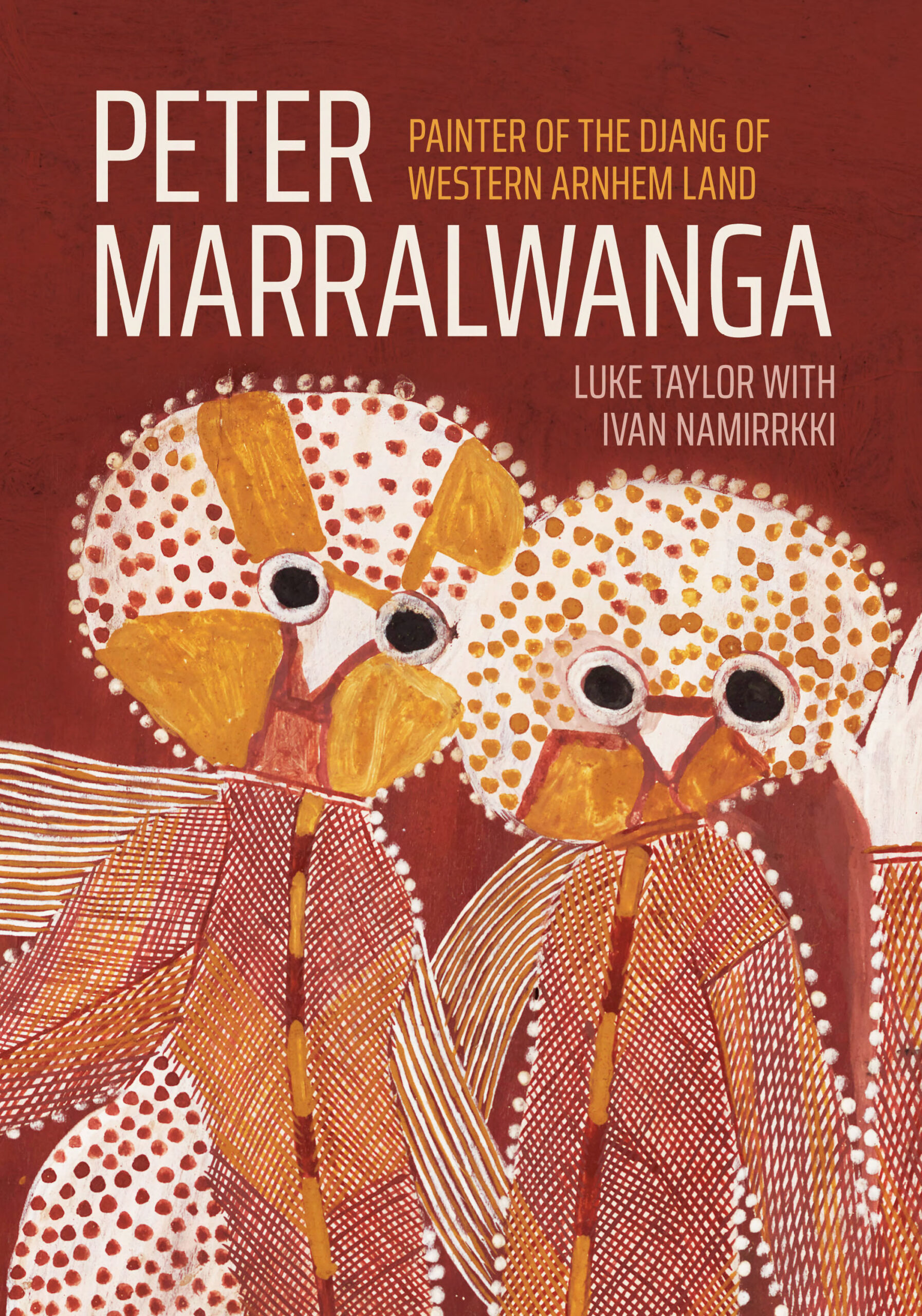
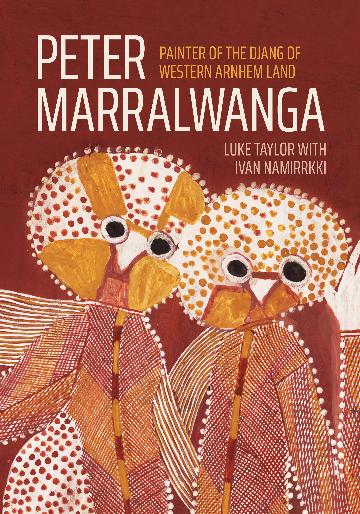
Peter Marralwanga was a famed artist, known for his bark paintings representing the Djang, the spirits of his ancestors. In Peter Marralwanga: Painter of the Djang of Western Arnhem Land, LUKE TAYLOR and IVAN NAMIRRKKI explore his life, legacy and incredible impact on Australian art.
Read on for an extract.
ABOUT THE BOOK
 Peter Marralwanga (1916–1987) was a leading figure in one of the great art practices of the world. He grew up in western Arnhem Land surrounded by artists painting in rock shelters and he learned to paint this way himself. The subjects of his paintings were the Djang who made his country and placed the spirits of people within it. Marralwanga’s story highlights the way bark painting became important as a way of evading assimilation policies rife within Northern Territory towns. Marralwanga established an outstation at Marrkolidjban where he could teach his children how to properly care for Ancestral lands, with part of this care involving a knowledge of how to paint. As a senior person who had travelled widely in his youth, and gained extensive ceremonial knowledge, Marralwanga was highly influential among a broad group of painters. Ivan Namirrkki, a painter of note and Peter Marralwanga’s son, has provided here his own account of his father’s life.
This book tracks Marralwanga’s life of learning about country and conveys the religious meaning of numerous major works, offering outsiders a richer understanding and appreciation of Arnhem Land art. It also shows the crucial role of individuals working for the community arts cooperative Maningrida Arts and Culture in facilitating Maralwanga’s rise to recognition as a major Australian and world artist.
Extensively illustrated, Peter Marralwanga: Painter of the Djang of Western Arnhem Land, is a study of unique knowledge and beauty.
**********
EXTRACT
INTRO
 Famed Aboriginal Artist Peter Marralwanga was born and raised in West Arnhem Land. Under the guidance of legendary bark painted Yirawala, Marralwanga developed his own unique style of painting on both bark and paper. Inspired by the ceremonial knowledge of the Bininj people, he was given special permission to create ceremonial images. He was responsible for painting his people’s ancestral spirits, known as the Djang, and developed a unique style of representing both plant, person, spirit and animal. He had two solo gallery showings during his life.
Painter of the Djang of Western Arnem Land is a gallery book of Marralwanga’s most famous works and places them in their religious and ceremonial contexts. With insight from the artist himself, and his son Ivan Namirrki,, this work tracks Marralawanga’s life and experiences of learning about country and ceremony.
EXTRACT
The innovation in Marralwanga’s work was the result of his determination to show that the figures in his paintings were not simply animals. Respect for the skills exhibited by Aboriginal hunters had been shown in the past; likewise, for their virtuosity in the delineation of animal species in paintings. Unsurprisingly, western Arnhem Land bark paintings that showed a hunter spearing a kangaroo developed an iconic status for collectors. Yet, in so‑called ‘primitive’ art markets, there was little appreciation that such imagery also had deep ceremonial reverberations for the artists who understood the subject matter as Djang and who were referencing creation events. For example, the motif of the spearing of kangaroo beings recurs in Kuninjku ceremonies such as Lorrkkon and Wubarr. By fusing elements of ceremonial painting with his figurative works, Marralwanga drew attention to this more profound interpretation. His extensive repertoire of Djang subjects reveals Ancestral creativity across the region. Seen through his eyes, this Country sparkles with everlasting powers. This was his inspiration for re-establishing a settlement at Marrkolidjban and his continual stream of bark paintings. As a responsible ceremonial leader, he maintained and promulgated this valuable, and otherwise unseen, knowledge of the Ancestral realm.
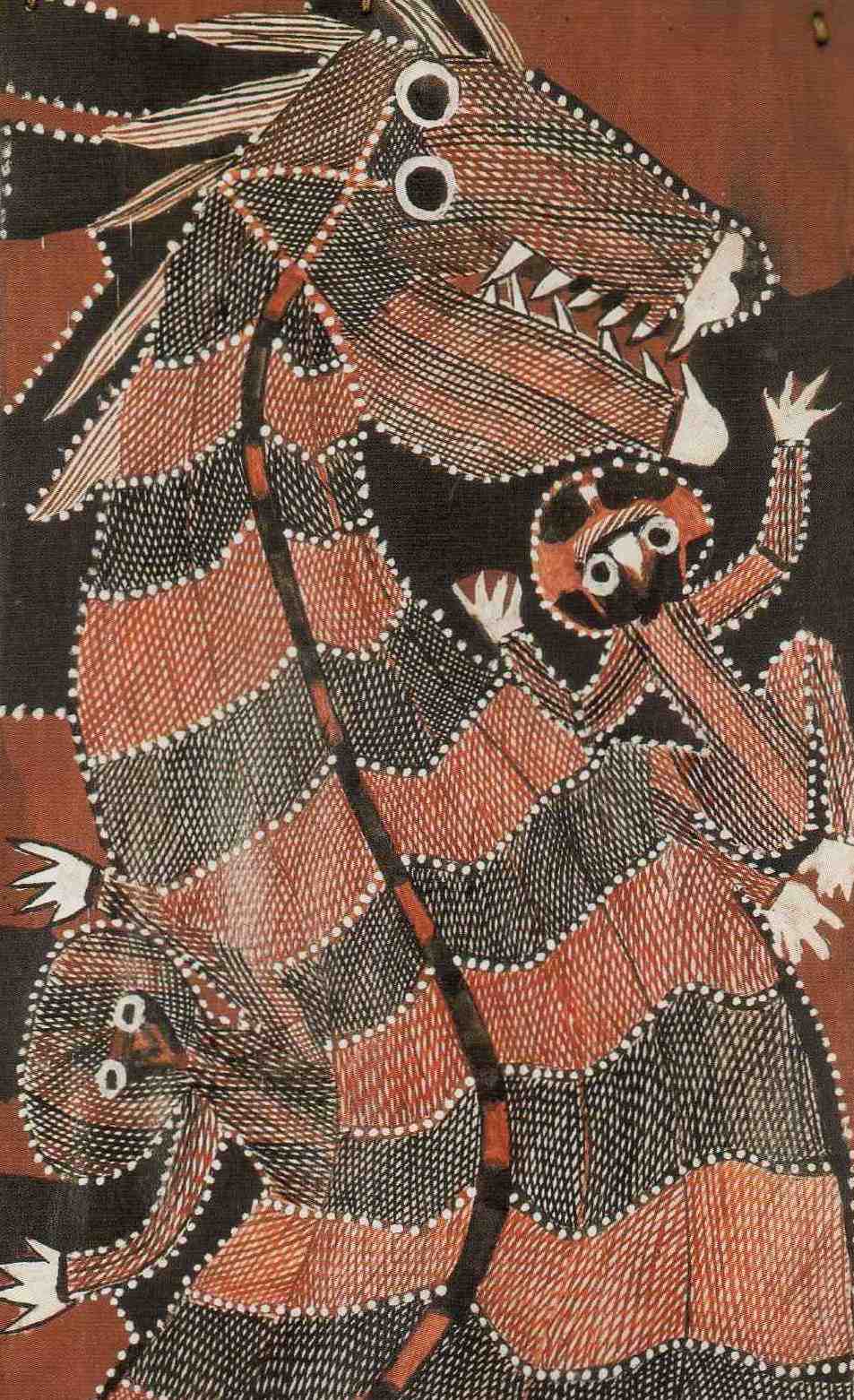 Marralwanga’s authority shone through in his interactions with Balanda and in his relaxed command within the Kuninjku world. He worked hard to care for his family and for the broader community of neighbouring outstations who were all trying to create their relatively self-determining existence. When the heads of these outstations came together, it was a joy to watch the easy familiarity of the older people who recounted the exploits of their shared lives – often amid great general hilarity. They would then work together in a more serious way to formulate the creative moment of ceremony. Marralwanga played a leading role. Arising in this remote locale were some of the most powerful religious and artistic expressions that I have ever been privileged to witness.
Marralwanga’s children were also encouraged to care for their Country and become leaders. Ivan Namirrkki has expressed in fond terms his duty to emulate his father. He has also described his exasperation at currently unsupportive governmental policies. Nevertheless, Ivan, and Marralwanga’s other children, were inspired to become painters of note. Each came to elaborate the way they painted the clan stories and, these days, more geometric forms are preferred. The changes they introduced developed from their strong knowledge of the stories for Country and the multiple formats of ceremonial painting. Marralwanga was a cultural wellspring for developing the foundations of their own creativity.
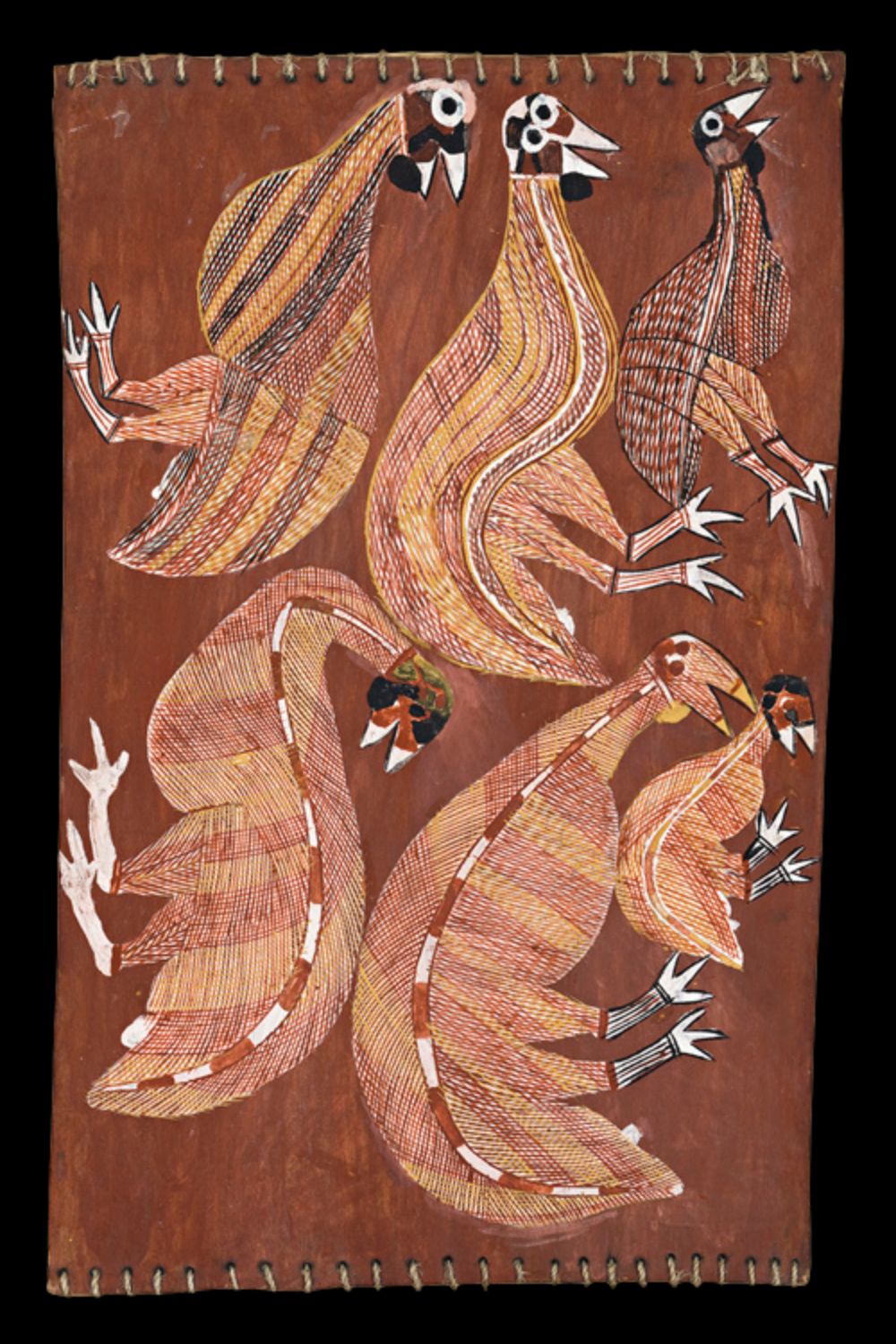 Central to Marralwanga’s eventual public recognition was the virtuosity of his work. We have investigated in detail the techniques used by Marralwanga to create visual energy in his barks. His excellence in many arts was appreciated locally. Balanda audiences can see and feel the vigour and effect of movement of the figures in his paintings; captured in the stimulation of contrasts in form and colour, they warm to the radiance of constantly changing patterns of rarrk. These elements can be, and are, perceived across cultures. There are points of common humanity, as well as distinctions, in the stories that address birth, growth, death and the ongoing existence of spirit.
For Marralwanga, these were stories embedded in Country. His cultural message is that the original heroes of these stories are Djang. His paintings comprise human strivings to indicate their original powers. This was the core meaning he wished to convey. His creativity bespeaks the productivity of a lifetime of learning, not just about Country, but also about different cultural ways of bringing Country to life in paint and in song. He was adept at wielding these material expressions to relay the beneficent power of the Ancestral world.
ABOUT THE AUTHORS
 Ivan Namirrkki was taught to paint by his father Peter Marralwanga(1917–1987) – a renowned bark painter and political proponent of the maintenance of ‘country’. Namirrkki began exhibiting his work in the early nineteen eighties and has been presented in numerous group and solo shows over the years, both in Australia and overseas. In 2006 he was a finalist in the National Gallery of Victoria’s Clemenger Contemporary Art Prize. Namarrkki’s art can be found in many collections including that of the Art Gallery of New South Wales, National Gallery of Victoria and the Art Gallery of South Australia.
Read more about Namirrkki’s work here.
Luke Taylor is an anthropologist who has worked in western Arnhem Land since 1981, mainly with the Aboriginal artists of the region, including Peter Marralwanga. Luke was a Senior Curator at the National Museum of Australia (1991–2000) and Director of Research and then Deputy Principal of the Australian Institute of Aboriginal and Torres Strait Islander Studies (2000–2013). He has published widely on Aboriginal art and contributed to numerous exhibitions of western Arnhem Land bark paintings.
0 Comments