


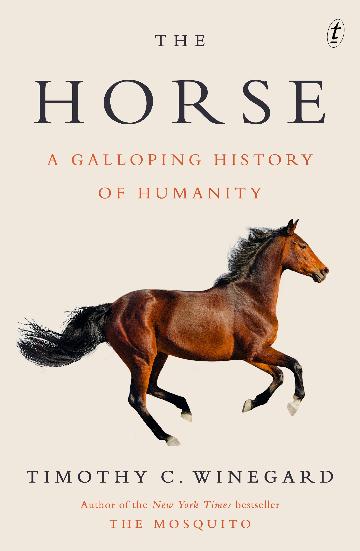
Now you have to be careful about horse books – you might get The Little Red Pony or Black Beauty when what you were after was War Horse or a history of the stirrup (not the game changer once thought). The proliferation of books about horses and their paraphernalia does however suggest the significance of this noble beast in a wide range of human cultures.
In The Horse Timothy Winegard provides a deep dive into the history of the last several thousand years using our equine friends as the unifying theme. As such, the book is of the same genus as Mike Kurlansky’s Cod and Salt. The use of a unifying concept permits the author to cover a lot of ground – both spatially and temporally – without becoming fatuous.
Winegard begins with an explanation of the horse’s evolutionary history and biomechanical advantages. Its unique ability to ‘eat and run’ and to run upon relatively poor quality fodder made it ideal for domestication – not just for meat and milk but also for warfare. The horse emerges into prehistory as Yamnaya Indo-European speakers with their horse-drawn wagons migrate from the steppes west into Neolithic Europe and east towards China around 6000 to 4000 BCE. They also brought the plague bacillus and with its assistance Indo-European languages ended up being spoken from Ireland to India. The role of the horse in this DNA verifiable expansion is necessarily speculative but undoubtedly significant.
From there on its into the Bronze Age chariots, Scythian cavalry, Macedonian Companions, horse archers, knights and, of course, Cowboys and Indians. Winegard is careful to avoid technological determinism in assessing the impact of the equine but there is no denying the importance of the horse in the technology of warfare and that at crucial moments it appears to have made the difference. The Horse also deals with the economic importance of the horse, particularly in transport and Winegard does not hesitate to get his hands dirty dealing with a major equine output, manure.
Nothing lasts for ever of course and by the 1920s the age of the motor car was upon us. By 1950 the number of horses on US farms had fallen from a peak of 21.5 million in 1915 to 5.4 million. Horses continued to be important militarily until the end of World War II. That was in the living memory of my grandparents so that world is not that far away. That may explain why the horse still exercises a fascination and why The Horse is a worthy member of an honourable lineage of equine publications.
Reviewed by Grant Hansen
ABOUT THE AUTHOR

Dr Timothy C Winegard is a New York Times bestselling author of five books including The Mosquito: A Human History of Our Deadliest Predator. He holds a PhD from the University of Oxford, served as an officer in the Canadian and British Armies, and has appeared on numerous documentaries, television programs and podcasts. Winegard is an associate professor of history at Colorado Mesa University.



0 Comments