


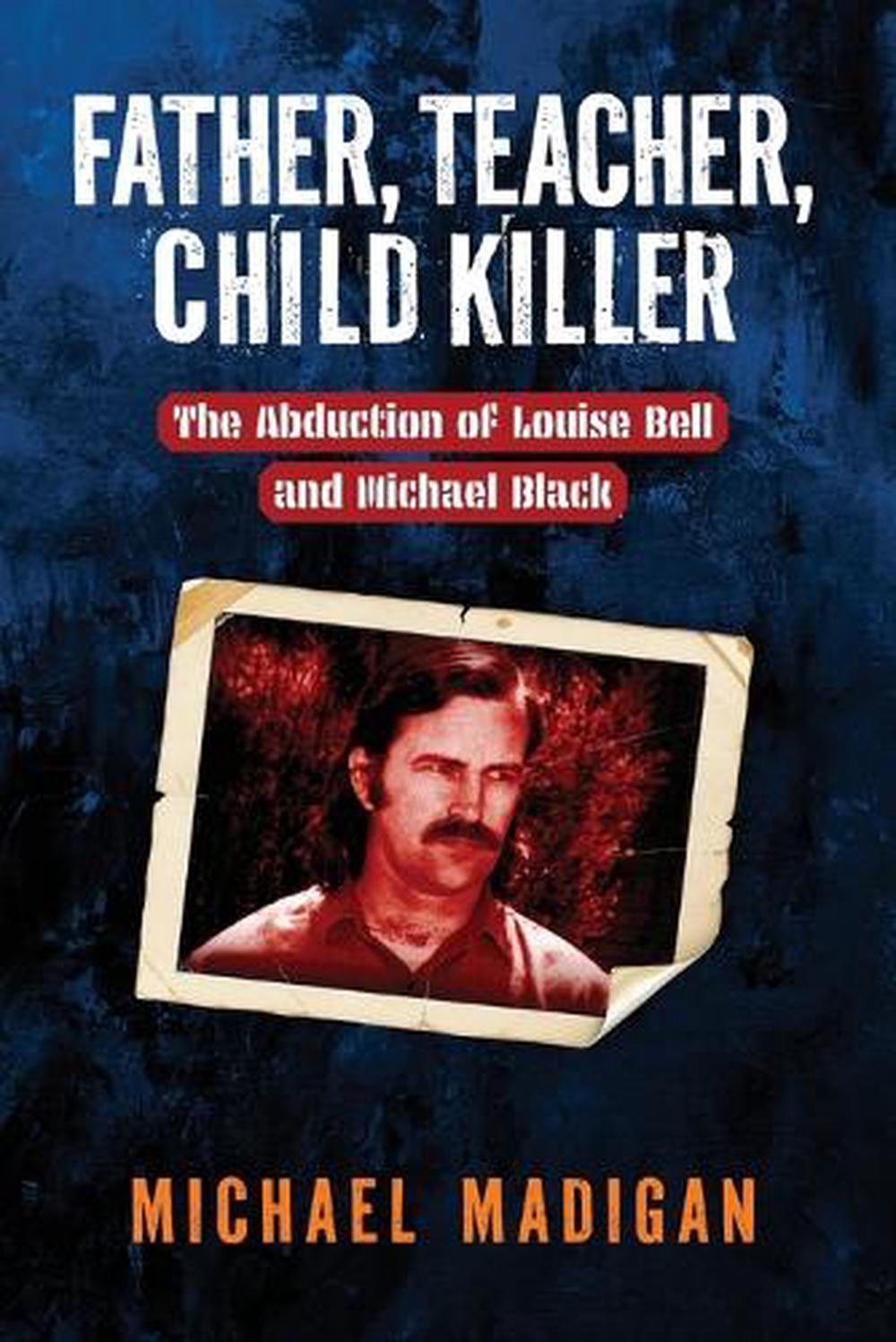
Father, Teacher, Child Killer by MICHAEL MADIGAN is a new and gripping true crime thriller, telling the stories of two disappearances six years apart. Read on for an extract.
ABOUT THE BOOK
 On a warm January night in 1983, ten-year-old Louise Bell disappeared from her bedroom in suburban Adelaide. Her family’s desperate search, and the police investigation that followed, would stretch on for decades. Louise was never seen alive again.
Six years later, in 1989, another child – nine-year-old Michael Black – vanished under chillingly similar circumstances. His body has never been found. This time, the trail led to a man few could have imagined: a trusted father, a respected schoolteacher, and a predator who had lived undetected among his neighbours for years.
This book traces the parallel stories of Louise and Michael, the anguish of their families, and the relentless work of investigators who refused to give up. It reveals how advances in forensic science finally unmasked the killer – and confronts the disturbing possibility that he may have been responsible for other unsolved child abductions that still cast a shadow over South Australia.
A chilling reminder that true evil can hide behind respectability, and even stand at the front of a classroom.
**********
EXTRACT
Chapter 1 – January 3, 1983
It was a typical Adelaide summer day; the air was warm and dry, with the sky a flawless stretch of blue, devoid of a single cloud. Residents of the southern suburb of Hackham West eagerly anticipated the cool change predicted for later that night. As the sun melted into the horizon over St Vincent’s Gulf, the temperature eased slightly. Still, within the cream-brick home of Colin (32) and Dianne Bell (32), the atmosphere remained uncomfortably warm, thick with the kind of stillness that felt both ordinary and, in hindsight, unsettling.
The doors and windows of their modest home were propped open, coaxing a reluctant southerly sea breeze to slip through. The excitement of Christmas had faded, but the school holidays were only halfway through. Louise (10) and Rachel (8), the Bell sisters, revelled in the freedom of school-free summer days. They were more than sisters; they were confidantes, partners in make-believe, their occasional squabbles dissolving as quickly as they flared.
At 7:30pm, the girls were in their shared bedroom, a warm space filled with pop star posters, soft toys, and the fading twinkle of Christmas decorations. Their laughter drifted into the evening, mingling with the cicadas’ song, marking the onset of nightfall.
The girls were excited about an upcoming trip to the cinema to see E.T., the blockbuster film directed by Steven Spielberg, a plan they had discussed with breathless anticipation, a level of excitement only children could muster. A family outing to the South Parklands in Adelaide’s city centre was also planned for the following day. The Bell family were close-knit, their lives tightly woven together by shared routines and simple joys. Life felt secure and predictable.
Wholesome.
Across the street, a neighbour glanced out her front window and paused, a soft smile tugging at the corners of her mouth. She had a clear view of the girl’s brightly lit room. She watched as Louise and Rachel danced with carefree abandon, singing along to tunes from a cassette player – a treasured Christmas gift.
Later, after showers cooled their sun-kissed skin, the girls changed into light summer pyjamas. By 8:45pm, the lights in the girls’ bedroom were out, and the house gradually surrendered to darkness, save for the soft glow of a street lamp casting long, faint shadows across the front yard. At 10:00pm, Colin and Dianne retired to their bedroom, only a thin wall away from their daughters. As was Colin’s nightly ritual, he covered the pet budgie’s cage in the kitchen, its soft rustling the last sound before quiet settled over the house. He then stepped onto the front porch, the screen door creaking briefly, to place empty milk bottles for the morning delivery. Colin then went into the girls’ room and lovingly kissed their foreheads.
‘Sleep tight.’
The neighbourhood seemed wrapped in tranquillity, but somewhere within that ordinary night, something unspoken stirred – an invisible thread unravelling, unnoticed until it was far too late.
At around 6am, Dianne awoke to the sound of rattling glass bottles as the milkman delivered their daily supply to the front doorstep. She immediately got out of bed, went to the kitchen, and began her morning routine. After she put the kettle on, she walked down the carpeted passage to check on the girls.
She was confused by the sight of an empty bed; Louise was not there. She frantically checked every room in the house.
Confusion soon turned to anxiety as she rushed out the back door and called out for her daughter. ‘Louise… Louise!’
Dianne’s movements quickened. She ran out the front door and jogged along the street. ‘Louise… Louise darling.’
The street was deserted apart from a stray cat dashing down a drain. Agitated, Dianne ran back inside her home and went to her bedroom, where she shook her sleeping husband. ‘Colin, Louise isn’t in her room. I’ve looked everywhere.’
Colin leapt out of bed. The parents entered the girls’ bedroom and woke up eight-year-old Rachel. ‘Rachel, where’s Louise?’
Little Rachel rubbed her eyes and looked blankly back at her parents. She obviously had no idea where her big sister was. Colin then noticed an opening in the wire screen window. The curtains were bunched together in the middle. He rushed across the road to 10 Meadow Way, which had a swimming pool in the backyard and searched there. He then ran to Louise’s school, which was nearby on Glynville Drive. There was no one there.
After frantically searching the surrounding area, Colin returned home. He sat on the lounge chair to collect his thoughts. His stomach churned with fear, and his mind raced with panic. He reached for the phone and called the police to report the unthinkable: his daughter was missing.
Two police vehicles arrived within ten minutes. Young constables systematically knocked on doors in the neighbourhood. At the same time, two senior officers examined the girls’ bedroom, which faced the street. The small room was fitted with candy-striped curtains from floor to ceiling, with both bedheads positioned below the window ledge. The bedroom was a typical one for young girls. Pop idol posters were sticky-taped to the walls, toys crowded the cupboards, and a basketball trophy stood proud and prominent on the dressing table.
Louise loved playing basketball for the local Saints team and had been presented with the trophy only a month earlier.
Police quickly noticed that the window’s wire screen had been tampered with. The screen, made of synthetic mesh material, had an opening that appeared large enough for a small child to squeeze through. Aside from the screen, there were no other signs of disturbance. Within 30 minutes, two detectives from the Christies Beach Police Station arrived and began questioning the parents.
Colin and Dianne sat close together on one side of the round timber kitchen table. The two detectives were seated directly opposite them. The senior detective spoke in a soft yet assertive tone as he questioned the parents, who were both trembling in a state of shock.
Colin Bell told police that when he said goodnight to his girls, he remembered seeing the sliding window in the girls’ room was only slightly open on one side and that the curtains had fully covered the window. In the morning, he found the curtains pushed to one side with the sliding window fully extended. Bell informed police that the flyscreen on the girls’ window had minor damage before that evening. Still, he believed the damage was now far more extensive.
Police pressed the Bells for any information.
‘No, we don’t know of any reason why she would run away.’
‘She was happy, a shy girl, and quiet… she would never run away from home.’
‘There is no reason in the world for her to leave home.’
‘No, I haven’t seen any stranger lurking around…’
Louise was described as being around 4 feet 6 inches (135 cm) tall, with short brown hair, tanned skin, and dark brown eyes. Dianne Bell told the detectives that Louise wore bright orange shortie pyjamas when she tucked her daughter in and kissed her goodnight.
Dianne’s voice rose. ‘She’s asthmatic; she needs her puffer.’ She put her head in her hands and started weeping. The neighbours of the Bell family spilled out onto the street, huddling in tight groups, their hushed voices barely masking their shock. The sheer enormity of the situation unfolding before them cast a heavy pall over the neighbourhood. In Hackham West, a suburb already scarred by tragedy, the chilling thought that
yet another child had vanished sent ripples of dread through the community.
Kirste Gordon had lived only a few hundred metres from the Bell home. She was only four years old when she and eleven-year-old Joanne Ratcliffe were abducted from Adelaide Oval in August 1973, snatched in broad daylight during a football match attended by over 12,000 people. Neither girl was ever seen again.
Now, with the disappearance of yet another girl from the same area, the eerie coincidence sparked a wave of speculation that spread like wildfire. Whispers turned into accusations. Men who had lived quietly in the district for years were subjects of dark suspicion. Paranoia festered behind drawn curtains. Within hours, one of the most extensive searches in South Australian police history occurred. The thumping sound of the State Rescue helicopter made broad sweeps of the district and then headed along the pristine coastal beaches nearby. The State Emergency Service and over one hundred Country Fire Service personnel scoured the area, checking the dry creeks and the nearby bushland.
The Bell home was typical of houses built in the early 1970s, featuring cream brick and a green tiled roof with three bedrooms.
Hackham West is a working-class suburb situated between the Onkaparinga Hills to the east and the Onkaparinga River, as well as the southern beaches to the west. Approximately 25 kilometres from Adelaide’s CBD, it was not your typical capital city suburb. Among the numerous symmetrical rows of houses were thick tracts of bushland, a nearby conservation park with its rugged terrain and dozens of deep, secluded gullies.
Eight-year-old Rachel Bell looked apprehensive as she climbed into the back of the powder blue Holden Commodore police car. She waved to her mother as she was driven down Meadow Way onto Glynville Drive. Detectives hoped the shaken but brave little girl could show them where her big sister used to play and visit.
Police urgently sent descriptions and photographs of Louise to police stations across the state. It was obvious that South Australian Police chiefs were working on a well-organised plan. It had been ten years since the Ratcliffe and Gordon abduction. South Australian Police now had the help of a newly installed computer system to organise the vast amount of information that they would soon be gathering.
A police command post was established in a cramped caravan at Hackham West Primary, only 100 metres from the Bell family home. The air was thick with uncertainty as officers, still on edge, hesitated to label Louise’s disappearance as an abduction. They were considering three possible scenarios, each more chilling than the last.
The first: Louise had left home on her own. But why? What could have driven a child to vanish without a trace?
The second: She left willingly but was taken afterwards.
The third – and the most terrifying – was abduction. Police were sure she had either crawled or been dragged through the window; the damaged screen pushed outward as if from inside the room. Clearly, the flyscreen had been tampered with, but was it a deliberate decoy designed to mislead them and send them down the wrong trail?
Questions lingered, each one more pressing than the last. Had the abductor entered through the front or back door, and how had they managed to carry Louise away undetected? Was the Bell home truly secure, or had someone been in the house before? How could a child disappear in the dead of night without a single sound breaking the silence? The more the police dug, the more the mystery deepened – and the more the fear settled in.
Colin Bell had spent the entire day pacing the streets and searching the parks around Hackham West, his heart heavy with a fear that grew stronger with every hour. Friends and family walked with him, their steps quiet, eyes scanning for any sign of Louise – anything that might bring them closer to her.
Colin’s legs felt like lead as the sun began to set, weighed down by exhaustion and the crushing dread that tightened with each unanswered question. When he finally turned onto his street, the sight that greeted him
made his heart thud – police cars lined the road, their flashing lights vivid and unmistakable even in the fading light. As he approached the front door, he silently prayed that Louise would be inside, sitting on her mother’s lap, smiling.
But Louise wasn’t there.
Instead, the living room was filled with stern-faced men in dark suits, their expressions cold and unreadable; their presence serving as a grim reminder of the situation.
His wife sat on the sofa, her face pale and hollow, her eyes empty with fear and exhaustion, broken by an ordeal no parent should ever face. Her hands gripped a tissue, twisted and crumpled beyond recognition, mirroring the fragile hope with which they had started the day.
Down the narrow hallway, men clad head to toe in white forensic suits moved meticulously, their gloved hands methodically dusting, lifting, and searching. They hovered in Louise’s bedroom – a space once filled with the innocent chaos of a child’s life, now a sterile, silent crime scene. Teddy bears and school books stood witness as strangers sifted through her belongings, hoping to find a clue, a fragment of evidence that might explain the unthinkable.
By nightfall, the words no family ever wants to hear were spoken aloud: Louise Bell’s disappearance was now officially declared a major crime. And somewhere in the darkness, the answers for which Colin Bell prayed were already slipping further out of reach.
ABOUT THE AUTHOR
Michael Madigan is an Australian author who writes compelling true crime and investigative works that delve into some of the nation’s most disturbing and unsolved mysteries. His titles include The Missing Beaumont Children – 50 Years of Mystery and Misery and The NCA Bombing: A Mafia Murder. Crimes that have haunted Australia for decades.
Michael’s writing is driven by a deep sense of justice and a fascination with the human stories behind criminal cases – his style is meticulous, compassionate, and unflinching. When not researching or writing, Michael bushwalks, reads true crime and explores Australia’s enduring mysteries.


0 Comments