




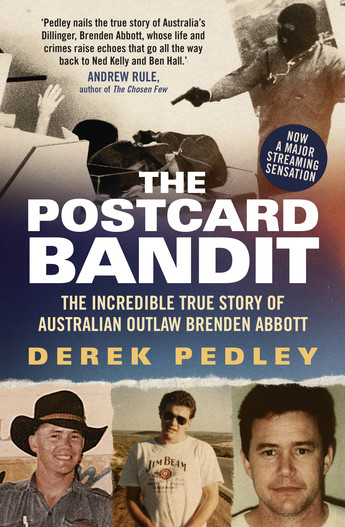
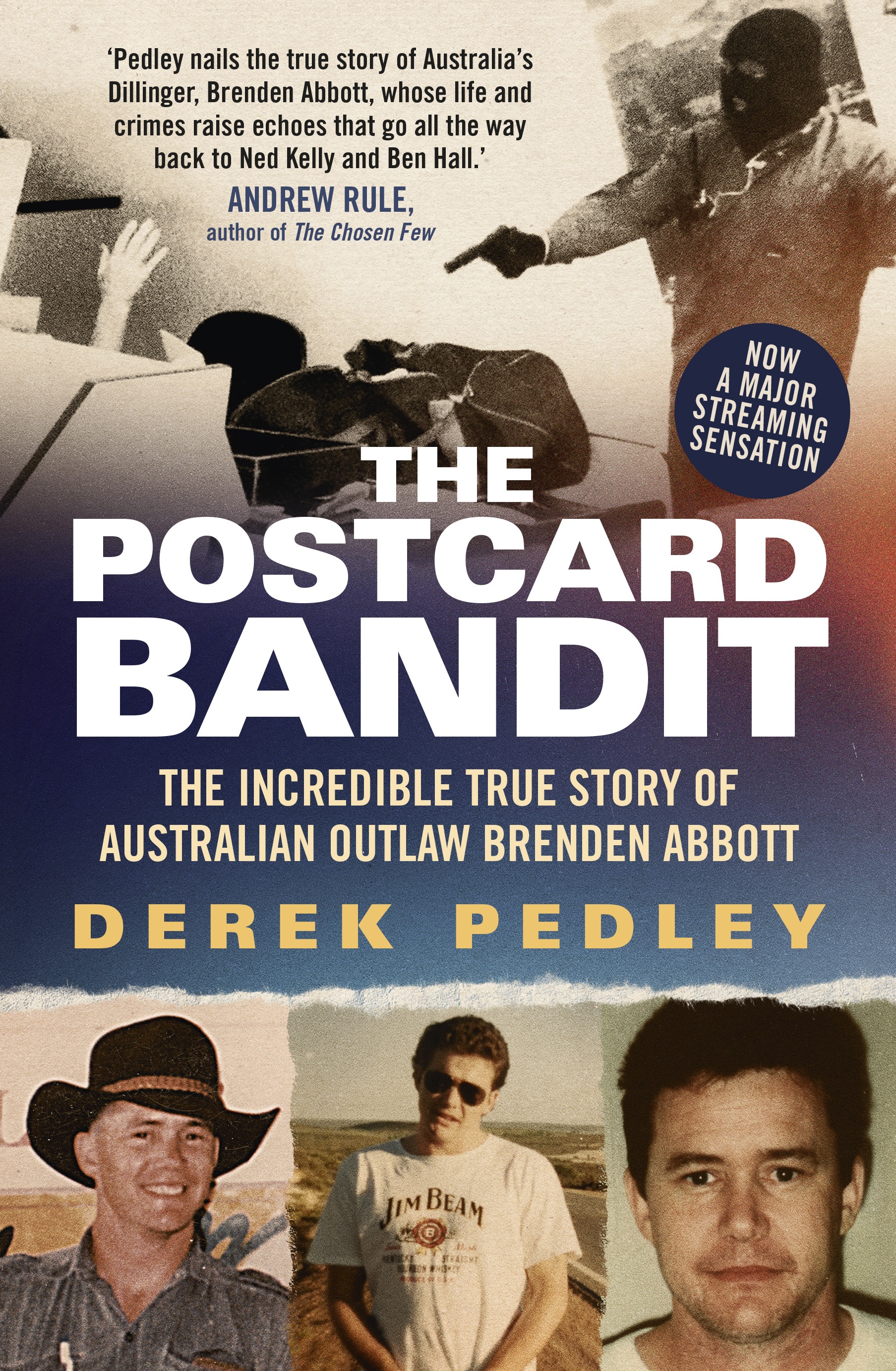
The Postcard Bandit: The incredible story of Australian outlaw by DEREK PEDLEY is the official authorised biography of notorious professional criminal Brendon Abbott.
Good Reading sat down for a chat with Derek to learn more about his inspirations and his choices to write about Abbott’s extraordinary life on the run.
What drew you back to Brenden Abbott’s story?
I never really lost touch with it. I’ve been reporting on Brenden Abbott’s crimes since 1994. Even through his long years of solitary confinement in Queensland, Abbott was rarely out of the news for long, whether it was his latest court battle fighting to be released from isolation, or his girlfriend selling his paintings.
In 2021, I re-established direct contact with Abbott because I was bemused by his continued detention in maximum security despite decades of exemplary behaviour. In 2023, I co-authored a letter to the SA government requesting that they drop an arrest warrant which was decades old and was clearly never going to make it to court. They withdrew the warrant and that’s allowed Abbott to finally be released from maximum security, into a self-care unit.
What new perspectives or insights does The Postcard Bandit reveal?
The original book documented Abbott’s life story up until 2006. This new edition brings it up to date, covering the last two decades of Abbott’s life in prison, his fight to get out of solitary, his extradition to Western Australia and most recently, his court case last year seeking that a court rule his imprisonment as unlawful. The new chapters are based on interviews with Abbott, his son James, and James’ mother Louise Laycock, who has never spoken publicly before about her relationship with Abbott while he was on the run. There’s also a new picture section, including exclusive pictures of Abbott’s arrest in 1995. It was a big thrill to get my hands on those.
What were the biggest challenges you faced while researching Abbott’s life and crimes?
When I wrote my first book on Abbott, No Fixed Address, I only had the cooperation of a handful of detectives, which made it very hard to tell the whole story. I subsequently spent years writing to Abbott and talking to him on the phone, building trust, and ultimately he shared his secret prison journals with me, which documented his life on the run. That allowed me to write his biography, and I used a lot of his stories verbatim because he’s an incredibly good writer with a great eye for detail, a dry sense of humour and a nuanced memory. When Abbott was in prison in Queensland from 1998 to 2016, the authorities would often cut our contact without explanation, so that was frustrating, but it’s been much easier to speak to him since he was moved to WA.
Why did Abbott choose to participate in this book, and what did he hope to gain from telling his story?
Abbott cooperated with the first edition of the book because he was sick of the myths and lies that were constantly repeated about him in the media. He was disarmingly honest about his life, and not all of the stories painted him positively.
He’s since told me he regrets sharing some of those stories, but I’m glad he did, because they revealed some of his vulnerabilities and faults. He is a complex character, not the stereotypical ruthless villain he’s often portrayed as in the media. Abbott is actually guided by a very clear set of morals and values and it’s a pity he didn’t adopt those much earlier in his life. He’s never sought money for telling his story, and I believe him when he says he’s only interested in getting the truth out there, particularly with regard to the punitive treatment he received in the Queensland prison system.
How did the nickname ‘Postcard Bandit’ shape public perception of Abbott over the years?
The ‘Postcard Bandit’ story was a myth, but because there were pictures of Abbott on the run living the high life, it was a story that was impossible to shake. There was a roll of film recovered from a stolen car that Abbott and his accomplice had used in a shootout with police, and a second roll of film was found when they arrested Abbott’s accomplice weeks later. The truth is that the only postcard that was ever sent was by mischievous Perth detectives to Abbott, after his 1995 arrest in Queensland.
The postcards story shaped a perception that Abbott was a larrikin who liked to taunt the police, and there is actually some truth in that.
 When he escaped prison for a second time in 1997, he left behind a signed prison transfer form, and when he was playing cat and mouse with the detectives who had seized his brother’s pager in 1995, he sent a message saying: “Sorry guys, but your little plan failed, maybe better luck next time, from BJ’. He loved the battle of wits with detectives. But Abbott actually hates the Postcard Bandit name and story. When on the run, he never did anything that brought attention to himself and was always vigilant about keeping a low-profile. That’s how he stayed free for five-and-a-half years. There are people who admire Abbott’s anti-authoritarian defiance, and I can understand why.
What aspects of Abbott’s life or crimes do you think have been misunderstood or overlooked?
Obviously the postcards story was a myth, but it made him famous and it irked the authorities. I think he’s been unfairly demonised in the media. There is no doubt that he traumatised many bank staff, and it’s a miracle no one was ever injured during his robberies or escapes. But with the exception of six months on the run, he’s been in prison since March 1995. That’s 30 years behind bars, mostly in maximum security, including about 12 years in isolation. That is a very, very high price to pay and it far exceeds the sentence many killers receive.
I believe Brenden Abbott is no longer a threat to the public. He has paid his debt to society and should be set free and allowed to live out his life with his family.
How does Abbott’s long-term imprisonment, including time in solitary confinement, shed light on systemic challenges within Australia’s prison system?
Isolating criminals in tiny cells for endless years benefits no one, and it’s a form of punishment, not rehabilitation. Criminals are sent to prison as punishment, not for punishment. I think people who read this book will be shocked by what Abbott has been subjected to. There is extensive research that shows that isolation in prison breeds anger, resentment and mental illness, and it is remarkable that Brenden Abbott has somehow retained his sanity and good humour.
After many years writing true crime, how has your approach to researching and telling these stories evolved?
My biggest lesson has been that planning, discipline and focus are crucial to researching stories.
I spent far too much time researching Abbott’s story and going down rabbit holes that I should have ignored. Australian Outlaw took five years from idea to bookshelf. That’s a hobby, not a book project. It is an incredibly detailed book because of the obsessive approach I took, but it was not an efficient or realistic method.
If I wrote another book, I would set a clear timeline and goals. Every research avenue requires a cost-benefit analysis. Is this element of the story worth investing time, effort and expense? If it’s not an emphatic “yes”, then it should be ignored. As most writers will attest, writing books is not a profitable pursuit. If you write for money, you will be disappointed. In updating this book, I was given a tight deadline and limited word count. That meant I had to prioritise the key new elements and work quickly and efficiently. And because of that, I was able to re-edit the book, and research and write three new chapters and an Afterword in under three months. But that also required a lot of discipline and hard work, because it was done in addition to normal work and family commitments.
**********
ABOUT THE AUTHOR

Derek Pedley always aspired to write true crime. That opportunity came in 1997, when notorious bank robber Brenden Abbott escaped from prison. The result was No Fixed Address, which was later adapted into the telemovie Postcard Bandit. After gaining exclusive access to Abbott following his recapture, he wrote Australian Outlaw, a biography chronicling the fugitive’s extraordinary life. His third book, Dead By Friday, explored a chilling suburban contract killing from 2001.
His memoir, Crazy Bastard, detailed his experience of forced adoption and led him to reclaim his birth name, Abe Maddison.
Following a 30-year career as a journalist at The West Australian and The Advertiser in Adelaide, Maddison now serves as the South Australian correspondent for Australian Associated Press.


0 Comments