


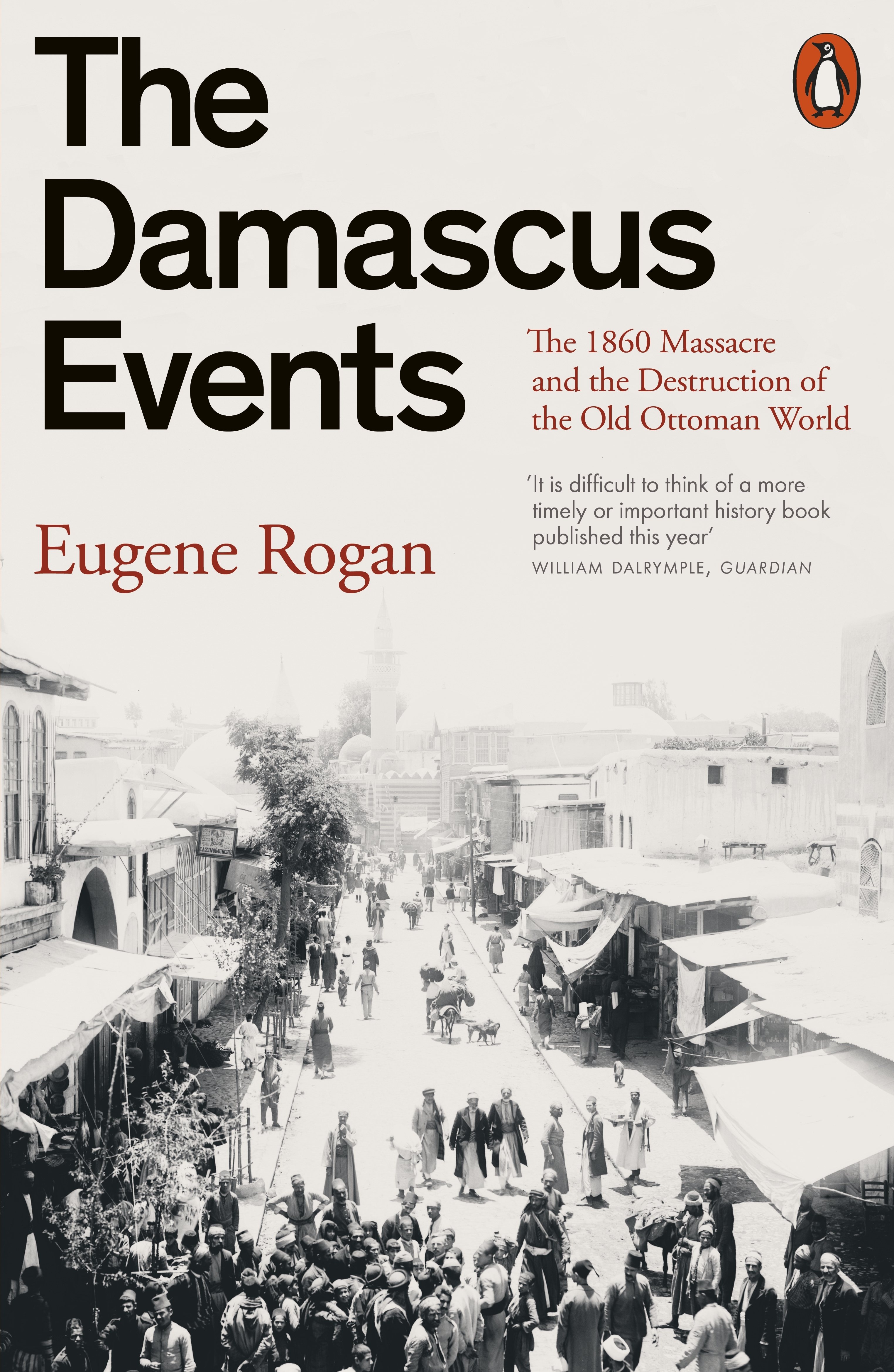
Eugene Rogan is a distinguished historian of the Middle East and recently featured in William Dalrymple’s Empire Podcast on Gaza. In The Damascus Events Rogan captures one of the moments where the old multiethnic, religiously diverse Ottoman Empire began the painful transition to ethnic and religious nationalism.
The Ottomans get a mixed press these days – like their great rivals, the Austro Hungarians, the 20th century was not kind to multiethnic empires – but its reputation is probably better than it used to be. That’s because, for all the Ottoman tendency to engage in communal massacres during rebellions, most of the time being a member of a religious minority in the Ottoman Empire was relatively comfortable compared to the position of, say, Moors in Spain or Jews in medieval England. Compared to the current position in the Middle East it seems virtually idyllic. Islam recognises Christians and Jews as members of protected communities – peoples of the Book – and provided you paid the jizya – the tax on such non-Muslims – the Government left you largely alone.
That started to change with the Tanzimat reforms announced in 1839 and applied much more vigorously from the 1850s. Tanzimat was the Ottoman attempt to catch up with the West and involved far-reaching reforms to taxation, education, commerce and military recruitment. One of the key beneficiaries of the reforms and the increase in Western trade to Damascus was the Christian community. French, British and American influence manifested itself increasingly through claims to extra-territoriality. Intercommunal tensions rose and culminated in 1860 in a series of massacres of Christians in Damascus in which several thousand died.
Rogan documents all this with admirable clarity and uses the journal of the US consul in Damascus – an Arab Christian – to give the narrative a vivid personal perspective.
The Ottoman official response was to punish many of the ringleaders, requisition housing for the homeless, and raise a local indemnity to fund reconstruction. Damascus and its Christian minority recovered and did well. Damascus continues to house a large Christian minority to this day and when I visited in 2011 you could still find a wine to have with dinner by scanning the horizon for a church spire. Since then, Damascus has suffered more than a decade of civil war. Whether Syria will remain a multiethnic and diverse religious state remains to be seen.
Reviewed by Grant Hansen
 ABOUT THE AUTHOR
 ABOUT THE AUTHOR
Eugene Rogan is author of the bestselling The Fall of the Ottomans: The Great War in the Middle East, 1914-1920 and The Arabs: A History. He is professor of modern Middle Eastern history at the University of Oxford and Director of the Middle East Centre, St Antony’s College, Oxford.



0 Comments