


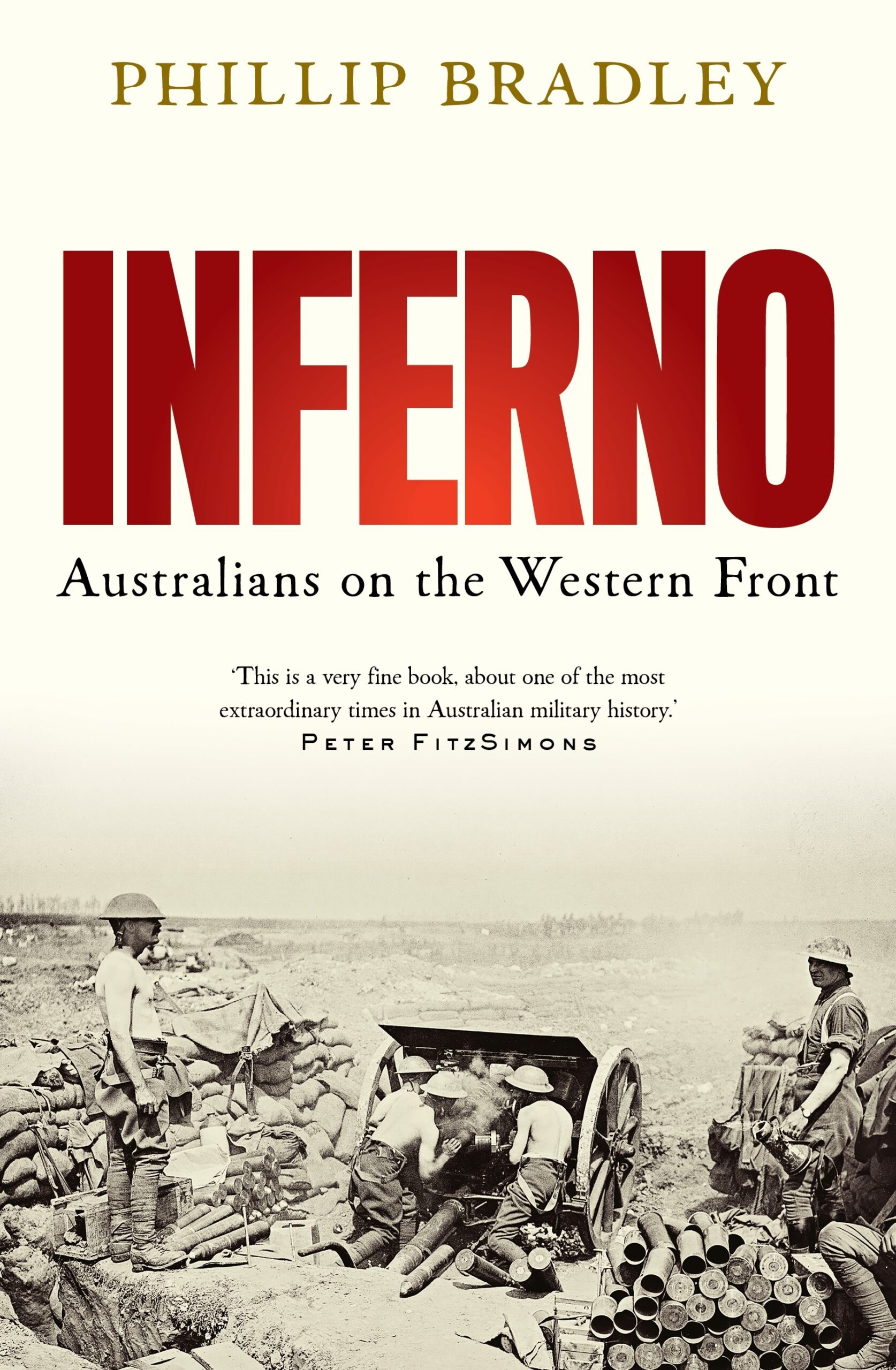
Inferno is the epic story of the Australians on history’s greatest battlefront, 1916-1918.
Told through the eyes of the Diggers and the Germans, each of the major Australian battles is recounted from the soldiers’ viewpoints in rich, historical detail.
Read on for an extract.
ABOUT THE BOOK
2 August 1914: German troops cross the border and advance into Belgium and France. Two days later, Britain and Australia declare war on Germany. Three-hundred thousand young Australians will depart to face the Western Front; forty-six thousand will not return.
Inferno is the story of Australians fighting in France and Belgium from 1916 to 1918 on the greatest battlefront in history, told through the eyes of the Diggers and the Germans. Each of the major Australian battles is recounted from the soldiers’ viewpoints in rich historical detail, much of which has been uncovered for the first time.
Written by bestselling military historian Phillip Bradley, Inferno is an epic of our wartime history, a comprehensive account of Australians on the Western Front. Amid the largest tragedy in Australian history, this is the legend of the Diggers, brought to life.
**********
Chapter 14
‘The barrage still thunders on and then the world goes forth’ – East of Amiens: August 1918
‘I am now in the middle of preparations for a very large battle,’ Lieutenant General John Monash wrote on 2 August 1918. ‘It will employ the whole resources of my Corps command.’ As part of General Henry Rawlinson’s Fourth Army, Monash’s Australian Corps would help spearhead the upcoming Allied offensive and Monash would employ the combined arms tactics he had engineered for the successful attack on le Hamel.
Tanks would again play a role in Monash’s plan. Lieutenant Thomas Lydster, who served with Lieutenant Colonel Harry Murray’s 4th Machine Gun Battalion, was among the four officers and 80 men sent to learn how to load and unload their machine guns from tanks and how to safely ride in the tank across shell holes and trenches. ‘They asked us to name one of the tanks,’ Lydster wrote, ‘and the name must begin with O.’ Thus, a tank named Oodnadatta, after an Australian outback town where it is as ‘hot as hell’, would take part in the upcoming offensive. ‘There are hundreds of tanks round here,’ John Turnbull noted on 3 August. Some tanks would be used for resupply, loaded with small arms ammunition, grenades, mortar bombs, water and rations. ‘The tanks returning from the line will carry the wounded out,’ Turnbull added. Some tanks were only decoys. ‘Surprised at one or two tanks made of timber and canvas, painted to look real enough from a distance,’ Ray Bishop observed, ‘one of them with a mule still inside, motionless, no driver.’
On 7 August the night before the attack, German shelling struck one of eighteen tanks sheltering in an orchard north of Villers–Bretonneux. All were ‘parked close together with camouflage nets over them’ and the fire spread rapidly. When William Atkinson and James Leyden went across from their gun battery to help, Atkinson was told to stop the fire spreading. Leyden then got into one of the tanks with three tank officers, as it took four men to drive. Three tanks were driven to safety and a fourth had gone about 10 metres when one of the burning tanks ‘exploded with such force that the tank was thrown about 100 yards out of the orchard’.
Captain Norm Nicolson watched the conflagration. ‘A great flare went up followed by black smoke and in an instant the whole place was alight and awful explosions started,’ he observed. ‘Great pieces of iron and stuff flew all over the place . . . Then, a great heap of petrol must have lit, for a teeming black cloud spiralled high into the sky with a terrific bang.’ Despite being told they were absent without leave, both Atkinson and Leyden were awarded the Military Medal. A third gunner, John Bannon, was mortally wounded fighting the fire.
Monash would also utilise his artillery arm to maximum effect. Norm Nicolson, who had been put in command of 53rd Battery for the operation, was told that the Fourth Army was to attack and keep attacking while the gun batteries ‘must be prepared to go on and on’. There would be no movement by day before the attack, with all ammunition brought up at night. Nicolson selected a battery position just behind a slight crest two kilometres from the front and the guns were dug in and camouflaged in front of old trenches that would shelter the crew and ammunition.
‘Out of every door and out of every window of the old village houses behind the lines, glowered the angry faces of Australian infantrymen,’ Nicolson related, ‘very annoyed at being cooped up like a lot of school kids,’ hiding from aerial observation. Nicolson’s guns were moved to the new position on the night of 4 August and, on subsequent nights, 3600 shells were brought up. The plan was that immediately after the attack barrage ceased, two guns were to be moved forward over the frontline trenches using bridges built by the pioneers at the last moment. ‘Whatever happens we will make history tomorrow,’ Nicolson told his men.
‘A great flare went up followed by black smoke and in an instant the whole place was alight and awful explosions started,’ he observed. ‘Great pieces of iron and stuff flew all over the place . . .
Concentrating so many men, weapons and supplies for the offensive was a challenge for the supply services. Claude Cardwell was a mule driver with the 3rd Division artillery. ‘Rotten tracks, mud, dead Germans and horses, shells, hard biscuits, shell holes in the dark and mules,’ he wrote. ‘Damn them.’ ‘Every gun has to have 500 shells,’ John Turnbull noted. ‘At night the roads are packed.’ Ken Downes carted ammunition by hand to a new artillery position in Villers–Bretonneux by night ‘under direct observation, so we dare not show any lights, or smoke’.
‘In the week or two before, the roads at night were crammed with columns of every kind,’ Ray Bishop related. When dawn broke the roads had to be clear. ‘A dump of ammunition was to be placed a couple of hundred yards behind the front line,’ he added, ‘on the attack morning our guns were to move up there to use it.’ ‘Gun pits, well prepared and everywhere ready for the guns to be brought up,’ Lieutenant Henry Neaves confirmed. ‘All the batteries are silent which proves they are in readiness for something very big,’ Noel Keating remarked.
‘Preparations still in progress and on a gigantic scale and much bigger than any stunt we have yet taken part in,’ Alex McKay observed. ‘All night long, great lines of transport carrying ammunition and petrol for artillery and tanks,’ Noel Keating wrote. ‘There seemed to be no end to the lines of GS wagons and limbers.’ ‘Great preparations are going on for the stunt which is to come off within the next few days,’ Hector Joel noted. ‘We with 5 other lorries cleared 17,000 gallons of petrol, 5000 oil, 1000 pounds of grease from the train to dump which is being formed for tanks.’
 ‘Every wood during the daytime was sheltering horses and men,’ wrote Henry Neaves, but dusk signalled tremendous activity. ‘Great streams of horses, wagons, limbers and guns would be seen moving from every wood on their way to positions ahead,’ he observed. ‘It was a wonderful sight to see all the men, horses, wagons, limbers, motor lorries, and cars, caterpillars with big guns and the tanks all making towards the line.’
Monash employed another ruse from le Hamel to cover the traffic noise by having aircraft constantly fly over the area. ‘Dozens of our planes over our lines by night,’ John Turnbull noted. ‘All night our planes droned back and forth above the frontline trenches to make a din that would drown the rattle and hubbub of the columns going up and back,’ Ray Bishop wrote. ‘Planes were flying low overhead to drown the noise of the tanks and gun limbers moving about,’ David Wilson confirmed. In the three days leading up to the attack, the weather was overcast, which made it difficult for German aircraft to observe the build-up. ‘To our advantage as there are guns, ammunition and stores everywhere,’ Lieutenant William Thomas noted. ‘Our guns all up in open positions but apparently have not been seen,’ Brigadier General Harold Grimwade recorded.
Geoff Rose moved up with the 30th Battalion on 4 August. ‘We knew this time that something big was going to happen,’ he observed. ‘The roads were crammed with transport of all kinds going both ways.’ On 7 August extra ammunition and rations were issued and Rose’s signals section got carrier pigeons and signal rockets. ‘We did nothing all day but play cards and smoke and watch the traffic,’ he added. ‘Our job was to follow on the first attack and leap frog to the second objective.’ George Watkins took a swim in the Somme canal to prepare ‘for the great push which is going to take place in the morning’. For Captain Sam Germon, the medical officer of the 44th Battalion, preparations involved briefing his 32 stretcher bearers and obtaining dressings, splints, stretchers and morphine for the inevitable casualties. At about 11.00 p.m. on 7 August the men ‘marched into the line in artillery formation along well laid out tape lines’, Germon wrote. ‘The night was very dark and foggy.’
John Finney and Vernon Gilbert had the job of laying the jump–off tape for the 44th Battalion. ‘Whilst waiting orders to proceed, a chap came up and asked me if I would swap jobs,’ Finney wrote. ‘He informed me he was to cut the wire, an even more precarious job than mine.’ As Finney moved forward, he could see the preparations for the attack. ‘Snugly and cosily hid among the fast–ripening crops can faintly be discerned the small and carefully camouflaged humps which denotes a gun waiting as if on silent guard, ever ready for the oncoming fray,’ he observed. ‘As far as the eye can see there are these silent sentinels of all calibres and sizes.’
Accompanied by two officers, Finney went out to lay the tape once dusk had fallen. ‘This had to be done in as silent a manner as possible, and everything had to be done by signs,’ he recalled. ‘It was absolutely necessary for us to remain in whatever position we were in at the time’ when any German flares went up. ‘At times we would hear the muffled snip of the wire cutters,’ Finney added. ‘The snip that seemed like the crack of a whip,’ he noted, knowing each crack meant that ‘another stumbling block in the form of a wire was cut’.
‘Preparing for big stunt in the morning,’ Frank Roberts wrote. ‘Moved about midnight to trench in rear of close supports.’ ‘So at last we are on the move in earnest,’ Isaac Betteridge commented. ‘Guns were moving from all directions; tanks were crawling about,’ David Wilson noted.30 ‘What a horrid shock Fritz was going to get shortly,’ Eric Russell wrote. ‘Gentelles Wood is packed full of guns, tanks and men,’ Noel Keating observed. ‘Tomorrow’s attack is going to be one of the greatest of the war.’
**********
 ABOUT THE AUTHOR
 ABOUT THE AUTHOR
Phillip Bradley is a leading Australian military historian and has had a lifetime interest in the field. His extensive research on the battlefield, in the archives and with veterans has given him an intimate knowledge of Australia’s military past. Eight of his books, On Shaggy Ridge, The Battle for Wau, To Salamaua, Wau 1942-43, Hell’s Battlefield, D-Day New Guinea, The Battle for Shaggy Ridge and Salamaua 1943, are ground-breaking works on the Australian role in Papua New Guinea in World War II, all characterised by extensive battlefield research and unique interviews with battlefield veterans.
His other books, Charles Bean’s Gallipoli Illustrated and Australian Light Horse, combine extracts from World War I diaries with unique collections of photographs to illustrate these classic campaigns. Bradley’s latest book,Inferno, completes his trilogy of World War I volumes.


Well I’m so impressed – four years of Australians fighting on the eastern front / I wrote two volumes of Australians o. The Western front and probably have 60 pages of references for 1918 alone – Bradley has 1914 (Australians where not on the western front till 1916) and he has a whole one and a half pages of references – shows you the degree of ‘research’ 🤪