


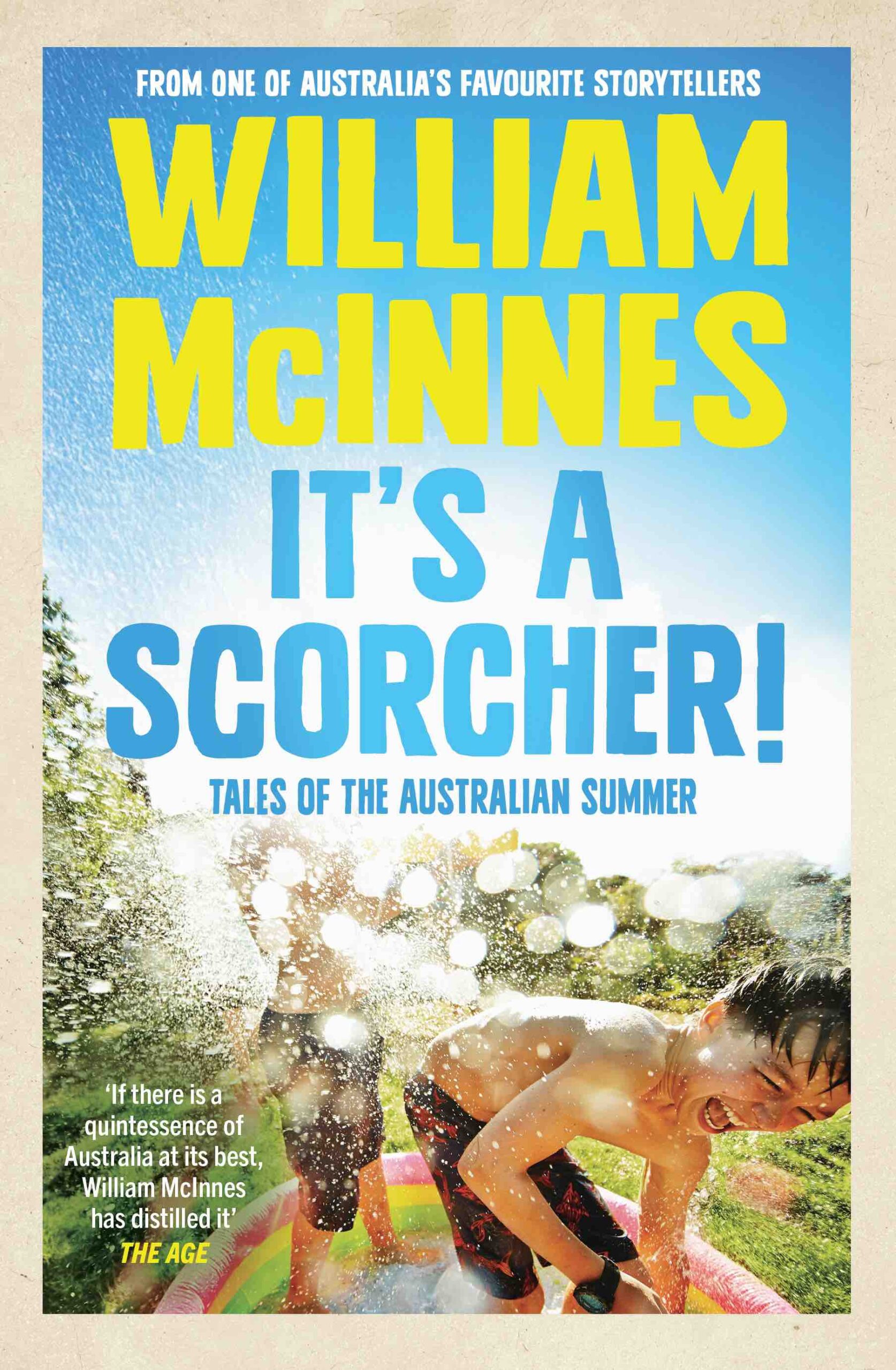
Bestselling author and acclaimed actor William McInnes returns with a collection of hilarious and heartwarming stories about those magical, roastingly hot months that make an Australian summer.

ABOUT THE BOOK
There is something about long, hot summer days that stirs our emotions. It’s all about holidays, festivals, family and Christmas; a time for swimming, a hit of backyard cricket or firing up the barbie. It’s the deafening sound of cicadas, the ticking of a backyard sprinkler, the pain of a wayward bindi or the sting of sunburnt shoulders.
In this collection of nostalgic stories that will make you laugh and make you cry, William McInnes recalls moments in time and memories of summers past. He takes us back to the energy-sapping heat of Redcliffe in the 1960s and 70s, ruminates on budgie smugglers, remembers holiday road trips that went on forever and epic Boxing Day Tests that stopped fans in their tracks. This is a book about the Australia we are and the Australia we were – and the magic of those boiling-hot days when you wake up and know … it’s going to be a scorcher!
**********
EXTRACT
Early mornings make me think of certain things. One of those things is my mother. And her pistol. My mother was very good with her pistol. Her aim was true, she had a sure hand and certainly never missed – which was unfortunate for me, for I was always her target. I wasn’t hard to miss for I was almost always asleep, or at the very least in the midst of some half-hearted attempt to wake myself up.
One summer holidays in my middle teens my mother decided that I was too keen for a lie-in and was ‘Sleeping your life away!’
She began by roaring at me in the early mornings. ‘Wake up. Wake up! You’re sleeping your life away, you stupid boy!’
My brother was some years older than me and had been a definite log in the mornings, but my mother swore he was nothing compared to me.
‘He hibernated, but you, you are mummified. Get up, get up from your sarcophagus, you swine.’
I had no doubt that my parents loved me. They loved all their children and we loved them. They just had a rather offhand way of dealing with us. And even though they loved us deeply, they would also quite happily throttle us at particular times. Sometimes, to put it frankly, we were a bit much, and they had other things they wanted to get on with.
What those things were was never really apparent to me back then though. It seemed to be grown-up stuff. Like yelling at mowers that wouldn’t work, shouting at the dogs, muttering ‘Where are my bloody keys’, definitely getting round to phoning so-and-so about something important and then never actually managing to do anything of the sort, or perhaps walking around ruminating.
‘I’m just going to walk the estate for a ruminate,’ my father would say, and off he’d go around his ‘estate’ – our battleaxe block on the Redcliffe Peninsula. Around the yard and down the drive and back again.
My mother also adopted the term and would sit in a garden chair looking down at a pot of mint with her head tilted to one side. If you interrupted her, she would roar, ‘Go away, I’m ruminating.’
I’m sure my parents did other things too, but understanding all of that was beyond me at the time. And, anyway, it was their business. And they weren’t fond of making their business our business.
One thing I did know was that one of the great irritants in my parents’ lives was having to get their brood of children out of bed.
‘We are not your bleeding alarm clocks!’ was my father’s opinion. ‘You want to get out of bed early then buy yourself a rooster and let him cock-a-doodle-doodle in your earhole!’
My father waved off certain parental duties, including the act of resurrection. ‘You lot are worse than bloody Lazarus, nobody will be rolling away your stone anytime soon.’
So, it was left to my mother to get us out of bed.
Five children into parenthood, my mother had had a gutful of attending to her chicks by the time I was a teenager.
My three sisters were not as tardy as we two boys and they required only a few hearty bellows to get them up and going or, on difficult days, a few ominous threats. These were rather theatrically delivered by my mother, who seemed to enjoy intoning, ‘Do we need a glass of tossed aqua?’
But for we boys, threats gave way to action. My older brother and I shared a bedroom so I had seen my mother’s wake-up tactics at close range.
My brother, the hibernating log, had indeed required the odd glass of water to be thrown at him to get him up and out of bed.
‘My God, it’s alive!’ I could hear my mother roar as my brother flung himself from his bed like a cross between The
Three Stooges and some poor sod who had just been zapped with an incredibly powerful defibrillator.
‘He’s like something you’d see in a Berlin nightclub!’ chortled our mum. The fact my mother had never been in, or even seen, a Berlin nightclub made the observation even funnier.
Then she would turn to me, still in my bunk, look down and sweetly say, ‘Now let that be a lesson to you when your time comes.’
But, at the same time, this tossed aqua method irritated my mother.
Her water-tossing was not a targeted effort. It was more akin to area bombing by Allied aircraft in the Second World War, where precision was not guaranteed. It could be effective but there was collateral damage, and in this case it was the bedding, which needed some lengthy airing afterwards.
Being the youngest and the most spoilt, I was a tad more entombed than my brother so, when it did come to be my time, my mother downstreamed her tossed aqua technique into a plastic orange water pistol. She had bought the pistol from the Woolies Variety store in Redcliffe. It had a vague resemblance to the .44 Magnum Smith & Wesson
Clint Eastwood used when he was playing Dirty Harry, the mean-eyed, tough-talking San Francisco police detective who doubled as a vigilante for justice.
Both my parents had a fondness for water pistols. My father had a yellow one, also a Woolies Variety purchase, in the shape of a Luger handgun. It was filled with kerosene and was tied to the frangipani tree next to the homemade barbecue he had erected.
This yellow Luger, he was at pains to point out, was no toy. It was tied to a branch with two knotted long white football bootlaces.
‘This is not a toy – it’s a utensil. Don’t be touching it. It’s a utensil – a barbie encourager.’
And he would take his utensil and squirt it at the budding barbecue fire and f lames would erupt.
‘It’s the little touch of kero that does the trick,’ he would say, as if he were some Stubbies-clad Jedi Knight explaining the benefits of a lightsaber. ‘It’s a f lame enhancer.’ And he’d gently wind the extended football laces back around a limb of the frangipani tree. ‘Always fancied using a Luger, lovely weapon.’
Once he’d placed it back on the tree, he would say in an outrageous German accent, ‘It iz not a toy! A uteenzil!’
Of course, every chance you got to use the utensil on the sly and make the barbie erupt like Krakatoa you would, but that was just part of the fun. Whenever an orange cloud briefly roared, my mum would say, ‘Well, at least the smoke keeps the mozzies away.’
Her choice of storage for her orange wake-up machine – the .44 Magnum water pistol – was inside the fridge. Ice-cold water would stream from its barrel and weave its wake-up and- out-of-bed magic at me.
It was quite something to have my blankets or sheet pulled back and to be awakened by a freezing jet of water to the melon. I’d open my eyes to see my mother towering over me.
She was a tall woman with a fountain of white hair and the orange Magnum extending from her hand. Dirty Harry would have been proud, though instead of saying, ‘Do you feel lucky, punk?’ à la Clint Eastwood, my mother one morning said, ‘Do you feel sleepy, punk?’
She was quite circumspect with her squeezing of the trigger, though occasionally she would throw back the sheets to let me have one. She might then see some signs of physical activity in my nether regions, and she’d let me have another few bursts along with the advice, ‘Put that thing out before you come downstairs, dirty bits!’
It was, I must admit, a bit fun.
I once told a friend who had served in the Australian military about my mother’s wake-up tactics and he laughed and said it sounded like a hazing ritual at Duntroon. ‘She sounds like a drill sergeant I had there.’ I assume he was joking.
My mum was impressed with the Magnum. ‘It’s so accurate, no need to dry the linen at all!’
She was especially pleased because the former collateral damage had implications when drying the bedding. ‘Forget the House of Windsor, we looked like the House of Bedwetters.’
My father thought for a moment and said, ‘If you spelt Bedwetters with a Z, it would have that ring of European royalty about it.’ Then he laughed to himself and offered to my mother, ‘When Eu-ro-a-pean’ – he elongated the syllables to make it sound like ‘when you-are-a-peein’ – ‘you are a Bedwetterzzzz. Von Bedwetterzzzz. German, most likely.’
After a pause he added, ‘Makes me want to grab my Luger.’
‘Colin!’ my mother yelled at him, and then laughed. For a while in our home going off to the toilet to do ‘ones’ was referred to as ‘Off to Von Bedwetterz’.
And as things invariably evolved in the house where I grew up, Von Bedwetterz soon became the name of one of those lovely old ropey movies that would screen on an early summer Sunday arvo, just before the cricket got serious. That’s how Frank Sinatra’s Von Ryan’s Express became known to us as Von Bedwetterz Express.
Ostensibly, the film was about prisoners of war making a daring escape, led by Frank Sinatra and his toupee in the role of tough-talking and perpetually cranky Colonel Von Ryan. Frank’s Von Ryan always appeared slightly irritated, as if he was in a hurry to get done with things and be somewhere else, the classic signs of someone who was busting. Or, in more correct English, someone who was eagerly wanting to urinate.
‘He’s in a rush all right,’ said my mother, ‘that’s why he’s cranky – probably wants to Von Bedwett.’
At the end of the film, Frank Von Bedwetterz, after bravely holding off a legion of Nazi troops, runs to a train with an arm outstretched, trying to pull himself aboard.
Throughout the film the bad guys had been terrible shots, spraying thousands of bullets this way and that and always missing the good guys, but miraculously the ending included the one good shot in the Wehrmacht.
Sadly, for Frank and his toupee, he was cut down by a suitably nasty pretend Nazi with a gun.
Frank and his hairpiece lay lifeless on the tracks. There was a moment’s pause before some old hammy ham intoned, in a suitably fruity theatrical voiceover, ‘I once told Von Ryan, if only one gets out, it’s a victory!’
We never really heard that line though because my father would always fill the pause when Frank and his possum lay on the tracks. ‘Well, that Jerry’s certainly not using a water pistol,’ he’d mutter.
‘No, but he is a very good shot,’ answered my mother.
Years later, during a long Christmas trip back to Redcliffe with my family, I sat with my mother in a coffee shop by the beach and Frank Sinatra’s lovely voice came warbling from the café’s sound system. He sang, of all things, ‘Summer Wind’.
As my mother delighted herself with a cappuccino, or ‘cuppa-chino’ as she loved pronouncing it, she paused long enough to sigh, ‘Oh here’s ol’ Blue eyes Bedwetterz.’
I nodded and then asked, ‘Whatever happened to your pistol?’
‘Oh, I threw it away. After a while you just got up by yourself at a reasonable time.’
I laughed a little.
‘You know,’ my mother continued, ‘it was a sin, you in your tomb sleeping away the summer days. It made me furious.
Summer is the time of bounty – of life to be lived, things to be done and adventures to be had. It wasn’t just me being an old crank, I was trying to teach you something.’
I saw she was serious. She took a sip of her cuppa-chino and licked her lips. ‘Life is to be lived, and summer is the time to live well.’

ABOUT THE AUTHOR
William McInnes is established in his ability both as a columnist and author in writing pieces that celebrate life whilst encompassing the wide emotions and situations being human can bring.
His bestselling titles are A Man’s Got to Have a Hobby, Cricket Kings, That’d Be Right, and The Making of Modern Australia.


0 Comments