


ABOUT THE BOOK
Inspired by The Artist’s Way and rooted in permaculture, this timely guide reimagines creativity as a living process of deep connection-with yourself, others, and the Earth. Part memoir, part workbook, part ecological love letter, Inner Landscaping blends personal story and guided practice into a powerful invitation to live more fully, consciously, and creatively.
Emerging from transformative workshops designed for Bali’s Green School community, reawakens your creative life by aligning you with nature’s ways of transformation, offering a soulful and practical path through personal change. Uniquely, the book encourages this process to be experienced in small groups-book clubs, writing circles, or friendship circles-where connection, accountability, and shared growth can flourish. In a world where loneliness and isolation are widespread, this collective approach offers a joyful antidote and a path to meaningful community. A wave of nature-consciousness is rising, with science confirming what ancient wisdom has long known: nature holds profound intelligence. Inner Landscaping helps you access that wisdom within yourself and shows how to live in harmony with natural cycles and rhythms-personally, creatively, and socially.
Perfect for anyone seeking to ignite their creativity and embrace the creative potential of change in a supportive, soul-centred environment, Inner Landscaping is a powerful invitation to create, connect, evolve – and remember we are nature.
**********
How Inner Landscaping started
Imagine this …
You are standing at the top of a ridge in a jungle, naked beneath your sarong. A path made of black lava stepping stones winds down the steep hill before you. The stones are coated with shiny moss, so you tread carefully. The sound of rushing white-water rises to meet you. The path turns a corner and there, on the bank of the swirling white river, you see the roof of your house, like a huge treehouse amid the green stars of coconut palms. You descend slowly, 99 steps to your door.
Close up, the house takes your breath away – like a fairy tale come to life. A thick orange mat of fresh-picked marigolds adorns the threshold. The door, teardrop shaped and eight feet tall, is made of glass with a thick bamboo frame. It swivels open from a single fixed point at the centre, top and bottom.
You push it on one side and walk through the opening, as if it is a magic portal, like the door at the back of the wardrobe into Narnia.
Once inside, you gasp. There are no straight lines or corners; it is all folds and sweeping curves, soft textures, colours and shapes. The floors, the furniture, the kitchen, the ceiling, all made of bamboo, emit a golden glow. Your eyes wander, from one detail – the bamboo tap – to another: bamboo light fittings and bar stools. Everywhere a surprise, nowhere to rest in the familiar. The bathroom, on your left, is a free-standing, tepee-shaped basket, large enough to walk into through a narrow spiral opening. The room smells of tuberoses – sedap malam – and spicy incense burns in the tiny temple wrapped in black and white checked fabric at the far end of the kitchen.
Everywhere a surprise, nowhere to rest in the familiar.
The paradigm-shattering, unexpected gift of life in Bali was the reawakening of my ability to attune my senses to nature’s code – and to remember that I, too, am nature.
The house, perched above the river, feels like a giant nest. There are no walls, only bamboo balustrades between you and the coconut and cacao trees. The huge poles that ground the house are strapped together with ropes, bound neat and tight. You drift towards the staircase that sweeps down the side of the house from your living room to your bedroom. The bamboo floor is soft and gives a little under your bare feet. The air is warm, engulfing, swirling with the fans above. A sudden whoosh of palm fronds against the thatched roof heralds a slight drop in temperature. Your damp skin prickles, shivering as a gust of wind blows through the room, billowing the mosquito net, and a sudden thick curtain of rain falls outside.
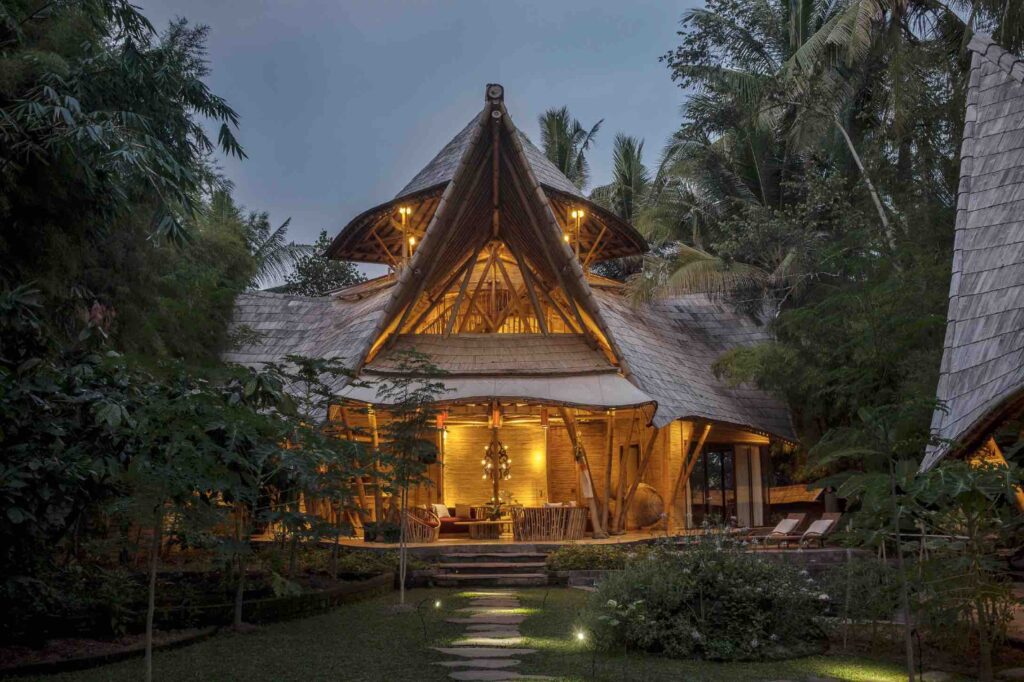
River House – my first home in Bali
The oversized teardrop door was indeed a portal. Like temple doorways, the bottom of the door sat above the floor, causing all who entered to automatically look down and bow as they walked through. Standing on that threshold for the first time, my belly rolled with a mix of anticipation and excitement. I was stepping across a mysterious threshold. I had chosen to walk away from my known world and was entering the unknown. What I couldn’t have known in my mind, but somehow knew in my body, was that this was a one-way portal, and there would be no going back.
My husband, Peter, and I built River House in a place called Green Village in 2009, not long after the opening of a school that would become integral to our lives, Green School. The warm-hearted smiles and vibrant colours of Bali were the perfect antidote to the safety of the shiny, alcohol-fuelled, fast-paced expatriate life we had been living in Singapore for ten years. I’d been researching alternative education, so I was curious to visit Green School, a pioneering school made of bamboo, in the middle of a jungle, never dreaming we’d ever live there. The school’s founder, a brilliantly creative, eccentric Canadian visionary named John Hardy, gave us a tour and he and Peter instantly imprinted on each other as if they’d been brothers in a past life, such was the impact of John’s charisma and Peter’s charm.
I was stepping across a mysterious threshold.
John shared with us his dream for Green Village, designed for families of Green School, and took us on a tour of the site. Green Village was at the far end of ‘Dancing Road’, named after the way the car shook you from tip to toe as it bumped through the corrugated dirt and potholes. Just when we thought we’d been shaken undone, the car stopped and we were led along tight, muddy paths pushing through thick rainforest, passing by coconut groves and tiny, neat, attap-roofed houses, before finally reaching a clearing
deep in the jungle. ‘There’s the path to the school.’ John pointed to a tiny dirt track. ‘Only ten minutes’ walk.’
The site office, an open-air space with a dirt floor shaded by a palm frond roof, was on the top of an escarpment, 50 metres above the raging Ayung River. A huddle of beautiful young people, with golden-brown limbs and dewy skin, chatted in an alluring blend of accents – South American, Italian, Balinese. Deep in their work, they didn’t notice us arrive. They were architects and designers, all in their 20s and 30s, leaning close over models and drawings, talking over one another, pausing, erupting into laughter.
We were introduced to Carolina from Colombia, Paolo from Italy, Komang from Bali, and Elora, John’s daughter, who’d just arrived
from New York. John and Elora showed us models of bamboo palaces with soaring ceilings and sinuous walls. Their grand, imaginative plans of structures so far beyond our normal idea of houses were shown in miniature replicas. Their vision of a residential community, walking distance from the school, seemed like an adventurous utopian tale
come to life. The possibility of living in a community of global adventurers, in a house with no walls nestled among swaying palm trees burst open the boundaries of our reality and ultimately proved impossible to resist.
The warm-hearted smiles and vibrant colours of Bali were the perfect antidote to the safety of the shiny, alcohol-fuelled, fast-paced expatriate life we had been living.
At that first meeting in the jungle we had no plans to enrol our son Billy at the school, and no desire to live in Bali, but we were curious. Green School and Green Village were inspired in part by visionary educator Alan Wagstaff’s ‘Three Springs’ design, with education, enterprise and society interconnected in a holistic village-school at its centre. The more we found out, the more we were intrigued. Entranced by this place, more a mirage than a reality at that stage, we drank the Kool-Aid in big thirsty gulps, sensing that
we were participating in the creation of a new world full of wonder.
At first, we built River House and visited as often as we could, while still living in Singapore and then Sydney. Five years later, Peter, Billy and I arrived for a more extended stay, not knowing how long we’d be there. Our daughter, Shannon, had already graduated from high school, Peter had recently retired and we were open to
new adventures.
Bali, we discovered, is not a place you simply decide to move to. Bali is a place that takes you – or not. It swallows you, marinate you in the spicy juices of its swirling belly, and either births you anew or spits you back out, a little worse for wear. People arrive from their normal worlds, but inside the belly of Mama Bali they become someone new.
Behind the curtain of monsoon rains, with the backdrop of gamelan and ceremony, anything can happen, and
often does.
As Billy flourished, attuning to life in our bamboo house became an unfolding revelation for me. Before moving to Bali, I’ had decades of therapy and had been taking antidepressants for 10 years. There was nothing especially wrong with me, other than the usual underlying anxiety and sadness that tends to settle in by midlife, in what Henry David Thoreau described in Walden as our ‘lives of quiet desperation’. But after a few months in Bali I was aware that things were shifting deep within me, just as they were for my son.
Bali swallows you, marinates you in the spicy juices of its swirling belly.
One day I noticed a beautiful purple vine, bunga telang, growing just out of reach of the kitchen bench. It had been there all along, but I hadn’t seen it. Each day revealed details I hadn’t noticed the day before. At first everything about the house was so unfamiliar that I needed to focus, to register the word ‘tap’ when I reached for the black stone sitting on the bench. The stone did indeed turn the water on and off, and when slightly pressed to the left or right gave hot and cold water. I constantly bumped into the sofa and dining table, and stubbed my toes on chair legs, as if my mind just couldn’t calibrate to furniture that was curved and organic in form, as if I half expected them to move as I approached, like strangers in a crowded room.
The sound of the white-water river never ceased. At first it was an unnerving backdrop of constant motion. At night, when all other sounds of life subsided, the roar was terrifying and I was afraid it would swell to take us and the house like a raft to the waterfalls.
Sometime later, I noticed that the sound of the water had become a comfort, like an ever-present beloved pet, always by your side, always on the periphery of your senses.
As the fixed shapes of the house became embedded within me, I began to notice the sounds and motion of the bamboo structure as it swayed and creaked. I found a rhythm, like a pulse, in the waves of moving shadows and lights, the flutter of palm leaves, the graceful hands of the women who came to bless our villa’s temple every morning, the occasional thud of a coconut dropping, the calls to prayer and gamelan tunes wafting over from the village temple across the river. This house was alive: it moved, breathed, changed moods and heaved in the monsoonal storms. As the details of the house seeped into me, my experience of what a house could be expanded – as did my awareness of who I was and what my life could be.
After a few months in Bali I was aware that things were shifting deep within me.
It was always hot, I was always sweating, but I quickly got used to the dampness, the glow. Always surrounded by the unfamiliar, I got used to that too. I became attuned, stimulated and agile.
There was no autopilot, no resting in mind-numbing routine. I was always ‘on’.
Life at Green School and Green Village was wild, and it was a place like nowhere else I’d ever encountered. It felt risky, edgy and cool. Aspects of my own personality that had lain dormant for decades began to reappear. For the first time in years I felt the urge to write every day, and the need for daily jungle walks reminded me of power
I’d once found running. In Bali, all that had once seemed rigid and permanent to me became fluid and flexible once more. The trappings of life began to peel away; a simple roof over our heads, enough food to eat and being part of a creative community was enough.
For six months I threw myself into the strategic review for Green School. As a community we interrogated our values, processes and structures until we crystallised a way forward. Along the way I interrogated my own life and unravelled. I was no longer sure of anything, my beliefs scrambled, my worldview crumbled. I could no longer be seduced by consumerism. My faith in science and the supremacy of the rational mind wobbled. My belief in the wisdom of nature expanded. The joy of being part of a creative international community grew and my sense of self dissolved. In the process of undoing the ‘me’ who I was, it seemed everything that I’d built my idea of self upon was called into question and had to earn its place again, or else was rejected. Caterpillars, I was once a little repulsed to learn, dissolve into a kind of soup inside their chrysalis. As earthbound creatures, they carry a blueprint, in the form of DNA within what are poetically named ‘imaginal cells’, which eventually expresses their winged incarnation. At first the imaginal cells operate individually, fighting to survive the attacks of the caterpillar’s own immune system, which sees them as foreign bodies. Eventually, as the caterpillar is reduced to sludge, the surviving imaginal cells begin to resonate at the same frequency, and they cluster, cooperate and eventually come together to become the butterfly. As it forms, the butterfly is nourished by the soupy remnants of the caterpillar.
I became attuned, stimulated and agile. There was no autopilot, no resting in mindnumbing routine. I was always ‘on’.
While I was undergoing my own small, private metamorphosis, I too became a soupy mess of dissolution, and the imaginal cells of my soul and psyche kicked in, like a secret blueprint unfolding. I began searching for frameworks that could help me to rebuild my belief system. Like the emerging butterfly, I drew strength from the surviving remnants of my past. I wanted to redesign my life and I needed a design system that rang true to the very core of my being.
In Bali the threads of my life came together, circling back to my childhood home, lutruwita/Tasmania. It was there, on the most southern point of Australia, that two environmental scientists, Bill Mollison and David Holmgren, identified the principles they observed in thriving natural ecosystems. By observing patterns, they devised guiding principles to design thriving agricultural ecosystems that emulate the natural world. Agriculture, at that stage, was generally based on subduing and controlling nature,
but Mollison and Holmgren had the brilliant idea to decode the way natural ecosystems work by aligning with nature’s energy and intelligence just as indigenous cultures have always done.
The imaginal cells of my soul and psyche kicked in, like a secret blueprint unfolding.
Permaculture, the design system they devised, works in harmony with nature, rather than against it.
Permaculture had been on the periphery of my life for years. Both Peter and my mother were ‘permies’ who grew food in alignment with permaculture principles and ethics. Our beautiful permaculture farm, nestled into an escarpment, backed by rainforest and overlooking the ocean, had been our Australian home for 25 years. A piece of heaven on Earth. While Peter and I were global nomads following his career as a CEO, the farm was a joy we came home to every year. So it made perfect sense to Peter, when we arrived in Bali, to invest in a start-up permaculture farm next to Green School – The Kul Kul Farm.
Orin and Maria Hardy, who designed The Kul Kul Farm, were intelligent, creative, passionate and joyful, and their interest in permaculture was infectious. I became more curious. Penny Livingston-Stark, a permaculture elder from the US, came to The Kul Kul Farm to teach herbal medicine based on the Hermetic tradition of alchemy. She stayed with us at Green Village, and we enjoyed many late-night conversations about permaculture from both a philosophical and practical point of view. I was spellbound
by her wisdom.
Permaculture grew to become Australia’s number-one intellectual export. Having emerged from the milieu of social change in the 1960s and 1970s, it offered a path to sustainable agriculture, based on the patterns and behaviours in natural ecosystems, and the practices of ancient cultures. As I dug deeper,
I learned that permaculture is now being applied to many human systems including agriculture, horticulture, ecology, economy, legal, financial, business, social, cultural and community systems design. Permaculture, it seemed, was more than compost, worms and herb spirals.
I was enthused by the possibility that I could apply the same code of permaculture principles to redesign my own life. And so it was, that while in my chrysalis phase in Bali, I picked up David Holmgren’s book Permaculture: Principles & Pathways Beyond Sustainability (2002) and had an almost religious experience. I knew I’d found a place where I could rest my weary mind.
Orin and Maria Hardy, who designed The Kul Kul Farm, were intelligent, creative, passionate and joyful, and their interest in permaculture was infectious.
**********
 ABOUT THE AUTHOR
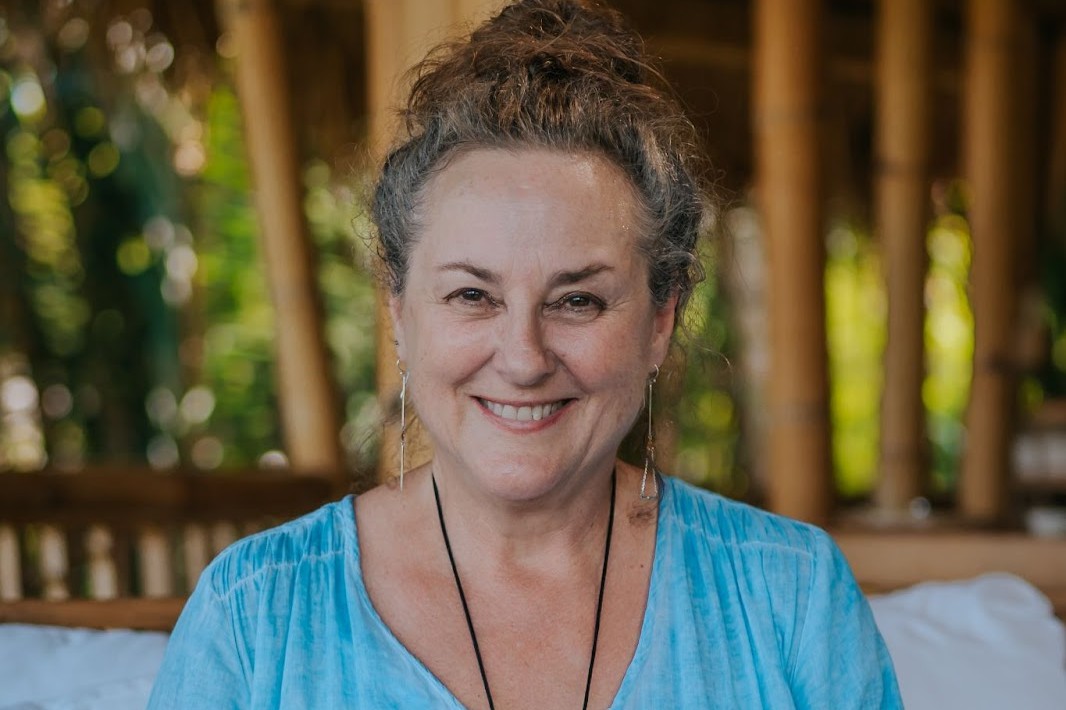 ABOUT THE AUTHOR
Kinchem Hegedus is an Australian author, creativity coach, facilitator, and ecosystems thinker whose work bridges regenerative design, nature-based creativity, and storytelling. She is the Founder of Life at Springfield, a creative retreat space where she has hosted residencies for some of Australia’s most acclaimed authors in partnership with The Stella Prize.
Previously based in Bali, Kinchem pioneered Inner Landscaping for the Green School community in 2015. Her professional background spans venture capital, banking, education, and wellness, with international experience in New York, Chicago, Sydney, Singapore, and Indonesia. She holds an MFA in Fiction Writing, a Graduate Diploma in Permaculture Design, and a BA in Philosophy.


0 Comments