



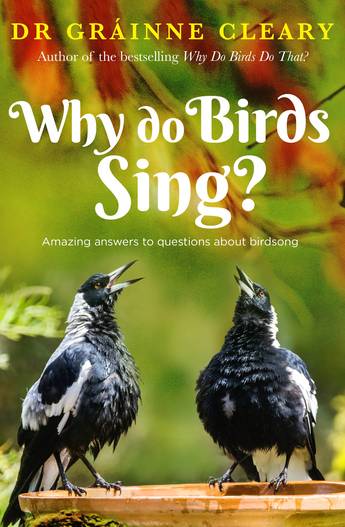
While the question ‘why do birds sing?’ might seem a simple one, the answer is complex!
Throughout our history birdsong has influenced art, poetry and music. It can elevate our mood and bring our backyards to life. We often hear birds singing as we go about our lives, but have you ever wondered who they are singing to and what they are singing about?
The term ‘bird brain’ has led us to underestimate the brainpower it takes to hear a song, remember it and practise until it is reproduced correctly. In the same way human infants learn to talk, young birds learn their song by listening and remembering the sounds produced by their parents. Not only that, birds use different songs and calls, and different pitch, tone and volume, depending on who they’re communicating with and what they want to say—much like the way we vary our speech.
Why Do Birds Sing? provides an insight into the world of bird communication that will surprise and delight you. It’s an absorbing and informative book filled with answers to many of the common and often uncommon questions we ask about birdsong.
After reading this book you will never listen to a bird song in the same way!
**********
EXTRACT
Why do birds sing to themselves?
Have you ever heard the low warbles of a single Australian magpie and wondered who it might be singing to? Would you be surprised to find it is singing to itself? Singing outside a breeding context, attracting a mate or defending a territory has been found to be a common form of vocal play shown in an estimated 4500+ species of songbirds. This makes sense, as songs are learned and need to be practised to maintain them. When a bird is prevented from practising or is unable to, the song’s structure starts to degrade.1 However, birds don’t seem to mind practising, as they do it willing without any obvious positive reinforce- ment. There is no immediate reward to practising; instead, singing is encouraged by the release of dopamine. In this way, dopamine acts as an intrinsic reward mechanism.1 Singing to themselves is tightly linked to a positive mood state. Just as in us, a bird singing by itself is a happy bird!
Directed song is the singing a bird does to another individual, while undirected song is sung when the bird is alone. However, the song a male bird sings when practising is not the same song it will sing in the presence of females. For example, in Bengalese finches the male typically reduces variability in its song when a female is present. This is because females are known to have a preference for song that is more stereotypical and has less vari- ability from one version to the next. But it is more fun to sing a song with more variability, especially when learning new phrases, as this helps with learning and reinforcement of the song. Just like in humans, variability when training our voices can lead to more efficient learning and performance.
In zebra finches, males have been found not only to change the quality of their song in response to females, but also how it is sung. They will sing faster and produce a more stereotyped repeated song than when they sing alone. For example, males make subtle changes to the length, tempo and variability of their song when singing to females compared to when they are practising. It has been proposed that variable undirected song represents a relaxed state in which the bird can explore different motor patterns, increasing its flexibility and learning. This is in contrast with the stereotyped directed song to a female that reflects performance. The female is listening, and the male is singing to her.
A study by Sarah Woolley and Allison Doupe from the University of California, San Francisco, tested for song preference in two groups of female zebra finches: mated and socially naive females.2 The study revealed that female zebra finches showed a significant preference for directed song over undirected song – even the socially naive females that had not mated before. This was despite the relatively subtle vocal differences between directed and undirected song. Female zebra finches’ choices were affected by the variability of note pitch: they showed a strong preference for less variability in pitch. Interestingly, the strength of the preference was influenced by how familiar they were with the song. When presented with songs from multiple males, the mated females showed the strongest responses to the directed song of their mate.
In juvenile songbirds, it is speculated that a certain degree of variation enables vocal learning. Similar to infants, young songbirds explore a range of vocal gestures to train themselves to produce their song. Similarly, in adult songbirds – and even in humans – variability appears fundamental for both song learning and maintenance. It allows the training of optimal motor patterns that are able to produce the sounds that match the memory of the bird’s own song. Hence, in a way, ‘variation begets fidelity’. The ability to introduce variation allows for innovation, which leads to increased song complexity.10 In this way, song practice can be considered a rewarding form of play behaviour for a songbird.
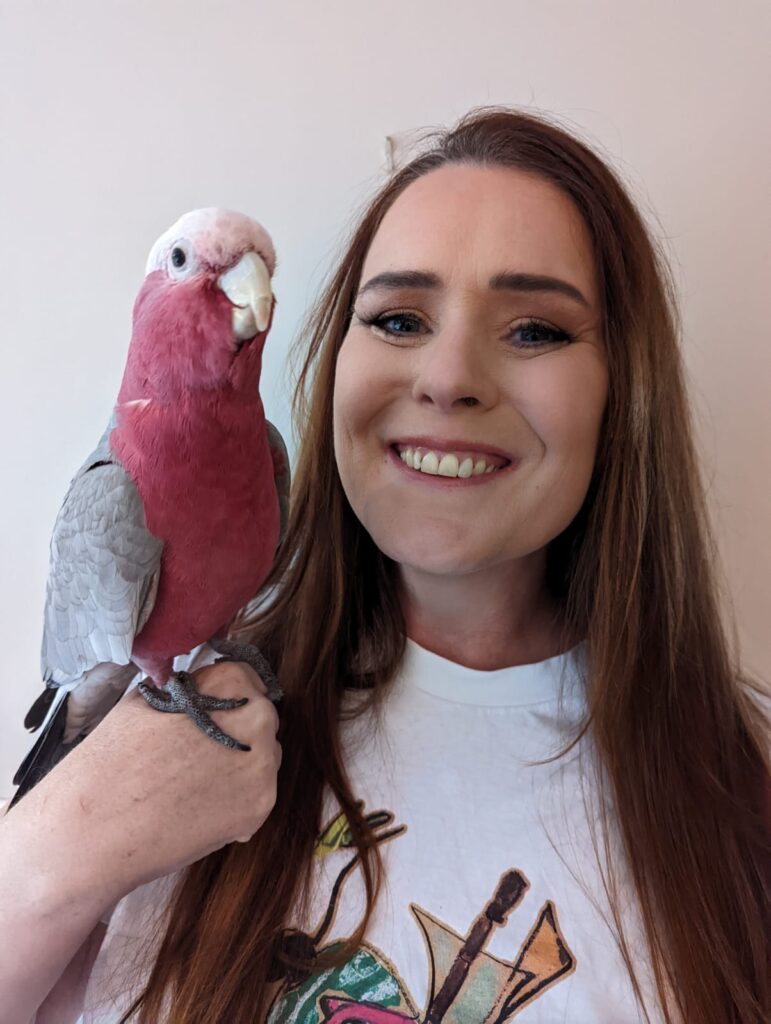
ABOUT THE AUTHOR
Gráinne was born with a passion and a curiosity for the natural world. In 2008 after graduating with a PhD from Trinity College Dublin, Gráinne moved to Australia where she immediately fell in love with the wildlife. Throughout her career, Gráinne has worked in universities and conservation bodies in both Europe and Australia.
Her research is focused on engaging with the public through citizen science to gain the best outcomes for urban birds. Gráinne is a frequent contributor on both national and regional radio where she discusses bird-related news. She is also a regular on the Channel Seven morning show Sunrise.
Gráinne believes our behaviour can have a huge influence on urban birds and how they can use our gardens as a refuge in otherwise inhospitable environment. Following the release of her bestselling book Why Do Birds Do That? Gráinne was inspired to write Why Do Birds Sing? due to the public fascination with this question.


0 Comments