


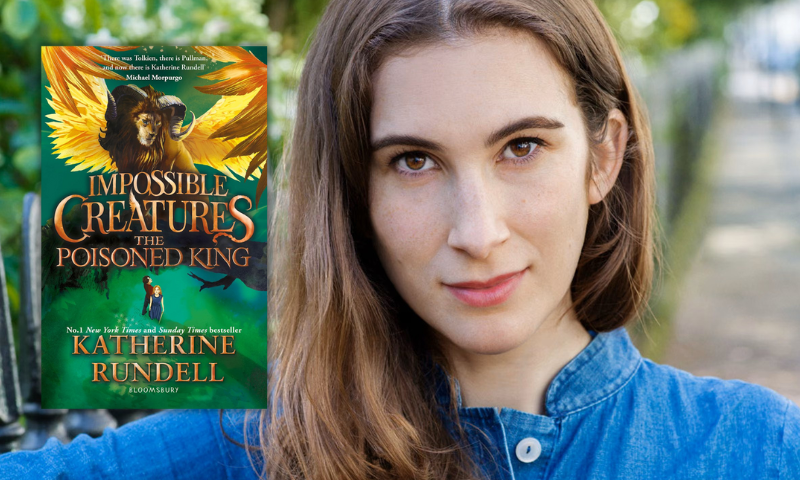
The Poisoned King is the dazzling second book in KATHERINE RUNDELL’s epic and bestselling ‘Impossible Creatures’ series. Read on for a Q&A with the author.
The Poisoned King is the second book in your ‘Impossible Creatures’ series. What’s new for Christopher in this book?
Christopher has been longing for the Glimouria Archipelago, so the chance to return is a great thrill to him. In this book he meets a girl, Anya Argen, whose father has been framed for murder: she is set on justice, and revenge. You could read The Poisoned King without reading the first book, if you wanted to, as it’s its own story, but children who have read the first book will recognise a lot of familiar faces.
What can you tell us about the dragons in your story?
We discover in the first chapter that the ancient dragons are dying, though nobody knows how or why (dragons are, understandably, not a population that many doctors are eager to attend). Christopher is summoned back to the Archipelago to save them.
Did you draw from any mythology to create the world in your story?
Yes! The book is inspired by our ancient stories of dragon hoarding gold: one of my favourites is the Norse Fafnir, who is a worm-dragon, and the Germanic oral legends stretching back as far as the fifth century. And it’s based very loosely on Hamlet: although with more bloodthirsty manticores than Shakespeare’s version.
What was your favourite part of writing this book?
I loved returning to the character of Jacques – the tiny jaculus dragon, small enough to fit on your thumb, who you find in Pliny’s Natural Histories from 70AD. He is frequently irate, which is a joy to write.
What new mythical creatures will readers meet in this book? And do you have any favourites?
I loved writing the gaganas; birds with copper claws and iron beaks, found in Slavic folklore. In my version, the Royal Gaganas has golden beaks and claws of silver. Anya is caring for a newborn gagana chick, freshly-hatched, who sits on her shoulder and tries to nest in her hair.
What do you love about the fantasy genre? And are there any authors or books you draw inspiration from?
I love the fantasy allows children to explore huge ideas in ways that make sense to them, and that offer them both meaning and adventure. Fantasy is, I think, philosophy’s more gorgeously painted cousin. There are so many fantasy writers I adore: Philip Pullman, Diana Wynne Jones, Tolkien, and the older texts, too: the Morte D’Arthur and the Fairy Queen. Most of all, I think, Narnia lit my childhood: I hope to offer children a similar sense of wild delight and immersion in a new world.
WATCH A VIDEO
ABOUT THE AUTHOR
 Katherine Rundell is a multi-million-bestselling author whose novels for children have won the Waterstones Children’s Book Prize, the Blue Peter Book Award and the Costa Children’s Book Award, among many others. Impossible Creatures was Waterstones Book of the Year 2023, and in 2024 Katherine was named the British Book Awards Author of the Year and Impossible Creatures won the Children’s Fiction Book of the Year. She is a Quondam Fellow of All Souls College and a Fellow of St Catherine’s College, Oxford, where she works on Renaissance literature. Her books for adults include Super-Infinite, winner of the Baillie Gifford Prize. Very occasionally she goes climbing across the rooftops of Oxford, late at night.


0 Comments