


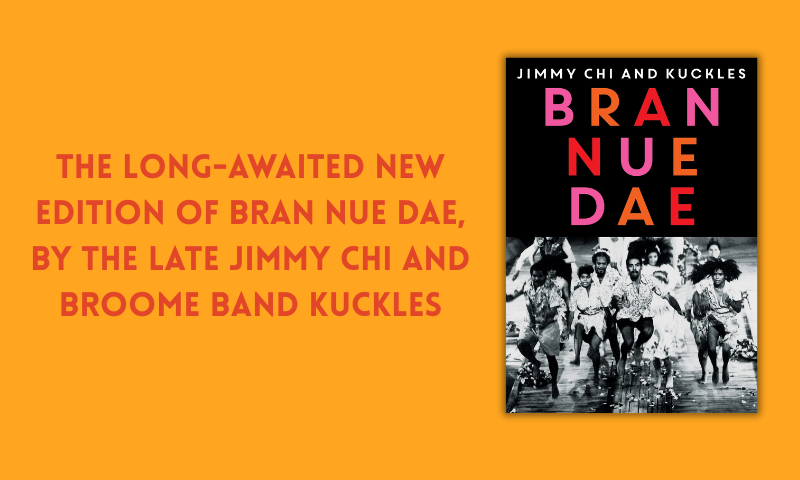
Read an extract from the long-awaited new edition of Bran Nue Dae, the script and musical score of the trail-blazing musical written by the late JIMMY CHI and musicians from the Broome band, KUCKLES.
ABOUT THE BOOK
 This new edition of the script and score from Broome’s trail-blazing musical Bran Nue Dae, written by the late Jimmy Chi and musicians from the Broome band, Kuckles, breaths new life into the Magabala classic.
Bran Nue Dae took Australia by storm when it premiered at the Perth International Arts Festival in 1990 — national tours followed. It won the prestigious Sidney Myer Performing Arts Award and was highly commended in the Human Rights awards the same year. In 1991, the book won the Special Award in the WA Premier’s Book Awards. A film adaptation with Jessica Mauboy, Erine Dingo and Missy Higgins was released in 2009. Set in the 1960s – the era of assimilation, the Vietnam war, Land Rights, the White Australia policy and the 1967 Referendum – it is a partly autobiographical story, one shared by many of Chi’s era.
Homesick Willy is expelled from his Catholic boarding school in Perth and embarks on the long road-trip home to Broome and Djarindjin, with a crew of irreverent, larger-than-life characters. He is in search of identity, love and belonging. On the surface a simple story, Bran Nue Dae explores darker truths of the era from an Aboriginal perspective. As Jimmy Chi once said, ‘The naked truth is ugly, but when he’s dressed in the fine clothes of the parable, then he becomes acceptable.
EXTRACT
Introduction
Welcome to the world of Bran Nue Dae. The setting is Sun Pictures in Broome, a site of the sacred and profane, where they’ve been showing movies for over 80 years – and where, they say, most of the town’s love stories began. Some things never change. Or is it as another song says: ‘The world keeps on turning and will never be the same?’
This is a story of how someone found his uncle and a whole lot more besides. Since white settlement of the country, Australians have looked on while bureaucracy ripped, religioned, cajoled and legislated Black children away from their families, mothers from their children, fathers from their roles. This was called ‘assimilation’. If it had succeeded a culture would be extinct, and a unique identity lost. Of course it did not succeed, and not just because the policy was a half-baked shambles from the start, a bureaucrat’s persistent dream, a blind nation’s backdoor nightmare. Assimilation could never have succeeded, and this musical tells us why. Australia has a Black soul.
Fifteen years ago, give or take, the idea of a musical about a journey to consciousness was born in a young man’s brain, but so were a million ideas in just as many brains. This idea lived because the young man in question had taken a walloping from his experiences of dislocation and imposed aspirations. He also grew up through the 1960s, which may have had something to do with it. Jimmy Chi was not an exceptional musician. He was self-taught, which in his crowd was usual. In a town of songwriters, he had a special gift for melody and spellbinding performance. At parties he would sing a piece, sometimes sitting on the grass, ‘Is You Mah Baby?’ and he would shake, and rattle, and roll the intellect — no one could sing it like him and the word virtuoso came to mind. The idea had begun to take shape in songs.
These songs were first performed by Kuckles, the Broome band that composed them in the way groups do: for gigs in bars and parties, at early morning beaches and on the road. Kuckles was a kind of rambunctious nursery, five men making music without thinking that one day the world might hear their work as a spiritual/ rock/reggae opera. That destiny is now cast, and what unfolds may give us cause to wonder. Critics will make their judgement of this play, with its sparkling lines, rich music and the orbital engine of its plot, but we can say now: it is a landmark work. As theatre director Brian Syron pointed out after the early trial of a few scenes in Sydney: ‘The people need this.’
Kuckles was a band defying the odds. Broome is such a long way from anywhere that it might as well be nowhere, which is perhaps a good starting point for surprises. But far though it may be, the old pearling port has a musical tradition as potent as the brews and as heady as the brawls of its past, with country music as deliciously present in parody – ‘Time Will Heal’ – as in comedy – ‘Seeds That You Might Sow’ – as well as in gospel, soul, torch, spoof, satire and passion. It is the music of a four-generation subculture that had a language and fun all its own: weekend fishing, a verandah, a guitar that had first to be mastered – lessons with a record scratched by repetition and a spinifex needle – an evening stroll or making love, not always with official blessing, or a visit to Sun Pictures and a seat in a segregated audience.
The old cinema with its ageing screen is still there. Solid, they say of this building. Just as well, for something cyclonic hit out of season, in September 1990, when volunteer carpenters and donated front-end loaders descended to make a jetty stage and tidal pools where the front row of canvas seats had once wriggled to impatient bottoms. With scaffold seating erected to accommodate a week of sellout houses, Bran Nue Dae played to its home town. ‘Yeah, I’m a man now,’ says Willie, in jail – and he is a Royal Commission in five words. They wept, laughed and anticipated lines, the songs scored in their own hearts. A thrilled audience stood to applaud, whistle and sing, night after night. But there is more to this story.
In 1986 the musical was still just an idea and a few songs. Enter the Aboriginal Writers, Oral Literature and Dramatists Association (AWOLDA). They put the idea through a staging workshop in Perth, where playright and poet Jack Davis gave advice. Jimmy Chi returned to Broome encouraged, but it was Marita Darcy who drove the tardy genius to get his musical down. The result of their interaction was a first draft. Some scenes were still in outline and the structure was picaresque but it suggested a powerful drama – and it was written. Magabala Books had been recently started in Broome. Just in time, you might say. The brave new Aboriginal publishing house was on hand to prepare a bright new work for presentation to theatre producers.
The interest that followed was not overwhelming but it was stimulating enough to keep Bran Nue Dae on course. This nurture at arm’s length came happily from Robyn Kershaw and then Duncan Ord of Perth’s Black Swan Theatre Company and Tasmania’s Salamanca Theatre, and closer up with a solid embrace from the Aboriginal National Theatre Trust (ANTT), which flew Jimmy Chi to Sydney in January 1989 to workshop some scenes and songs, with help from the Aboriginal Arts Board of the Australia Council.
Kuckles’ manager Peter Strain found finance for further development, script editing and music transcription. The work was becoming known. Some realised that a theatrical coup was waiting for a company daring enough to show faith. Philip Parsons of Currency Press has watched over the birth of more Australian theatre than there are wharves to Sydney Harbour. On reading the text, listening to the demo tapes and hearing Chi himself delivering those pungent lines of dialogue, he was moved. ‘This is it. The Australian musical we’ve all been waiting for. It has everything, it must be done.’
Back home, they needed no convincing. Having grown up with Chi, they knew this to be an enterprise of great pith and moment. They formed a working group led by Peter Yu, created Bran Nue Dae Productions, and appointed Chris McGuigan executive producer. He and Yu approached Andrew Ross to direct, impressed by his sensitive work on the plays of Jack Davis. The Black Swan Theatre Company had agreed to put on the show.
The redrafted script was handed to Ross on a sunny day in Melbourne, which had to be propitious. With it came a challenging task. Bran Nue Dae would premiere at the Festival of Perth in February 1990. It would have six weeks to prepare in Broome, using a cast mainly of local actors but with professionals brought in for the leading roles. There would be just two weeks further rehearsal in Perth before the opening at the Octagon Theatre. Ross arrived in Broome having already devised vital changes to make the script work on stage. Scenes were simplified, dialogue woven through songs. In the sweat of tropical January heat, in an unlined iron shed in Broome, helped by buckets of iced water and inspiring sunsets, thirteen actors, director Ross and choreographer Michael Leslie put it all together, with those Kuckles musicians once again. The show was the hit of the festival. It went on to a second production, and after singing and dancing its way through the north-west, toured interstate with mounting success. One of those eleven first tour venues was the school lawn at Kalumburu. Flying by five light planes over the awesome Mitchell Plateau to the furthest of places, Bran Nue Dae returned to its roots in an Aboriginal community, playing to an audience on the grass, from a stage marked by a ring of flour. A self-raising musical, or miracle.
So much for beginnings. Bran Nue Dae is made to travel. It has healing, happy and zestful work to do. It is a suitcase stuffed with magnificent songs. It is a love letter, like Little Abby’s, to a wiser present; a musical that will continue to win over audiences long after recession, athletic interest rates, AIDS and ozone holes are, we hope, consigned to a past century. I can’t think of a better anthem to take us into the next than ‘Child of Glory’ or ‘Everybody Looking for Kuckle’, ‘Sweet Sister’ or ‘Listen to the News’, ‘Marijuana Annie’ or the title song itself. They will be singing these songs on their way to liberation in South Africa, they will sing them for warmth in Russian winters and with astounded recognition in Berlin. Even Nue Yorkers will feel that way again. World, welcome to Bran Nue Dae.
Peter Bibby, Broome, 1991
ABOUT THE AUTHORS
Jimmy Chi was born in Broome in 1948 to a father of Chinese and Japanese descent. His mother was the daughter of a Bard woman from the Dampier peninsula and a Scottish station manager. Jimmy was a composer, musician and playwright. He and his colleagues won numerous awards for Bran Nue Dae, including the Sidney Myer Performing Arts Award, and a Certificate of Commendation in the 1991 Human Rights Awards. Jimmy Chi pass away in 2017.
The band Kuckles (Broome Kriol for cockles) was formed in the early 1980s when Broome musicians Jimmy Chi, Stephen Pigram, Michael Mavromatis (Manolis), Garry Gower and Patrick Bin Amat were students at the Centre for Aboriginal Studies in Music (CASM) in Adelaide. ‘Milliya Rummara’, their best known recording, means ‘brand new day’ in the Yawuru language. Kuckles made an indelible mark on Australian music; its legacy lives on and original band members performed in the 2020 production of Bran Nue Dae.


0 Comments