


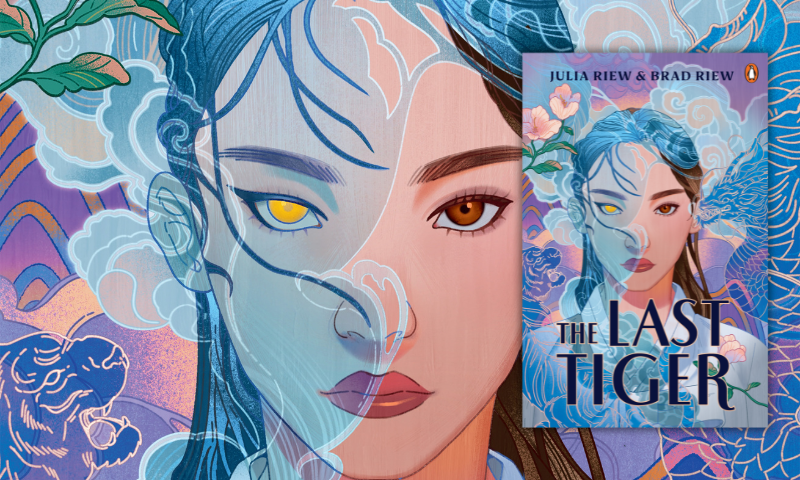
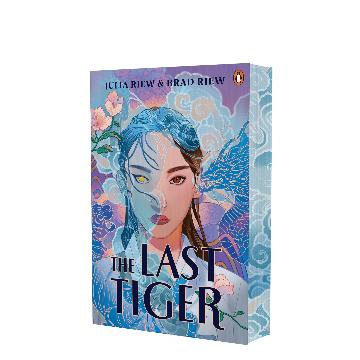
JULIA and BRAD RIEW’s debut fantasy novel, The Last Tiger, is inspired by their grandparents’ lives during one of the darkest periods in Korean history. Read on for a Q&A with the authors.
What can you tell us about the inspiration behind The Last Tiger?
Our grandparents lived during some of the darkest and most turbulent times in Korean history, but through it all, they managed to have this incredibly cinematic, beautiful forbidden romance. We grew up hearing about their lives from before they immigrated to America – the countless struggles they experienced, including colonization, war, hunger, etc… at one point, both of our grandparents took the time to write down some of their experiences. Grandpa wrote in one email, ‘Can you make up a fictional version, based on what I’ve written up to this point?’ and so we always knew that we wanted to do something special with their stories.
Inspired by the story of how their love overcame colonisation, class differences, distance, and time, we were moved to write The Last Tiger, a romantic fantasy YA novel set in a magical world inspired by our grandparents’ youth. The story is about star-crossed teens, Seung and Eunji, who come from opposite worlds, yet are both trapped within their respective fates as citizens of the colonised Tiger Colonies. Part I begins in our heroes’ small hometown, Kidoh – but as we enter Parts II and III, their worlds expand … what starts off as a quiet, two-person rebellion grows into a full scale revolution against the oppressive Dragon Empire.
How much of your grandparents’ real-life story made it into the novel?
Although this book is a work of fiction, there are many details that are directly inspired by our grandparents’ actual love story. Our grandma came from a wealthy family, our grandpa was poor, so to be together they would sneak out at night, meeting at the old abandoned palace – our grandpa really did join an underground movement against the Japanese Empire – and our grandma really was put under house arrest for months after refusing to marry the boy her parents had chosen for her.
Of course, there’s a lot of material in the book that we’ve altered or invented, too, for dramatic purposes.
Why did you choose to incorporate fantasy elements into this story rather than keeping it purely historical fiction?
We believe that fantasy as a genre can also be a wonderful way to tell emotional truths in an even more vivid manner than real life. In our novel, magic serves as a fun and accessible way to tell deeper stories about suffering, oppression, love, and freedom. It’s a way to mix whimsy with politics, emotion, and spirituality, to make entertainment and education two sides of the same coin, and to engage young readers, hoping to stimulate their own opinions and ideas about human nature outside the context of the world as we think we know it. Additionally, as Korean-American authors who belong to a global diaspora, writing in the fantasy genre gives us the liberty to invent places and people who truly resonate with us culturally; room to build worlds that may not yet exist in our reality, where we can mix elements of Korean and American sensibilities. Although our story is rooted in a Korean past, it’s meant to speak to young people like ourselves, growing up in a global yet fragmented world.
What was it like writing a novel together? And what was the collaboration process like?
On Mother’s Day, 2021, Brad and I were eating at the dinner table, and I turned to him and said, ‘What if we wrote a YA Fantasy novel inspired by Grandma and Grandpa’s stories?’ and he said, ‘Sure,’ and then a few hours later, we’d devised an entire magic system, a notebook full of character names, and a full outline of the book.
In terms of the actual writing, Brad and I tried a bunch of different methods of working together. Being sibling authors is really great for a few reasons. Firstly, we have this shared family history, and we also grew up watching/reading a lot of the same materials, so we have a built-in shorthand for creative discussions. Also, there’s no ego or need to sugar-coat or be delicate with sharing opinions and feedback. We could be very honest with each other. Eventually, we landed on a system where we each split up and took the sections that we were most excited about writing – wrote a messy, drafty version – then we’d swap, and Brad would go over the draft that I had written, and vice-versa. Brad enjoys crafting descriptive text and has more of an interest in history and spirituality, while I, as a playwright, enjoy the process of laying down action and dialogue. As you read the book, you can try to guess who wrote what, but ultimately, we both ended up working in every sentence of the book.
What was the most rewarding or challenging part of writing this novel?
We started writing this story in 2021, and both of our lives underwent a lot of changes since then – in the fall, I went back to school to finish up my senior year of college, and then I was moving to New York City and navigating big developments in my writing and composing career. Brad was diagnosed with ME/CFS (chronic fatigue) after he developed Long Covid, and that was a big challenge for our writing process as well.
We also spent a lot of time figuring out how to spin a lifetime of stories into one digestible fantasy novel … we ended up completely rewriting the book around four times before we landed on the current structure!
Would you collaborate again on a future novel? If so, would you stay in fantasy or try a different genre?
We’re currently working on our next novel, which is a YA comedy-sci-fi!
What do you hope young readers take away from The Last Tiger?
We know young people are growing up today in a world that’s full of challenges. A world that feels like it’s broken in so many ways. And it can be easy to feel lost, or confused in that world, to not know where to look to find hope. Our message is that we’re not alone in facing difficult times – the biggest thing we hope young people can take away from our story is that we can look to our heritage, and remember that our ancestors not only survived some of the darkest times in history, they found the love in their hearts, and the strength, to carry them through. To build something beautiful and different on the other side of suffering. Even in the darkest of nights, you can still see the stars. So we want young people to feel that if our grandparents could meet their moment, then maybe we can meet ours. Our wish is for The Last Tiger to be a source of hope for young people, and hopefully even to inspire others to learn more about their own ancestors’ stories.
READ AN EXTRACT FROM THE LAST TIGER
ABOUT THE AUTHOR
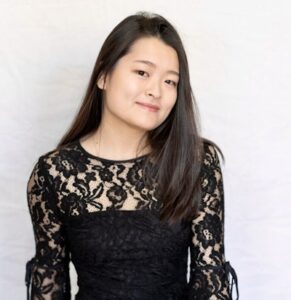 Julia Riew is a Korean-American composer-lyricist, librettist, and novelist from St. Louis and NYC. She is best known for her viral hit Dive, a reimagining of the Korean folktale ‘Shimcheong’, which has captivated millions online and is currently being developed for the stage at the American Repertory Theater with Tony-Award winning director Diane Paulus and GLAAD-Award winning playwright Diana Son.
Julia also wrote the book, music, and lyrics for the new original musical ENDLESS (dir. by Zi Alikhan, Seoul, 2026), which features an expansive, celestial mythological universe and a cinematic pop score. Julia’s literary work includes upcoming YA fantasy novel The Last Tiger (Penguin Random House, 2025), as well as MG fantasy novel Shim Jung Takes the Dive (HarperCollins, 2026). Other upcoming projects include a YA sci-fi comedy thriller novel, and two more musicals slated for development in Korea.
In addition to being the 18th Annual Fred Ebb Award winner, Julia has been Playbill’s Featured Songwriter of the Month, a Woman to Watch on Broadway, a Princess Grace Award Honoraria recipient, and the recipient of the Harvardwood Artist Launch Fellowship.
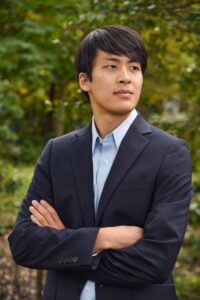 Brad Riew is an MFA candidate in Fiction at New York University’s creative writing program. He graduated from Harvard College in 2018 with a degree in Psychology, where he won the Ecker Short Story Prize. The Last Tiger, co-written with his younger sister Julia Riew, is his first novel. Brad lives in Brooklyn, New York.

0 Comments