


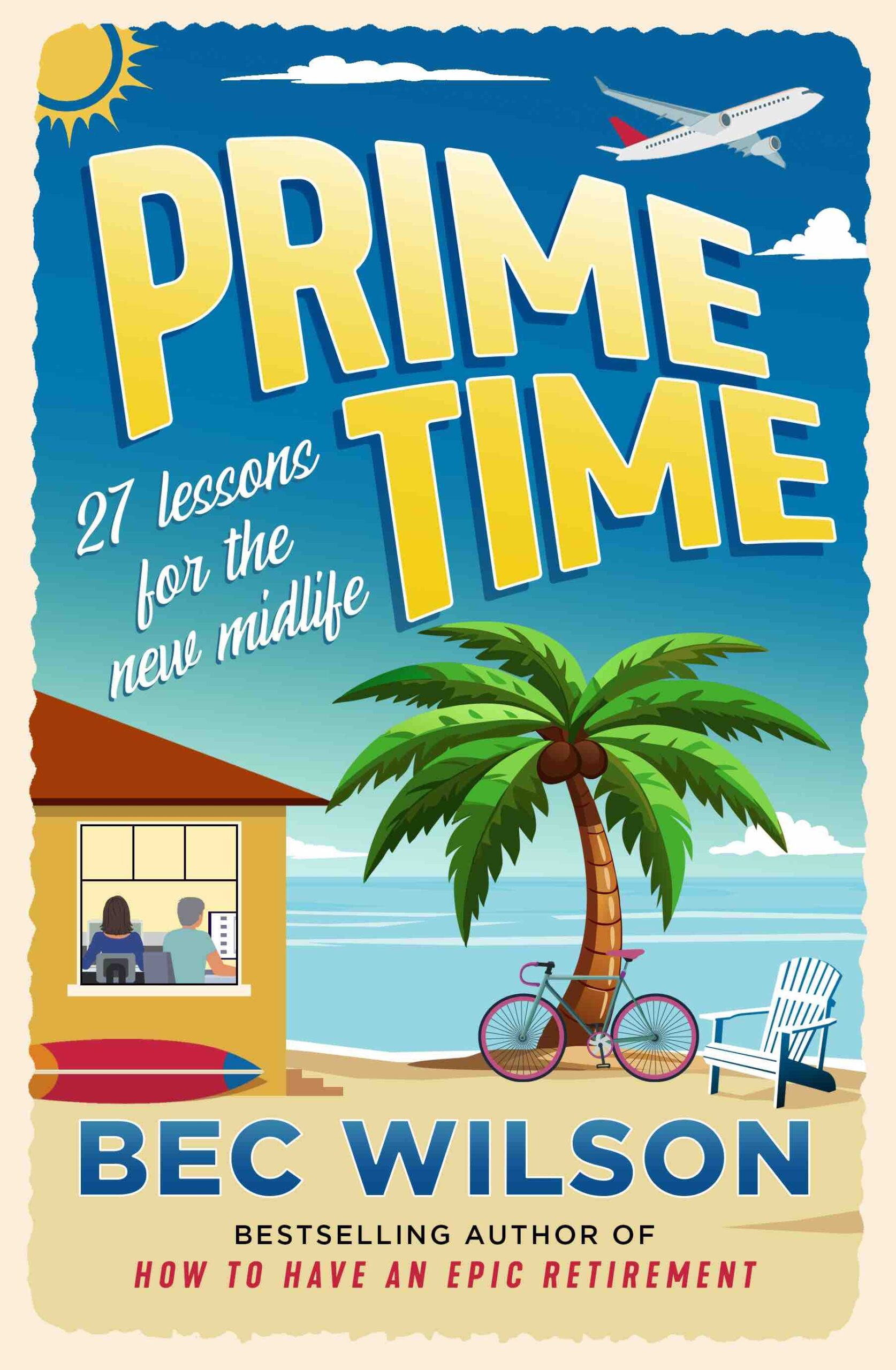
In Prime Time, Bec Wilson goes beyond the financial essentials to offer a roadmap for living with greater purpose and fulfilment in midlife and beyond. This extract dives into her practical advice starting with Lesson One.
LESSON 1:
THE SHAPE OF LIFE AS WE ALL LIVE IT HAS CHANGED
The shape of life as we all live it has changed the shape of life has changed fundamentally while we’ve all Been living it.
Think about it.
Someone born today moves into a childhood that lasts maybe until they’re 10-12 years old. That’s much shorter than it used to be. In my opinion, childhood ends when you get handed your first iPhone, fully loaded with one or even two social media accounts. At this point, the outside world comes into your life in an uncurated and unrestricted manner that your parents really struggle to control. (And it’s doubtful any government age limit will be able to control it for them.) That’s when you become a teenager. And your teenage years last a lot longer than they used to!
To me, the teenage years are those years when your parents look after your expenses but you’re stepping gradually toward emotional independence. Skyrocketing housing prices in our major cities today mean many children live with their parents, with their expenses subsidised or even fully supported until their mid to late 20s. That’s not just impacting the teenager’s life but also their parents’ lives, limiting their ability to ‘cut loose’ and launch into their own next stage.
 Then the teenager moves into adulthood, working their way through the list of stereotypical steps in young-adult life – building a career, finding a mate, buying a home and paying a mortgage, growing a family, and juggling obligations. Meanwhile, the parents of that child step into this new phase I’ve coined their Prime Time, where they have quite a bit of financial firepower because the money they have been spending on their kids is now gradually freed up for themselves, and they have less need to meet ‘society’s expectations’ because there are less of them – if any. Many have already achieved the key milestones in their careers, while others are on track for fulfilling roles they can maintain through their 50s and 60s. This is the time when they can start redefining their next set of goals, shaping a future that’s focused more on what they want for themselves.
This is not a stage of life that can be defined by age, because your Prime Time can really only kick off when your children become more independent and your financial obligations toward them lessen. If you had children later in life, then your Prime Time will probably begin later in life.
And if you never had children, then you might find you never really ‘lost yourself’ in the stereotypical parenting roles and lengthy process of supporting teenagers into their 20s. And, alongside this, your level of ongoing financial self-orientation has allowed you to retain the ability to freely choose throughout your life – something many parents can’t say they’ve been able to do. But you may still enjoy a Prime Time priority shift.
No matter how you look at it, though, your entry into Prime Time is marked by an increasing feeling of having more time, adequate financial resources to make more choices, and a desire to seek greater fulfilment in life.
If you embrace it, your Prime Time can be a long window of your life, possibly the longest stage of life you’ve lived so far. I see it extending from when your adult children get their P-plates, even if they continue to live in your home, all the way through to your active or epic retirement – the time when you give up work completely and forever. These can be the best years of your independent life.
Your Prime Time is a phase of life that has several stages within it.
Your Prime Time is a phase of life that has several stages within it. There are some years when you knuckle down and save hard, taking advantage of your empty nest’s lower costs. I call these your set-up years. Then there are your lifestyling years, when you work passionately, mostly full-time, but start to push more lifestyle into your life. You might take longer holidays or sabbaticals, enjoy a long weekend each month, or adopt a more flexible work structure that fits around your priorities. Then there are your part-time years, when you start to step back the volume of work you do and pick up more leisure activities.
Then, as your Prime Time ends, you move into your active or epic retirement years when you’ve stopped working and you fill your life with living. And, if you’re healthy, happy and have financial confidence, none of these years are boring.
After your epic retirement come two more life stages you need to be cognisant of, passive retirement and frailty, neither of which are the focus of this book, but you do need to plan for them. The fact is that while we are in our Prime Time, we’re often managing our parents through these two stages of life, so that’s when we become more familiar with them.
And that’s it – seven phases of modern life to think about:
- Childhood
- Teenage years
- Adulthood
- Prime Time (incorporating set-up years, lifestyling years, part-time years)
- Epic Retirement
- Passive retirement, or ageing years
- Fraility
STOP AND THINK ABOUT HOW LONG LIFE REALLY IS
There’s a huge space in the roadmap of life chiefly because one thing has changed – our life expectancies. Over the last 50 years, we’ve added between 15 and 25 years to modern life expectancies, and, if health advancements progress at the pace of recent decades, we can expect this trend to continue.
Actuaries in Australia expect that today’s 50-year-olds, if they make it through to the age of 65, a critical age used in projecting life expectancy, will have a median life expectancy of 90 for men, 92 for women and 95 if they’re part of a couple. But men also have a one in four chance of living to 95 and women to 96, and if they’re part of a couple, one of them should plan to live to 98.1
Life expectancy really does reshape our lives and how we live them.
And I have good news: in recent times, the number of years we spend in poorer health at the end of our lives hasn’t really changed that much as a percentage of our lifespan. In the 2022 Australian Burden of Disease Study, the Australian Government said men should expect to spend 88 per cent of their lives in good or full health, while for women the figure was 87 per cent.2 That puts most people well into their 80s before their health declines and they need to stay closer to regular healthcare services.
The big message I want you to hear is that all those years we’ve added to our life expectancy are productive, healthy years. We didn’t just add 15-25 years to our life expectancy over 50 years. We added those 15-25 years to our Prime Time of life.
**********
 ABOUT THE AUTHOR
 ABOUT THE AUTHOR
Bec Wilson is a leading voice on midlife, modern ageing and the future of retirement, in Australia and beyond.
She’s the bestselling author of How to Have an Epic Retirement – Australia’s #1 retirement book in 2023 and 2024 – and Prime Time: 27 lessons for the new midlife, as well as the founder of the Epic Retirement Institute, a trusted hub for practical retirement education, insights and tools.
Bec hosts the Prime Time podcast, one of Australia’s top 200 podcasts, and writes a weekly newsletter at epicretirement.net which brings together a large and loyal community of midlifers and retirees. Through the Epic Retirement Institute, she runs the popular six-week flagship course ‘How to Have an Epic Retirement’ and partners with super funds and organisations to deliver pre-retirement education programs.
Bec writes a widely read syndicated finance column for The Age, the Sydney Morning Herald and other Nine mastheads, and manages the thriving global Facebook group The Epic Retirement Club.
She’s a mother of three teens and young adult children, a lifelong learner, and is living her own Prime Time – while dreaming of her Epic Retirement, one day.


0 Comments