


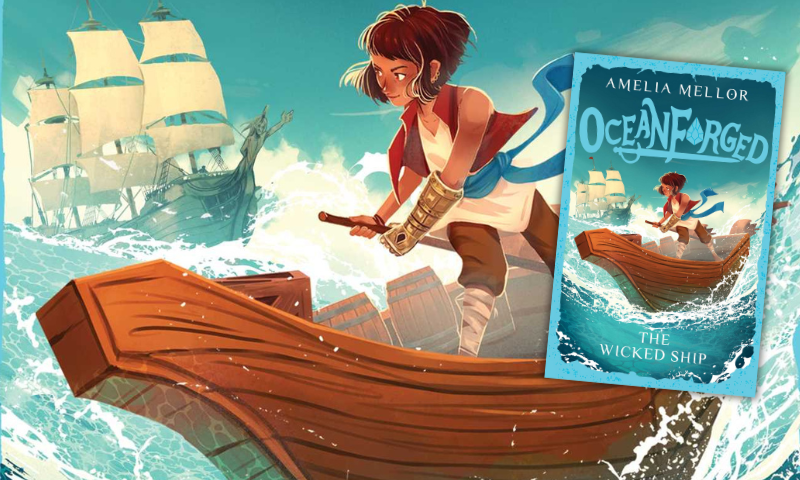
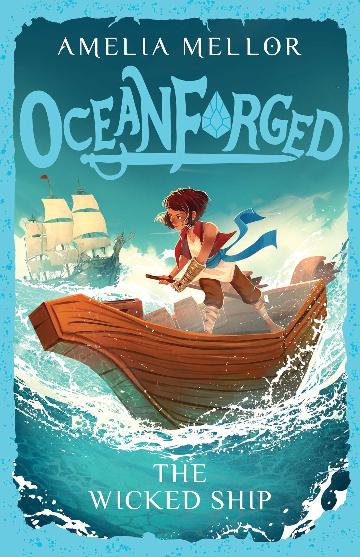
AMELIA MELLOR’s latest book, Oceanforged 1: The Wicked Ship, is the first instalment of an epic new fantasy adventure series. Read on for a Q&A with the author.
The Wicked Ship is the first book in your new fantasy adventure series ‘Oceanforged’. What inspired it?
There were three major influences on the look and feel of ‘Oceanforged’, based on recent experiences of mine. In 2021, I wrote a small comedy musical for the students of the primary school I was teaching at, using sea shanties as the inspiration for the songs. The tone, piratical theme and intended audience of The Wicked Ship have a lot to do with this little musical! I had been on a couple of recent adventure trips to Exmouth and Port Douglas. I had also been to the home of a private collector to see his Cole’s Book Arcade collection, but he also showed me an astounding collection of scrimshaws, flintlocks and swords.
What challenges does Cori face as a girl in a brutal pirate crew?
In early drafts, Cori was a prisoner of the pirate crew, but that role made her too passive for the story’s needs. And it was more interesting to start her as a minion of the villains, who was allowed to move around the ship! History offered me lots of interesting ways to make Cori’s life miserable – and highlight her courage and resilience. In the Golden Age of Sail, young boys (and occasionally, women disguised as teenage boys) worked at sea in similar jobs to the ones Cori does in the early chapters of The Wicked Ship. Powder monkeys, as they were called, had to run back and forth from the gunpowder storage area to the cannon deck during battles, supplying the sailors at the cannons with powder. Kids could also be trained young for a lifetime in a demanding physical job, such as that of a topman, whose work high in the rigging required excellent balance and climbing fitness. And servants, officers-in-training or deckhands might also start in their roles at a fairly young age – typically around 12, but they could be younger, and that was the norm in wider society as well. Pirates often had to be generalists, so I mashed as many of the heaviest demands and scariest dangers together as I could for Cori’s role in the crew of the Harridan!
How did your scuba diving experience at Ningaloo Reef influence the world of Aquinta?
One aspect was the monsters. On different diving and snorkelling adventures on that trip, I saw species like whale sharks, humpback whales, stingrays, moray eels and green turtles. The whale sharks were true monsters of the deep, serene yet powerful. The main thing we had to be careful of was getting hit by their tails as they swept from side to side. But another aspect was the colour and life of Aquinta’s environments. High fantasy still heavily tends towards gloomy northern European forests and I’m not sure why. Ningaloo Reef is just one of the beautiful and biodiverse places that inspired the world of my series.
What was your research process like for this book? And did anything unexpected from history sneak into the final story?
The research process for this series was more of a search for narrative possibilities and world-building vibes than my previous historical fantasy. Rather than searching for out-of-print books or reading newspaper databases, I looked for more opportunities to do or observe things in person, like touring palaces and tall ships, and taking a silversmithing class. ‘Oceanforged’ has plenty of surprising real-life inspirations, one of which is the pirates’ pledge! In pop culture, ‘the pirates’ code’ is depicted as a code of honour, but in real life, it was more like a code of conduct – a contract. The ship’s articles, as they were called at the time, outlined the rules for anyone who joined the crew. And as I’ve included in The Wicked Ship, these had rules like sharing plunder fairly with crewmates, keeping matches and tobacco pipes away from the gunpowder magazine, and avoiding fights with crewmates – with the penalty for breaking these rules often being voted on by other crew members!
What messages do you hope to convey to young readers about our relationship to nature?
I’m hoping that ‘‘Oceanforged’ will make young readers curious about and interested in our natural world. Ignorance and pessimism are two major challenges to protecting the environment on Earth – so many people don’t know what’s being lost or don’t believe it’s possible to save. ‘Oceanforged’ is kind of my way of rebutting those messages. Nature in this series is beautiful and ferociously resilient, and it has its ways of punishing those who exploit, abuse or try to control it.
What freedoms does fantasy offer you as a writer – and what new challenges did you encounter while worldbuilding?
I’ve been really enjoying the freedom to write a society that isn’t confined by the same historical injustices as ours, although it does have some of its own. But I do find myself stumbling at times on certain words and customs with specific historical origins on Earth – such as, should characters say ‘hello’ in a world without the telephone, since that’s how ‘hello’ as a greeting caught on? And sometimes I’ll come up with an idea that’s too unfamiliar for the Earthling reader, and have to scale it back. I would have loved to base Aquinta’s currency on little glass stars shaped like fossil crinoids, similar to the way shells and beads have been used as traditional currency in some cultures. They ended up as gold and silver coins with stars on them, and I saved up my supply of outlandishness for the details that really matter, like the magic system.
ABOUT THE AUTHOR
 Amelia Mellor is an author, teacher and nature nerd. She is the creator of The Grandest Bookshop in the World, The Bookseller’s Apprentice and The Lost Book of Magic, a multi-award-winning historical fantasy trilogy based in Melbourne where she lives. She holds degrees from Monash University and The University of Melbourne. To find ideas for Oceanforged, Amelia spent three days at sea, swam with sharks, hiked in jungles, got lost in Italy, handled real pirate artefacts and scuba dived on a shipwreck. When she’s not writing or researching, she’s usually tending her collection of tropical fish or attempting a wildly ambitious craft project.
Read a Q&A with Amelia Mellor about The Bookseller’s Apprentice


0 Comments