


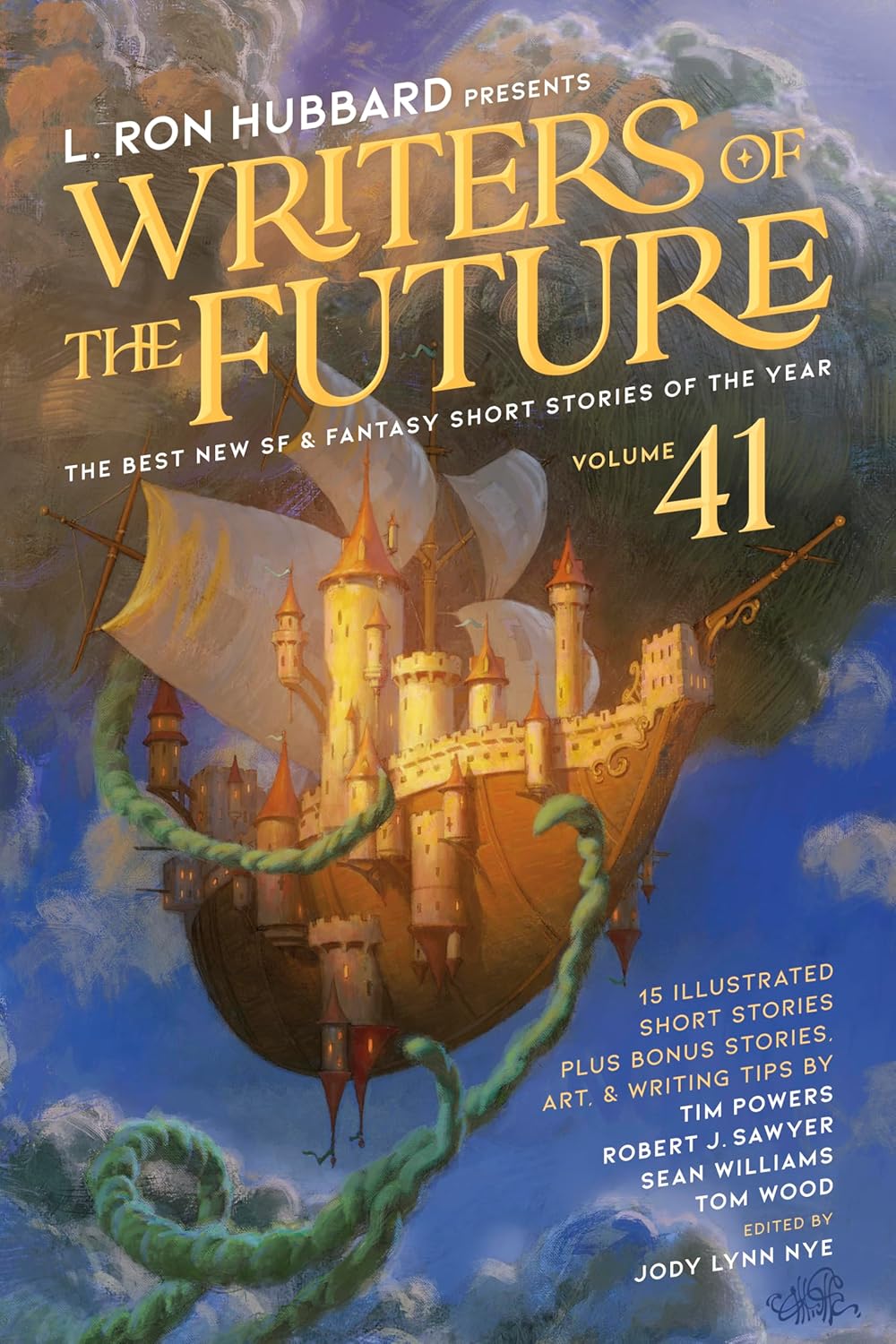
Extablished in 1983 by L Ron Hubbard, Writers and Illustrators of the Future is a writing contest for science fiction and fantasy stories. Hubbard wrote a number of successful science fiction books and he saw the contest as a way of ‘giving back’. Each year a new volume of Writers of the Future is published with the best entries short stories and artwork received.
Read on for an extract of the 2025 edition, Writers of the Future, volume 41.
STORM DAMAGE
by T R Naus
illustrated by Haileigh Enriquez
ABOUT THE AUTHOR
T R Naus emerged from a love of exploration. He grew up traveling across Europe, Asia, and the United States as a military brat and later as a soldier in the US Army, developing a passion for wandering, adventures, and intriguing stories in the process. His journey led him to experience fascinating cultures and subcultures, where he learned from inspiring people, but with each new encounter, he wondered how evolving technology impacts how we see ourselves and the communities around us. He eventually settled in Virginia with his wife and two daughters and turned to speculative fiction to express those anxieties – and hopes – about our future.
‘Storm Damage’ grew from an amazement that we haven’t yet destroyed ourselves. Human advancement removes a little more wonder from the world but uncovers even more new mysteries. It also inches us closer to the potential for irreparable harm on a global scale. It may be up to us to prevent that, but we create deeply personal narratives that define how we see ourselves and our legacy based on our vision of the future. Are we strong enough to make the right choice when it threatens our dreams?
Available through Amazon.com.au
Download Book Club Discussion Questions
**********
Storm Damage
The storm looked much bigger than any Dr. Gregors had seen before. From his seat in the back of the helicopter, he could look over the pilot’s shoulder at the dark horizon. In the distance, he could see thick, gray clouds producing new explosive plumes in a rhythm of constant motion that brought the tempest closer to them.
The helicopter was maintaining a course that sped them toward the darkness. The forecast had only called for some clouds and light rain to the north, some distance from their destination. It was a surprise to see how quickly the weather pattern changed to defy the most advanced predictive models. If Dr Gregors didn’t know any better, he would have thought that the storm was determined to meet them.
The pilot had asked to turn around, but the mission lead, Captain Vladimir Kushner, had denied the request. He did not mask his displeasure about the risk Dr. Gregors was exposing them to, but Mission Control gave him two direct orders. The first was to get to the destination Dr Gregors identified, so Kushner made the call to trust the prognostications and press forward.
This mission was based on Dr Gregors’s recent detection of tachyon energy in the vicinity. His groundbreaking research into tachyon energy proved that it was associated with time manipulation, but it was never recorded outside a controlled environment until now. He was very excited at the possibility of a natural occurrence, but Mission Control was suspicious of its proximity to a top-secret facility exploring this new type of energy.
It was by chance that Dr Gregors even noticed this tachyon energy emission. With most of his team temporarily assigned to another top-secret project in the shielded chamber, he had time to improve his time-shifting prototype in the unshielded laboratory. His previous experiments shifted time by a second, but he was on the verge of jumping forward or backward by minutes. When he turned on his sensor to prepare for his first test run, he noticed that tachyon energy was already present. Someone relatively nearby was already playing with time, and by the size of the reading, they were doing much more manipulation than he was.
Dr Gregors was surprised at how quickly Mission Control agreed to his request to investigate the energy source. He assumed they saw it as a potential threat, except that the chief of security, Captain Kushner, vehemently opposed any trip outside the wire. One of Kushner’s superiors pulled him aside, and whatever they told him worked. He walked past Dr. Gregors and barked, ‘Wheels up in one hour.’ The team was ready for liftoff in under 60 minutes.
The looming darkness made Dr Gregors nervous, but he remained excited. The pilot sat alone in the front while Dr Gregors was seated in the back with Kushner and two soldiers. He wasn’t positive, but it looked like one of the soldiers was asleep.
He turned his gaze to the white-cliff coastline below them, where angry waves slammed against the chalk and flint wall.
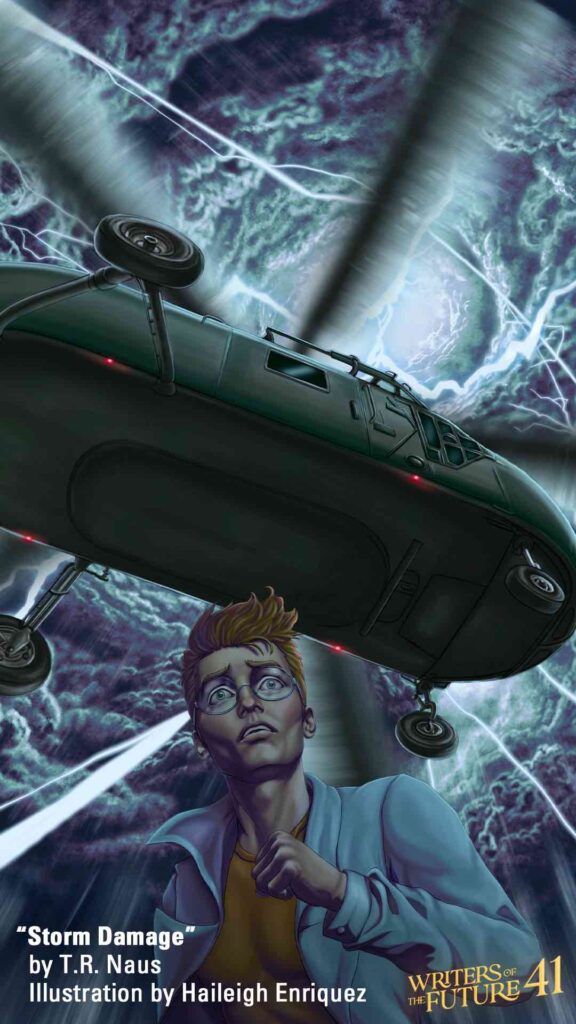 ‘The storm is getting worse,’ Dr Gregors said. He was not quite used to the helmet. It muffled the helicopter’s engines but made it difficult to hear anything else. The pilot was talking to somebody periodically, but Dr Gregors couldn’t make out the words. He assumed it was normal chatter.
‘You should have thought about that before you begged Mission Control to take you on this little escapade,’ Kushner said. ‘Now shut up. We need to keep the comms line open.’
He didn’t look at Dr Gregors as he spoke. He rarely did since he often talked about Dr. Gregors rather than to him.
‘The temporal reading …’ Dr. Gregors started. He stopped speaking when Kushner shot him a stern glare. Dr Gregors preferred it when Kushner did not look at him.
He stayed silent for the rest of the trip. A lifetime of dealing with people like Kushner taught him to keep his head down and be invisible.
He continued to look out at the storm. He distracted himself by running through the experiment he hadn’t yet finished. Halfway through his mental checklist, he heard the pilot’s voice clearly through the helmet’s headphones.
‘Approaching the coordinates.’
Dr. Gregors looked down to see a single cottage on a high cliff overlooking the sea. It was not what he was expecting. It was disappointingly ordinary.
‘Is this the place, Doctor?’ the pilot asked.
Dr. Gregors looked at the readings from his handheld sensor to confirm.
‘Yes,’ he said. ‘It looks like that is the epicentre.’
‘Roger,’ the pilot said. ‘It’s showtime, boys and girls.’
The pilot dove the helicopter at a steep angle but landed her gently about fifty meters from the cottage. Dr Gregors’s excitement was tempered by rolling cloud coverage threatening to blot out the sun. The storm had not yet reached their location, but its shadow created a gray and dreary landscape.
‘Be fast or make peace with the residents quickly for shelter,’ advised the pilot as they touched down. He warned them that the rain clouds were moving faster than anticipated. They would have no more than thirty minutes – probably less before he returned to base. Orders or not, he refused to get caught in the storm.
‘We will be at this lz in 25 minutes,’ Captain Kushner yelled over the engine. His helmet was already off. ‘And so will you.’
The two soldiers jumped out of the helicopter as Dr Gregors removed his helmet. Before Kushner joined them, he bent over to Dr Gregors, his lips close to the scientist’s ear.
‘I am responsible for keeping you alive,’ he said. ‘So you will do exactly as I say. Am I understood?’
‘Yes,’ Dr Gregors said. Be invisible, he reminded himself.
‘Stay behind us,’ Kushner said as he jumped out of the helicopter.
He ran in front of the two soldiers already in position. They were on one knee with their weapons raised and scanning the area before them. With a hand motion indicating ‘move out,’ Kushner led them quickly yet cautiously toward the cottage. Their steps were short, quick, and deliberate. They held their rifles up, ready to fire, and rotated their upper torsos in small arcs from side to side. Dr Gregors jumped out once they were a few feet from the spinning blades. He bent down and walked as fast as he could. He wanted to race ahead but reluctantly placed himself behind the two armed guards. Take it slow and remain calm, he reminded himself.
‘They are here to protect me,’ he repeated quietly to himself over and over.
The thick wooden door opened as they approached. Kushner and his soldiers stopped and immediately pointed their weapons at the gentleman who emerged. He appeared in his 50s, with silver streaks running through his dark hair and beard. He looked down at the three laser dots dancing on his chest. When he looked back up, he was smiling broadly.
‘I don’t think guns will be necessary for this conversation,’ he said.
The two soldiers disappeared, and Kushner now held a radio beside his ear. There were no weapons in sight.
The sudden change startled Dr. Gregors. He quickly looked around for the two guards. He jumped again when the radio blared.
‘Blackguard Six, this is Mission Control. I say again. Have you made contact? Over.’
‘I would recommend you give your superiors an answer,’ the stranger said. His hair was now completely gray, and there were wrinkles on his face that Dr Gregors hadn’t noticed before. ‘And let them know that there is no danger.’
‘This is Blackguard Six, affirmative,’ Kushner responded into the radio. ‘Initiating contact at this time. Over.’
What is going on? Dr Gregors asked himself. He didn’t see any sign from Kushner that he was aware of what had just happened.
‘Would you like some tea?’ the man asked. He turned around and returned to his house, leaving the door open.
‘Where’s your weapon? What happened to the soldiers?’ Dr Gregors whispered to Kushner. He felt his pulse quicken as panic edged closer. ‘People don’t just disappear!’
Kushner looked equally confused. ‘You said that they would not be necessary. You asked to go alone and with no weapons. Against my recommendations. Mission Control agreed with you on the condition that I join you.’ He took a deep breath through his nose. ‘Don’t lose it now. Find what you are looking for so we can get out of here.’ Kushner entered the cottage.
True, he had wanted to go in alone, but Mission Control had not agreed with him. Wait, had they? He was no longer sure of what he remembered. He looked around again for the two missing soldiers.
‘Weird,’ he said quietly. He took an extra second to calm himself before following Kushner.
He walked through the door that opened into a kitchen. Their host had already placed three small teacups on the wooden table.
‘Milk and sugar?’ he asked.
‘No,’ they both said in unison.
‘We should probably start,’ the cottage owner said as he sat down. ‘My name is Dr. Stanley Richwine –’
‘Dr. Richwine,’ Dr Gregors interrupted. ‘What happened to the soldiers?’ He couldn’t let it go.
‘What soldiers?’ Kushner asked with his eyebrows furrowed. ‘I told you to keep it together.’
‘Please, call me Stanley,’ Dr Richwine said. ‘I will answer your questions, but based on the speed of the storm’s approach, I do not think we have much time to start the transition. Are you ready?’ He looked into Dr Gregors’s eyes without blinking as he waited for an answer.
It took several seconds for Dr Gregors to process the question, but he didn’t get an opportunity to respond. Kushner loudly interjected.
‘What transition?’
‘I am sorry, Captain Kushner,’ Stanley said calmly. ‘I am probably going to die when that storm reaches us.’ As if on cue, heavy raindrops started tapping on the glass window. ‘If Dr Gregors doesn’t accept the position, I may not be the only one.’
‘I don’t …’ Dr Gregors started to say. ‘I don’t understand what you’re saying. How do you know who I am? Accept what position?’
Before anybody else could talk, Dr Gregors stopped and said, ‘Wait.’ He then closed his eyes and slowly counted to five. His therapist had taught him this technique when he felt overwhelmed and needed to refocus his priorities.
‘I am sorry, Captain Kushner,’ Stanley said calmly. ‘I am probably going to die when that storm reaches us.’ As if on cue, heavy raindrops started tapping on the glass window. ‘
He opened his eyes again.
‘I am sorry,’ he started again, ‘but we are here to find an energy source associated with time manipulation.’
‘I know why you are here,’ Stanley said. ‘You are looking for the fail-safe.’
He took a sip of tea as he turned to look out the window. The raindrops thudded against the glass louder and quicker, and his smile faded. Dr Gregors restrained an urge to interrupt.
‘I do not understand how or why,’ Stanley said, ‘but when the Maker or Makers made Earth, they created an unbelievable way to protect us from ourselves.’
‘What makers?’ Dr Gregors asked. The question escaped his lips before he could stop it.
‘I haven’t the foggiest,’ Stanley responded. He turned to look at Dr Gregors after putting his teacup down. ‘But whoever he, she, or it was, they left. They are gone.’
The pause was anything but silent as the rain outside got heavier.
‘But they left a fail-safe?’ Dr Gregors asked. He couldn’t explain it, but he felt uneasy and wanted this conversation to speed up.
‘They developed a mechanism so that if we did anything too stupid, someone could go back and fix it,’ Stanley said.
‘Time travel?’ Dr Gregors asked in a whispered voice. It would account for the high level of tachyon energy he found, but he needed to be sure. He pulled out his handheld sensor to get a reading.
‘Time travel,’ Stanley agreed. ‘One person, a fail-safe, can go back and reset the timeline if we doom ourselves as a species – something that we’ve had to do more than a few times. The Allies lost World War II, and the consequences were devastating. The famine that followed alone …’ His voice trailed off.
Dr Gregors looked up from his device with the realisation that Stanley was the source of the tachyon energy.
The sky turned black as the clouds hid the last rays of sunlight.
‘So, these fail-safes – you – go back in time and get some kind of do-over?’ Kushner asked.
Dr. Gregors remembered trying to explain tachyon energy to the military personnel during their first-week indoc. When he was done, Captain Kushner asked Mission Control for the actual briefing. The room full of soldiers laughed at the joke. Kushner refused to look at Dr Gregors or take him seriously. Instead, he accused Mission Control of wasting his highly experienced team’s time and talents to lead an academic exercise to validate a ‘nonsense theory about time travel from a crackpot.’ Dr. Gregors was relieved to hear Mission Control order Kushner to protect the scientist and his experiments at all costs and to keep his uneducated opinions to himself.
‘Yes,’ Stanley said flatly. There was no trace of humour or sarcasm in his voice. ‘Unfortunately, the process gets very draining. Each time we go back, we age quicker. As best we can tell, it is another fail-safe to prevent frequent or unnecessary changes.’
‘We?’ Kushner asked. ‘Who is funding you and your team?’
Lightning flashed. It was followed a few seconds later by a thunderclap that shook the cottage. Stanley jumped in his seat. He took a deep breath before he started again.
‘I am not part of a conspiracy,’ he answered. ‘A fail-safe can talk to past fail-safes. I do not have the time to explain, even if I could. The more pressing problem is that I think my time is over, and I need a new fail-safe. A candidate always finds a way of showing up.’
‘Why not pass this on to your family?’ Dr Gregors asked.
‘I do not have a family,’ Stanley said.
‘Can we focus on finding the source of this energy?’ Kushner asked in an attempt to get the mission back on track.
‘So, fail-safes can’t have close connections?’ Dr Gregors asked as if he hadn’t even heard Kushner. He had, of course, but Dr Gregors was done being sidelined. They may have found the tachyon energy source, but he wanted to know more. He couldn’t help but believe that Stanley was a time traveler, which meant Dr Gregors could be one, too.
‘I don’t think there is anything to prevent us from getting married or having children,’ Stanley answered. ‘I spent a lot of time debating with myself, but I finally decided I would’ve needed a compelling reason to risk my objectivity. I always felt I could not take a chance of anything holding me back from doing what was necessary when the time came to make a tough choice.’
‘What does this have to do with the storm or the energy?’ Kushner asked.
‘The storm is new,’ Stanley said. ‘We normally have plenty of time to share more and explain everything.’ He pointed out the window. ‘This is not normal.’
‘I sense it, too,’ Dr Gregors said slowly. He felt as if the puzzle pieces were fitting into place. ‘We are part of a project to understand time manipulation. We may be able to help you figure this out, and you may be able to help us advance our research.’
‘Dr. Gregors, you need to stop,’ Kushner thundered. ‘Remember your obligation to safeguard protected information.’
‘This is bigger than …’ Dr Gregors started before he was interrupted by Kushner’s radio.
‘Blackguard Six, this is Mission Control. Impose radio silence on this channel and maintain second operational order. Over.’
Dr. Gregors turned to look at Kushner with an inquisitive gaze.
‘Why are they going radio silent?’ he asked. ‘And what is the second operational order?’
He was surprised to see the puzzled look on Kushner’s face as he looked down at his radio.
‘Classified,’ he answered slowly. He seemed unsure what to do next.
‘They built a time machine, haven’t they?’ Stanley asked.
‘Impossible,’ Dr Gregors said.
‘I think it is very possible.’ Stanley turned his attention back to Dr Gregors. ‘Normally, the resets result from many mistakes that culminate with us destroying our planet or the human race. This was quick, with no significant buildup. It was very confusing to me, just as confusing as an actual, visible storm. I wondered what was different this time, but when I saw you outside, I realised that you were the cause. Your discovery has made time travel possible, and because you did, we have a new trigger for the fail-safes to account for. Time travel seems to require a more prompt reset than we’ve seen in the past.’
‘You are wrong,’ Dr Gregors said. ‘I would be part of any project to build a time machine. They need me.’
‘Do they?’ Stanley asked.
Dr Gregors didn’t respond immediately. Something caught his attention and refocused his racing mind. Kushner had shifted in his chair and was slowly moving his hand down his leg. Dr. Gregors wondered if a knife or gun was hidden in his boot. Seeing Kushner anxious was strangely comforting.
‘What is the second operational order?’ Dr Gregors asked Kushner again.
Kushner straightened up and slammed the radio on the table harder than he wanted, but he was fed up with the charade. His second order was clear: Keep Dr. Gregors away from the facility until he was given the all clear. It did not say that he had to listen to their delusional ramblings.
‘We need to find the energy source,’ Kushner said.
Dr. Gregors pointed to Stanley. ‘He is the energy source.’
‘So it would seem,’ Stanley added.
‘I’ve had enough of this nonsense,’ Kushner said dismissively.
‘I agree,’ Stanley said. He looked directly at Kushner. ‘You have been rude and disrespectful in my home. I think it is time for you to go.’
Kushner disappeared without a sound.
‘Where did he go?’ Dr. Gregors asked. He wasn’t sure why he was still shocked to witness another disappearance.
‘He was never here,’ Stanley replied. He picked up the radio that was still on the table and turned a knob until they heard the voice of Mission Control.
‘T-minus six minutes.’
Stanley put the radio back on the table and continued talking.
‘He was never selected for the mission. Nobody cared enough about the success or failure of your investigation, so Mission Control sent you out here to get the readings alone. They just needed you out of the facility.’
‘You went back in time?’ Dr Gregors asked. ‘Twice?’
‘I did,’ Stanley said, ‘but it is taking its toll.’ Stanley’s hair was now pure white, and his wrinkles were deeper.
‘Then how do I remember Captain Kushner or those soldiers?’
‘Because you will soon be a fail-safe,’ Stanley said. His voice was a little softer now. He changed the subject. ‘You made time travel possible, and they are about to make it real. They do not need you anymore to do it.’
‘No,’ Dr. Gregors said. He started speaking faster and louder with each sentence as the anger boiled to the surface. ‘They wouldn’t do this without me. They promised me more time to research the effects and ramifications. We agreed to go slow.’ His mind was now sprinting over all the clues he had missed.
‘This is my project!’
‘I am sorry that you’ve been blinded by what you wanted to see,’ Stanley said. ‘But you needed them as much as they needed you. Science is often expensive and dangerous.’
‘T-minus five minutes.’
Dr Gregors glanced at the radio. They could hear the winds outside battering the cottage and an eerie whistle as it passed through a small opening somewhere in the building.
‘How is it dangerous?’ Dr Gregors asked. ‘Each new advance in science brings new opportunities for humanity. There are risks and hiccups, but we always find our way.’
‘No,’ Stanley said. ‘No, Dr Gregors, we have not always come out of each new invention unscathed. We regularly turn to the military to help make controversial science real and pay the price for that Faustian bargain. We’ve managed to kill ourselves and destroy our planet so often that a fail-safe was necessary for our survival.’
‘We’ve only dropped an atomic bomb twice in our history,’ Dr. Gregors said quickly. ‘We learned from that mistake and found better ways to use them as deterrents.’
‘It was neither the only time nor the worst weapon we’ve created,’ Stanley countered. ‘They have never been a good deterrent, so we sadly allowed those two bombs to go off in hopes that we would learn from it. That helped for a time until World War III.’ He paused. ‘It is a constant vigil, Dr Gregors, that starts with a single, difficult choice that weighs our future against our legacy.’
‘T-minus four minutes.’
Neither of them looked at the radio this time. A tiny waterfall sprang from a new crack in the ceiling, creating a puddle on the table. Stanley continued to talk.
‘Did you honestly believe your military investors would not use your discovery to advance nationalist interests? You have a chance to change that.’
There was a long pause as Dr Gregors remembered his path to this moment. His colleagues laughed at him when he published his paper. It was regarded as a fringe theory barely meeting the standards of scientific rigour, but the military showed up to his research lab with funding and promised to turn his theory into a practical application. They offered him a way of proving his thesis and validating his life’s work.
A tiny waterfall sprang from a new crack in the ceiling, creating a puddle on the table.
‘T-minus three minutes.’
‘You …’ Dr Gregors started, unsure of what to say. ‘You want to restart the timeline before my discovery?’
‘Yes, and soon,’ Stanley answered. He pointed to the radio. ‘Before they make that first jump in time.’
‘But this will be one of the biggest scientific advancements ever!’ Dr Gregors exclaimed, his heart racing. All of his life’s work would be erased. His stamp on history would be removed before it was even made. How was this fair?
‘I refuse to accept it,’ he said. If Stanley was correct, then the military was about to do what everybody told him was impossible. No more snickering at him behind his back. He was going to be famous.
‘We can alter the trajectory of how this science will be used,’ Dr Gregors said. He felt the physical signs of panic flood through him uncontrolled, but he couldn’t stop himself. He leaned forward, his eyes wide, his breath quick. Everything he wanted was within his grasp!
‘I am afraid that isn’t possible,’ Stanley said. ‘Good intentions are never enough to keep us in check. Humans always find loopholes, so I need to restart the timeline and ensure that you never make your discovery. You need to be here to become the new fail-safe if I don’t make it back.’
‘But …’ Dr Gregors started. He couldn’t say it out loud. Voicing it would make it real; he didn’t want it to be real. Not on the cusp of his dreams finally coming true.
‘Yes,’ Stanley interrupted. ‘Your work will be lost forever. It is not the first time we forced society to forget something significant, but we have proven through our history that we cannot handle the responsibility that comes with it.’
‘You don’t understand …’
‘T-minus two minutes.’
The building creaked loudly but held its own against the onslaught outside.
‘Don’t I?’ Stanley said. He grinned as he stood up. ‘I created the first fusion power source, Dr Gregors. It was incredible, but it was deadly. I was given a choice. It is the same choice that you have right now.
‘As you saw, I can change the past to alter the present, but I am tired. I can transfer that gift to you. You will learn how it works immediately because of the past fail-safes who will guide you. You will not be alone in this.’ Stanley walked over and, with a relaxed smile, put his hand on Dr. Gregors’s shoulder. ‘I realize what I am asking is difficult,’ he said. ‘I am sorry, but losing my life’s work was not nearly as hard as giving up hope of having a family. It is my only regret, yet I did it because it was the right thing to do.’
‘I am not going to give up anything,’ Dr Gregors said. ‘You told me that time is running out for you. I see it. You’ve aged a decade since I walked through your door. You could’ve changed my past to prevent this, but you need me. I am your last, best, and only option, and I believe we can find another way.’
‘You have a choice to make, Dr Gregors. I must guarantee you don’t publish your findings. How that happens is completely up to you.’
‘T-minus one minute.’
The storm was upon them in full fury. Lightning cracked loudly when Dr Gregors announced his decision.
‘We will not change the past,’ he stated firmly.
‘I am sorry to hear that,’ Stanley said, shaking his head as he looked to the ground.
‘I am the fail-safe now, Stanley,’ Dr Gregors said. He felt confident in his decision for the first time in his life.
Stanley walked out of his cottage with a cup of tea in one hand and an old newspaper in the other. He was moving much slower, but what could you expect from a septuagenarian? The storm had passed quickly, sounding worse than it was, so he had sent his daughter out to see if there was any damage to the property. Riley would be back soon.
He glanced at the vintage copy of The Southern Star folded open to the obituaries. It was a small-town newspaper from many years ago that he’d had to special order. It was important that somebody remembered, he thought. He reread the tragic story about the death of a bright boy with so much potential. Geoffrey Gregors had been hit by an oncoming car on a deserted back road in Ozark, Alabama. It was unclear whether it had been an unfortunate accident or if Geoffrey had intentionally jumped in front of the vehicle to escape the bullies that had plagued his young life.
Riley appeared from around the corner of the cottage. The lanky teenager stopped at the open door.
‘No damage, Dad,’ she yelled. ‘I am going to get ready for our walk.’
She waved at him and ducked inside to change.
Stanley turned his gaze out over the ocean as he drank his tea.
A new fail-safe always found a way of showing up. Dr. Gregors was gone, but Riley was ready for the responsibility. During the storm, he had told her it was time. She had asked to spend one more day with him before the transfer, and he agreed. Far from clouding his objectivity, he found that his love for her gave a deeper meaning to his sacrifices.
‘Yep,’ he said to himself. ‘No damage.’
**********
Available through Amazon.com.au
LISTEN TO A PODCAST
Science fiction author Sean Williams, illustrator Connor Chamberlain and John Goodwin on the 40th Anniversary Volume of Writers of the Future



0 Comments