


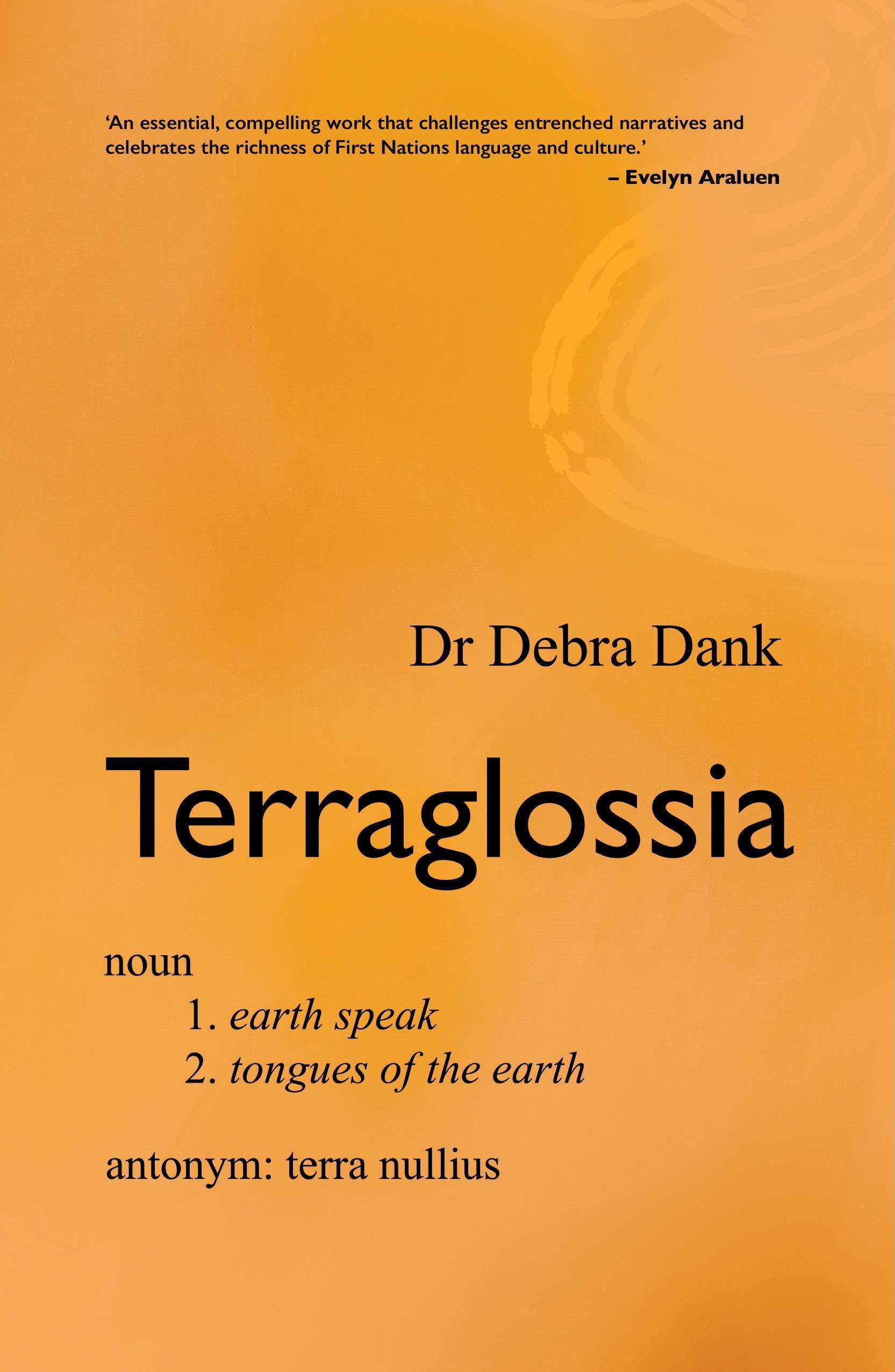
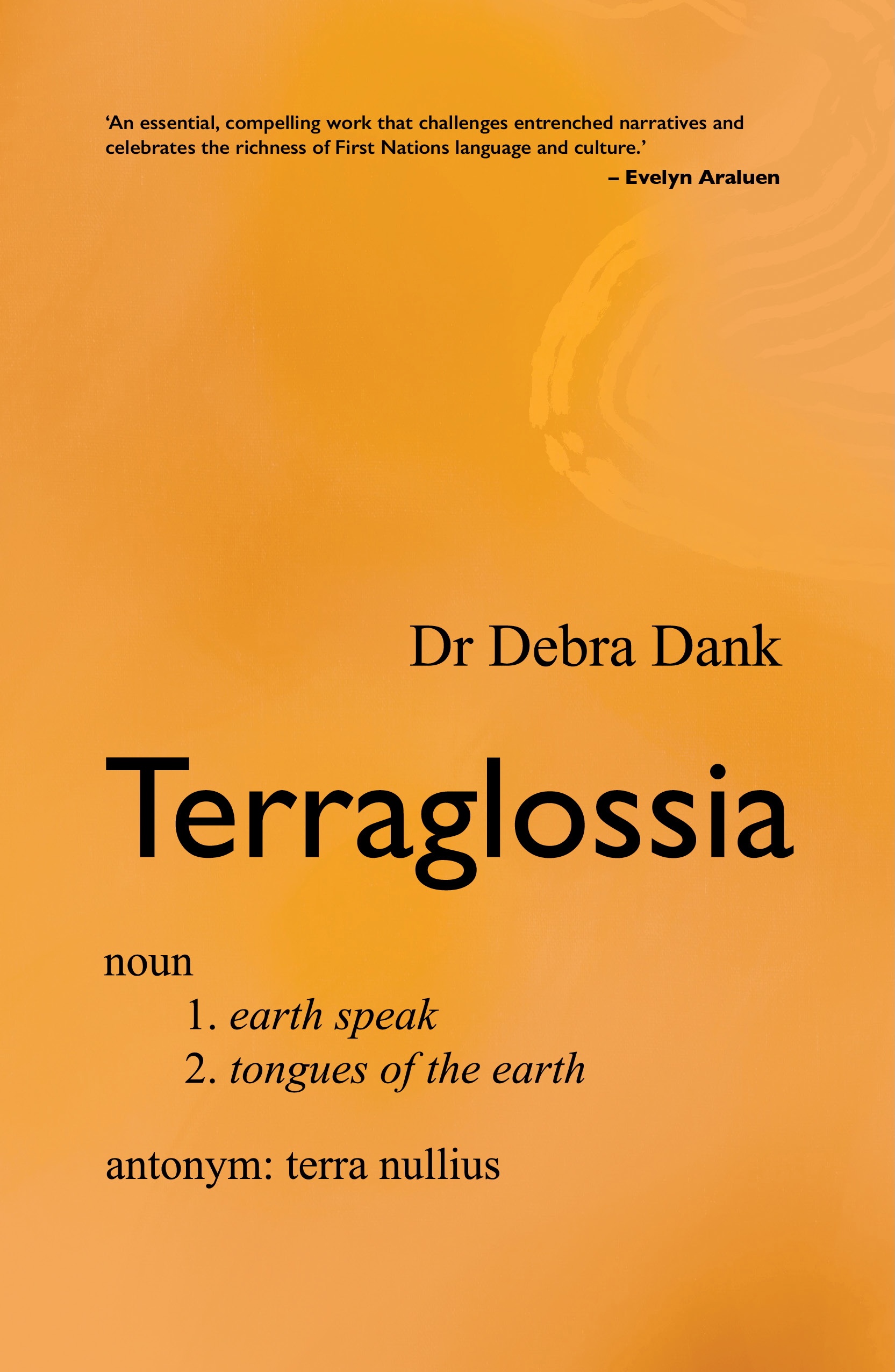
DEBRA DANK is the award-winning author of We Come with This Place. Read on for an extract from her new book, Terraglossia.
 ABOUT THE BOOK
**********

The moving tide
– an introduction
In April of 1770, a moving tide brought into what is now known as Botany Bay, a single barque, a British Royal Navy vessel built in the style of a Whitby cat. HMS Endeavour sailed under the command of Lieutenant James Cook. The local Dharawal people of Kamay challenged Cook and it is recorded that they did not want to interact with these newcomers. Despite this clear lack of welcome and the obvious occupation, Cook claimed Dharawal land and the lands of all other first nations across this continent for Britain in the name of the British king. A
s recorded in the Secret Instructions for Lieutenant James Cook Appointed to Command His Majesty’s Bark the Endeavour 30 July 1768, Cook had been charged with several secret orders from George III, including ‘with the Consent of the Natives to take possession of Convenient Situations in the Country in the Name of the King of Great Britain’. This direction he ignored, and that set in motion more than 250 years of ignoring Aboriginal presence and all that entails.
Several years later, Captain Arthur Phillip sailed to what is now known as Australia with 11 ships comprising the First Fleet and set up a penal colony on 26 January 1788. Phillip had proposed to treat Aboriginal peoples well and with consideration, but as with the directions from King George III, many of the plans for the ‘discovery’ of this place had gone awry. I cannot help wondering what and how the thinking of those first new Australians, rejected and ejected from their own country so violently and transported to a place that had only become a solid reality in the awareness of most British people several years before, contributed to what would occur here. I cannot imagine the terror and the fear of that journey, but I do imagine that perhaps some of these deeply turbulent emotions made the violent aftermath of those landings possible.
The landing of Cook and his subsequent claiming of others’ lands, and the actions of those who came after him, continue to have significant, mostly detrimental, effects on the First Peoples. The life-altering events that have affected all Aboriginal populations since Cook’s arrival have generally motivated this book and are alluded to in some places, but it is primarily about communicative form and function and how this influences the interactions of Aboriginal and non-Aboriginal people.
There was an item of cargo in the company of those who came here on that first cat that continues to grow almost unchecked. It was in the form of a new language, a language that had not visited the shores of this continent and which continues to struggle to articulate the broader context of what had evolved here for thousands of years. There is an urgent need for a big conversation, and a recognition that, in the interests of truth telling, is long overdue; and it seems, to me, that the elephant in the room, or the 800-pound gorilla, but realistically, that clandestine passenger on the Whitby cat, is slowly squeezing the breath from its more than ancient–new Australian body.
With the levels of flora and fauna species extinction, Australia has achieved the dubious title of highest rate of mammal extinctions in the world, achieved since Cook’s arrival. There is an ongoing disregard for the ‘natural world’ and a seeming dedication to taking everything that it is possible to remove from the environment without consideration for the wellbeing or welfare of future populations. Our leaders are swayed by the immediacy of economic gains and the politicisation of protecting the geographic space.
It is hardly surprising, then, that care for and consideration of the first human populations of this continent is so haphazard and piecemeal.
That oft-quoted phrase, ‘History is written by the victors’, is specifically about wars being fought and lost and the motivations for such tumultuous events. The endeavours of First Peoples in protecting communities, families and Country were acts of war in response to the difference in political, civil, social, economic and territorial ideologies newly arrived here. The recordings of these activities have generally been written by others, not Indigenous peoples.
Many have denied that wars did in fact occur here on Australian soil while we remember Australian participation in wars on the shores of other places. I think, however, that it may well be better and kinder to our national psyche and global standing to admit to wars being fought here rather than the other explanation for the sheer depth of violence and shattering outcomes to both population numbers of the First Peoples and to our living conditions on the Australian continent.
It is widely accepted that the Aboriginal population size would have been around a million at the time of invasion. Surely, an acknowledgement of war is better than admitting to the depravity that I imagine is necessary, and makes it possible, for an original population size to be reduced from that figure to the 116,000 people who the Australian Bureau of Statistics claims identified as Aboriginal or Torres Strait Islander in the 1971 census. After 201 years, that data suggests more than 884,000 people had lost their lives, because Aboriginal births had occurred in those two centuries, which contributed to the 1971 number.
What other explanation can there be for almost 85 per cent of the population to be missing after 200 years of ‘repopulating’? And to frame that in a way that may be better understood, statistics tell us that more than half of the Jewish population of Europe was murdered in the Holocaust. I quote one of my favourite authors now because I cannot conceive of any other way to respond to those facts: Kurtz in Joseph Conrad’s Heart of Darkness saying, ‘The horror. The horror.’
A particular tone to the contemporary and historical tellings of those times still exists across this present-day Australian nation. That tone is one of taming a landscape, the rugged and wild landscape and all that is located within it, and there is a carefully structured and worded and oft- told tale about creating the nation. These stories all reflect and represent a single version of the broader truth of this place, which elevates one part of Australian society through the denial of the other. There is also an awareness, but one of which as a nation we do not speak, perhaps because of the pain, that in the clearing of the landscape, people, too, were cleared. There is a carefully maintained overt ignorance of the culturally derived diversities that exist between Aboriginal Australians, and absolutely between Aboriginal Australians and non-Aboriginal Australians.
 I believe that some explanation for this can be found beyond those narratives and can be understood when the language itself is examined. Narrative, story, account and tale all describe approximately the same thing – the sharing of an event, in this case, with words through utterance.
There is a common primary school refrain – ‘Sticks and stones may break my bones, but words will never hurt me.’ Although words do not have the capacity to brandish those sticks, they can indeed narrate a story that might be damaging to those doing the telling and certainly to those about whom the telling is told.
For some time now, as a nation, we have seemingly challenged those attitudes and behaviours that reflect the privileging of one group over another. We have debated the presence of racism, prejudice and bias, and attempts, at much expense, have been made to address the inequities that are experienced by Aboriginal Australians, but such work has resulted in limited success or improvement of the conditions of the first populations of this continent.
We have not, however, focused on the very thing that is at the heart of this new Australian national community – words, and the ways in which we use them, and the mechanisms that govern the communication between Aboriginal and non-Aboriginal peoples. I find that to be a tantalising circumstance. A language new to this place, in fact, a language just new, trying to engage with the world’s oldest continuous lived civilisations. This, then, is what this writing is about.
In 2022 my first book, We come with this place, was published. It was born of one half of my PhD study. Much of this conversation, and I hope it will be a conversation, is derived from the second half of that study. Some parts may be challenging or perplexing but I hope they are also stimulating and thought provoking, because I am presenting Aboriginal people and our communities in ways that non-Aboriginal people rarely see us.
I am presenting some theoretical underpinnings of my own Gudanji/ Wakaja community. (I expect there are more similarities than dissimilarities with other Aboriginal communities, but I have no authority to speak for them.) I do hope, however, that this sparks further discussion and insider research to further claim a place within the great philosophical traditions of the world because the Ancestors deserve that, at the very least.
There is much knowledge contained within the claim of being the oldest continuous lived civilisations in the world. There is much to be shown and told and illustrated, and much of it lived, and lives still, outside that institution in which I have spent such a large part of my life. Aboriginal knowledge lives in the people and the environment and in the relationships with our non-human kin, but the explanations and definitions needed to expose that knowledge must be told through our thinking ways, through our philosophical underpinnings and not in a translated mode of telling.
I hope that all of what I offer in this book will reveal some of the big but different ways that Aboriginal and non-Aboriginal people communicate. Mostly I hope for a better Australia where we can name the behaviours, thinking and positionings that diminish some to elevate the other, and where we no longer maintain a very unwise consumptive practice that causes extinctions and a weakened way of living for us all.
There is a Gudanji/Wakaja focus, which may or may not be heard, because that is my community, and had been the place of my research. More than that, though, it is my cultural reality. As a child, I grew within that community. I have what many people refer to as mixed heritage, but I did not grow with that part of my community who make it possible for others to claim I am not a real Aboriginal. I grew with Aboriginal people who practised Aboriginal ways of thinking, knowing, being and doing. Like everyone in the world, I am a product of my nurturing, my community and my heritage. Therefore, I am Gudanji/Wakaja and I must acknowledge that I have Kalkadoon heritage.
Identity is more than skin colour or a quantity of melanin. As with those who identify simply as Australian and ignore the fact that their ancestors arrived here in very recent history – which makes it possible for them to also potentially be identified via such abhorrent terms as half-caste, octoroon or quadroon Australians – I identify in ways that honour my parents and their work in raising me without the worry of or attention to blood quantity or indeed skin colour.
The question of identity and the relationship to blood quantum is deeply problematic for Aboriginal Australians. For too many of us, our identity is judged by many outside our community according to the colour of our skin. The difference between me and people who deny me the right to identify in ways that are valid and appropriate for my community is this: my heritage comprises people with a range of skin colours that are not white or black alone. This is not a rejection of other communities and/or identities that may have been mine; it is simply who and how I have grown into becoming. It is not possible to reject something that was never mine and I certainly have no interest in becoming that which I am not.
As a Gudanji/Wakaja person, I have grown with a particular linguistic background, and it is not Standard Australian English (SAE). In my community, we had our language first and some people used some English vocabulary, in some contexts, to ensure they could par- ticipate in work activities. I highlight the change from SAE to English language vocabulary because it is an important part of understanding some of the motivations for writing this book. SAE, the formal iteration of English language here in Australia, is typically expected to be used in education, the media, law and politics, and is not necessarily used by all Australians as everyday speech.
I think it is imperative at this point to reflect on the occurrence of the English language here in Australia. English is an important language within the broader context of the global community, but it is in a deeply confronting location for colonised peoples. Its location for the coloniser also poses difficulties, if one was so inclined to ponder. It is not possible for a language that has evolved in one place, for one community of language speakers, to travel and operate well and with care, in a colonised community. Work must be done to ensure that language grows to encompass that new context and its new speakers in the fullness of their community.
If that does not happen, I believe that colonisation is continuing, and that assimi- lation is continuing and that both of these are continuing to cause loss for those colonised populations. I claim this because languages grow for and about communities. They do not only contain the rules that tell us how languages work; there are many underlying and invisible contributors to languages that do not always articulate the ways of other places well.
As Gudanji/Wakaja, we now use English language vocabulary so that we can participate in school, and access such local community facilities as shops, social events and the picture theatre – sometimes, but that story is for another day. As children, we learned to read, to write and to speak English but through all of that we maintained traits of our first ways of communication, particularly non- verbal methods that govern meaning-making, those that operated, and continue to operate, in our homes, families and communities where we engaged with others just like us.
Spoken language users make sounds, or utterances, to create words that are understood by others who operate and produce the same sound-utterance words. We make choices and decisions that are incredibly fast and invisible about what words we use and how we use them to make sense – it might be thought of as using a code to share messages with others who know and understand the same code. The greatest moral here is that every language community has its own distinct code through which sense- making happens.
Many ways of sense-making go hand in hand with those other more commonly known rules that we were taught at school for effective communication but there are other sense-making ways, hidden and often unknown. Indeed, those silent and invisible ways in which individuals across a community make sense may be the first component of communication and one that directs, in distinct ways, how and what we share as messages.
This mostly unconscious practice is common to all children and, indeed, to adults. A key component in the effectiveness of our communication with one another is who stands at the front of the classroom or at the shop counter or at the ticket office of the picture theatre – it is dependent on the presence of those who speak the same language that you do. For members of the dominant English-speaking community in Australia, their communication and language use, in the fullest sense, will be affirmed and confirmed in all those places, and more, such as media, billboards, even street signs. Teachers have referred to this as environmental text.
For Aboriginal Australians, however, our first languages are not SAE. Accepting this is important because languages do not grow alone and in isolation. Languages come with many necessary accompaniments and accoutrements that not only identify the need to learn but also what languages should be learned, and how.
People in my community speak English to varying degrees according, and in response, to their needs. I studied to become a teacher, so I speak a type of English which allows that work, and which is close to SAE, but is not the way I speak at home with family.
My mum worked as a telephonist, so she spoke a different language from what was spoken in our home. My dad worked with cattle and, mostly, other Aboriginal men, so their language was different again. Languages have always been a tool to allow people to communicate with one another in ways that work for that purpose, and languages are always in a state of flux. Languages stretch and shrink, they grow, and they become thick and rich with the knowledge that is held by the communities in which they exist. They expand to include new behaviours and new entities in their communities while discarding the words that are no longer needed.
Languages seem to me to fulfil such pragmatic functions, always carefully working to keep the sense- making ways that exist outside the words, but that occur to ensure the words can do their work.
This ever-evolving practice can be better understood through a study area called semiotics – which is simply the way communities identify, interpret and understand the signs and symbols around them. Semiotics allows us to understand the multiplicity of ways in which communities transfer knowledge within those same cultural groups but, more importantly, it also offers us ways to understand how other communities, different from our own, operate. I believe that a semiotic framing is at the very core of developing better and more considerate ways to communicate across the culturally different communities that Australia has always contained.
As explained above, languages are created by and evolve within communities for the needs of those communities. They reflect the values, the norms and the mores of their speakers and develop in response to their social, economic and linguistic requirements, or in other words, according to the cultures in which they operate. Vocabulary or spoken words are simply one component of a much bigger communication process. Communicating is significantly more nuanced than uttering sounds that produce meaningful words and it is impacted by many other considerations.
Although languages grow according to the needs of the community, they also have their own rules and laws. SAE has a set of grammars that standardise vocabulary use. We follow those conventions when we use a language because then we can be assured that we make sense and that we understand the messages shared with us within that specific community.
Alongside grammar and punctuation, which show us how to arrange vocabulary, other important parts of languages include syntax, phonology, morphology, semantics and pragmatics. However, when multiple languages are being spoken within a geographic space, there must be another critically important addition to that list: semiotics.
Although languages grow according to the needs of the community, they also have their own rules and laws.
It is essential to recognise that although several linguistically diverse communities may share a sign or a symbol, what is known of that sign or symbol within each community may, and is likely to, differ because all human communities have different ways of relating to one another and to their environment.
I am convinced that understanding semiotic function from an Aboriginal perspective can add vital knowledge to how we, Aboriginal and non-Aboriginal Australians, interact and communicate in ways that respect the cultural identities and diversities of us all. In fact I believe that an understanding of semiotic contexts is necessary for all different cultural groups to engage respectfully with one another, whether Aboriginal and non-Aboriginal or not.
It is crucial to understand, too, that the way in which language or communication occurs in my community is as different as it is the same as SAE. The first Australian languages are not a deficient form of English nor are the first languages primitive or simplistic or unevolved. The first Australian languages do no more and no less than languages all around the world – they reflect and respond to the values, knowledge-making systems and understandings of relationships between entities within their community.
Many researchers claim that at least 250 languages and up to 800 dialects were spoken here before James Cook landed – before the arrival of English and its evolution into SAE. This density and diversity of language is commonly understood when considering the African, Asian or European continents, but not so much in the case of Australia.
There is no single Aboriginal language. Aboriginal languages were, and remain, distinct from one another, with all their own unique and specific traits. The first populations spoke several languages and multiple dialects that supported trade and a range of other interactions with neighbouring groups. We were, and in some parts of Australia still are, speakers of many languages and dialects, and anywhere else in the world, those speakers of multiple languages would be celebrated as the polyglots they truly are. There is also that earlier mentioned trait of all languages, the invisible and tacit implication of how meaning is made and how communication exists in all its forms beyond utterance.
Aboriginal people lived, and many still do, in and with their environment in a way that would now be described as sustainable, but no single word could encompass the complexity of that existence. It is important and useful here to reflect on the longevity of Aboriginal occupation of this continent. Methods of living and organisation occurred in ways that demanded individuals work not to take away the rights of other human kin, or the rights of our non-human kin, but rather to support the wellbeing of all others.
The careful and judicious use of resources, strict rules governing the harvesting of food, the range of travel across a given landscape and non-negotiable laws around the social organisation of peoples ensured an existence that was contained and stoic.
Australian languages grew and evolved to articulate and to perpetuate this way of living. These interdependent relationships between the human and non-human population are negotiated and acknowledged via vocabulary exchanges and constitute a key and significant difference in how languages evolved here and the language that now plays such a significant role in this place. In the simplest sense, the three participants in the way this communication occurs – human, non-human and utterance – all hold similar importance and share validity.
There is, however, limited recognition or understanding of what this linguistic presence and diversity means in a broader context, and there is even more limited knowledge of what a semiotic focus offers to understanding what such practices bring to ways of communication. There is also another complication: the limited conduct of research from an Aboriginal perspective, which extends English language vocabulary that is cognisant of Aboriginal thinking. I will explain later why I suggest it is reasonable practice to extend English language vocabulary and not merely offer an Aboriginal interpretation.
This is important work and it brings together the philo- sophical traditions and definitions familiar to Aboriginal Australian communities and to communities far from Australia where English was birthed. These well-travelled traditions, also companions of and arrivals with that Whitby cat, have a different process of sense-making, one that, having grown a long way from here, still struggles to find its Australian land legs but one that now controls the discourse of our entire Australian family.
The ways of sense-making that now live with Aboriginal thinking ways and English language vocabulary are making valiant attempts to allow old and new Australians to speak together but there are big gaps in that conversation.
***********
Typically, linguists will identify the language practice, where I come from, as Kriol. This means that I and others who speak Kriol often use English vocabulary differently from people who speak SAE, or who have English as a first language. Linguists will often say that Kriol evolved as a survival language, one that developed quickly to facilitate communication between two different language groups.
In my community, it was to enable Aboriginal people across the top end of Australia – the Barkly Tablelands and into the Kimberley specifically – to work in the cattle industry. Linguists also describe a language that has arisen out of mixing English and an Aboriginal language as Aboriginal English (AE). AE is a valid language with its own set of rules and grammars and is not, as is often claimed, a ‘bastardised’ form of English.
Many have believed that Aboriginal folk are not educated enough to have a fuller grasp on the English language, but AE has evolved with its own set of rules that insist on a type of standardising that informs its use. Of course, as more research is conducted in this area of language use and cultural interactions, terminology changes and new knowledge is added.
I want to acknowledge, particularly, the contribution of many Aboriginal folk in numerous communities who, for a long time, have worked to maintain our languages. I also want to acknowledge other Aboriginal academics and researchers who are making important contributions to this knowledge because it is through their work that distinct practices in our ways can be seen and understood.
My contribution here, hopefully, can help to stop the constant leak and loss of traits and practices that make Aboriginal cultures what they are. The work of non-Aboriginal researchers, too, is important, and has specifically made it possible to revive many languages, but it is vital that Aboriginal folk contribute to the understanding of meaning-making in Aboriginal languages. Because they live inside the environments that motivate language growth and use across the community, their insider knowledge allows important nuances to be revealed and told.
To reflect Aboriginal thinking, a new vocabulary within the English language must be created, and it must not be merely translated ideas or knowledge. ‘Lost in translation’ is a reality when a dominant language group assumes the power or authority, even if it is unintended or kindly, to speak for a minority through the same ideas and concepts that exist for that dominant community.
The notion of in translation covers too many assumptions and has allowed important practices that have been instrumental for healthy Aboriginal living to become soft and passive. It has also enabled the vocabulary of SAE to be used in ways that do not contain necessary traits, ideas and ways of Aboriginal peoples. In response, and to moderate that loss, many of the common thoughts, values and/or knowledge held by non-Aboriginal folk are not explicitly reflected in this book. This is because it has Gudanji/ Wakaja at its centre. It assumes the validity of Gudanji/ Wakaja ways of thinking, knowing, being and doing. This is not a privileging of our ways; rather, it is the application of the same assumption of right that is made by the dominant community. It is in no way aggressive, or angry, just as much of the claiming by the mainstream Australian community is not aggressive, though there can, of course, be overt dominant behaviour because a large group, through numbers alone, can exert control and subsequently claim authority over others.
Different cultures occur because we are just that, different, and our differences grow in ways that are deeper than what we hear in utterances alone. Significantly, in the case of the First Australians, our differences, when measured against or articulated via English language vocabulary, will mostly be seen as deficient and the strengths and wisdom that have enabled the longevity of these civilisations will not be recognised.
One example of an erroneous messaging about Aboriginal Australians is the often-applied word, ‘nomadic’. This word, which means ‘migratory’ or ‘moving from place to place’, does not recognise the systematic and structured ways of travelling across a defined landscape. It does not represent the thinking, knowledge and disciplined decision-making that means people can relocate to another environment, one that has had time to regenerate since its last occupation.
Different cultures occur because we are just that, different, and our differences grow in ways that are deeper than what we hear in utterances alone.
Since Cook, Aboriginal Australian lives andwaysof living have been defined through the vocabularies, the concepts and the perceptions of people and languages that are not our own. And unless the identification and articulation of Aboriginal ways of thinking, knowing, being, doing are at the beginning of discussions for and about us, too much is lost. I am seeking to offer a deeper explanation of how English and Aboriginal languages typically operate and the complexities that, as a nation, we still do not ponder. Sadly, this lack of consideration reverberates throughout the Australian community in ways that do not reflect well on any of us.
Some of the discomfort and anxiety that readers may experience can also arise because of an important national narrative, one that most Australians hold dear. As Australians, we pride ourselves on being the lucky country, on giving everyone a fair go and on treating everyone the same. Such beliefs may be important for national cohesion, but they contain falsehoods and rely on those assumptions of right. Australia is the lucky country only for some.
A fair go has a different face when it is identified from a different perspective. We cannot treat everyone the same when not everyone started the same, when people come from distinct cultural heritages or practices. It is often assumed that the details of the human condition are universal and can be represented by Western articulated understandings and definitions. They cannot. Living within distinct communities and geographic spaces, and the ways in which social and spiritual connections are understood, mean that the details of the human condition are many and varied. It should not be assumed that such concepts and arrangements are a standard truth or that non-Western peoples aspire to the Western norm.
I want to introduce three significant concepts that play an important role in this conversation and that come from important Western theoretical traditions. I want to explore ways in which the dominant vocabulary can genuinely become more inclusive of others. I believe that, as a nation, we can stretch and expand our national vocabulary to truly move it from the distant northern hemisphere to its new location in this southern land. Words such as home or food, and of course there are many others, look very different for different cultures.
This type of difference existing within understandings of a single word is called polysemy. Narratives can be, and are, told by a range of tellers, in ways that contribute to, participate in and share common stories. This multiplicity of voices in the telling of a story is called polyphony. And all narratives have multiple forms of their telling – through media and the voices of individuals, including other creative practice forms – which is called polyvalency. These three terms are critically important to what is contained in this book and will reappear later.
I am not advocating the sidelining of English language or SAE, but I am advocating for something more – the stretching and growing of English language vocabulary to include Aboriginal Australians and our more-than-ancient knowledges. It is becoming more and more critical that we begin growing ways of relating to this place through vocabulary that includes the new Australians and that reflects our unique and distinct place.
Australia currently has a strange kind of thinking when it comes to humanity – a singular perspective. This place was never singular, but it was inclusive, and with some reflection on and awareness of both our own practice and the practice of others, we can return to that necessary component of the human condition.
You may not control all the events that happen to you, but you can decide not to be reduced by them.
Maya Angelou
 ABOUT THE AUTHOR
 ABOUT THE AUTHOR
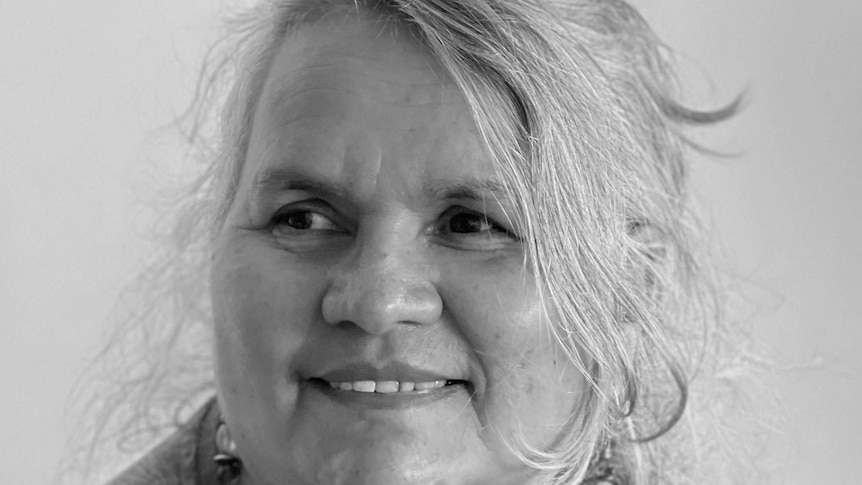
A Gudanji/Wakaja and Kalkadoon woman from the Barkly Tablelands in the Northern Territory, Dr Debra Dank is an Enterprise Fellow with the University of South Australia. She has spent 40 years working in primary, secondary and tertiary education roles, in urban and remote areas across Queensland, New South Wales, Victoria and the Northern Territory. She is interested in multiform narrative and its practice in Aboriginal and non-Aboriginal communities and the role semiotics plays in that.
Her book, We Come with This Place, won numerous honours in 2023, including four New South Wales Premier’s Awards and the Australian Literature Society Gold Medal. Debra is passionate about the environment, especially as her Country, on the Beetaloo Basin, is under threat of being fracked.
Read our book review of We Come With This Place by Debra Danks
Read an extract from extract from We Come With this Place by Debra Dank

0 Comments