


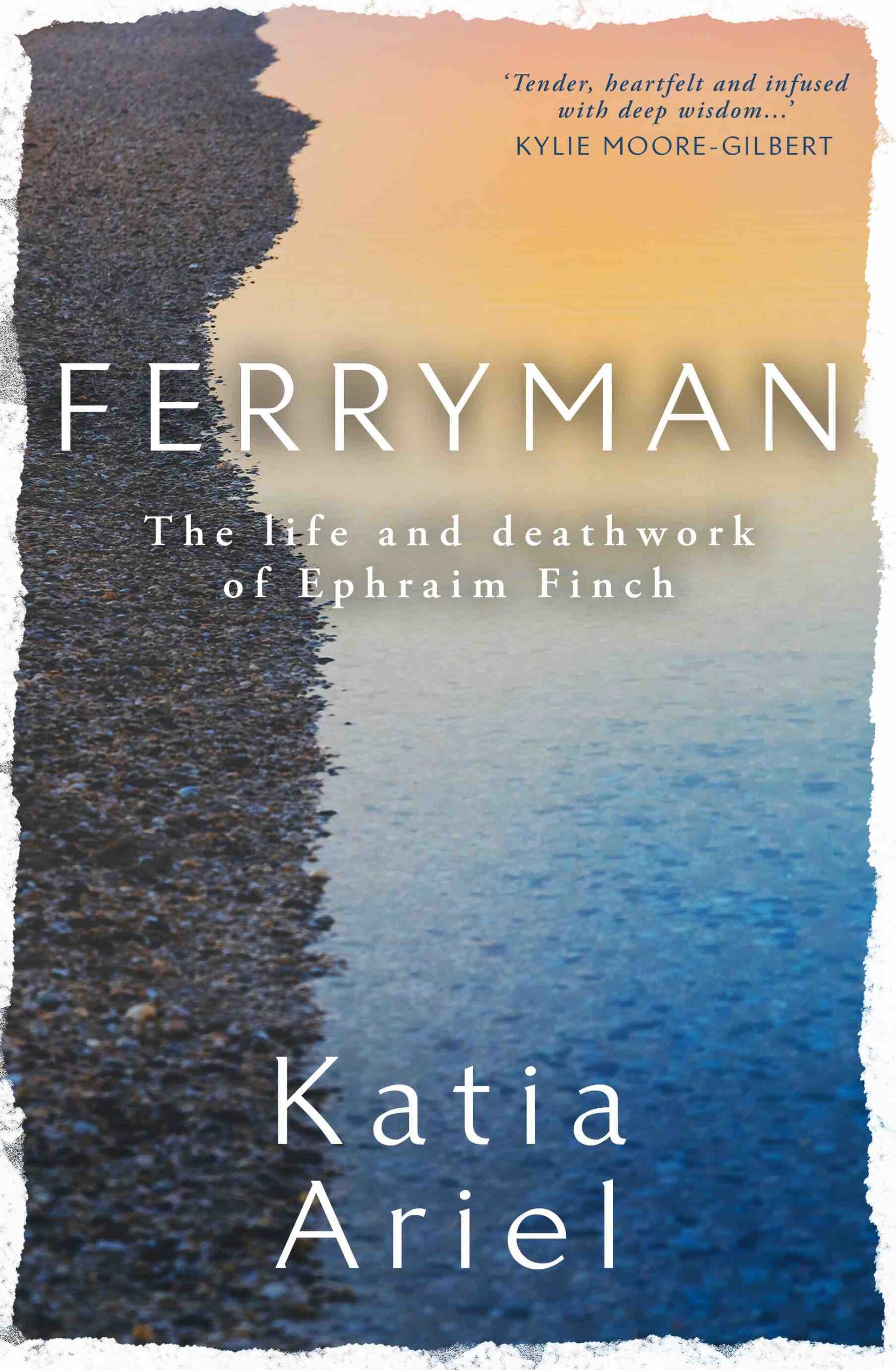
In Ferryman: The Life and Deathwork of Ephraim Finch KATIA ARIEL brings to life the remarkable story of Ephraim Finch OAM – a deathworker, community builder, and guardian of cultural memory.
Read the Prelude below …
ABOUT THE BOOK
Drawing from Finch’s handwritten journals and intimate interviews, Ariel masterfully explores themes of grief, memory, ritual, and the celebration of life, all with tenderness and wisdom. Finch’s extraordinary journey – from his working-class Sydney upbringing to his conversion to Orthodox Judaism, and later, his pivotal role as director of Melbourne’s Jewish Burial Society – offers a deeply human reflection on belonging, service, and the enduring power of stories.
For thirty years Finch provided unwavering support to bereaved families, including Holocaust survivors, while seamlessly navigating coroners, police, clergy, and medical professionals. A consummate connector, he preserved sacred Jewish traditions while fostering understanding across religious and secular communities, making death and its rituals less daunting and more accessible.
At a time of increasing cultural division and societal fractures, Ferryman is a vital and timely story – one that reminds us of the power of compassion, service, and the sacredness of life itself.
**********
Prelude
It’s a cool summer morning in the last days of 1959 and a teenager is riding his bike through Sydney’s Rookwood Cemetery. As he glides across the grounds, he notices the signs of dawn. The dew is melting off the grass. A fox leaps behind a bunya pine, and as if out of nowhere, a few of its cubs follow. The soil is firm beneath his tyres, and he can smell it warming, roused by the sun after a night of slumber.
Riding his Malvern Star, he is carefree. But Geoffrey William Finch, this lanky not-quite-man on his way to his carpentry job, is also careful. As he traverses the grounds, he sees the sun come up behind the headstones. Then he rounds a corner and sees the very same sun shining on an east-facing row, blazing into the engraved names of the dead.
This morning, as every weekday morning, he could circumvent the cemetery, ride along the waking bustle of Lidcombe. Instead, he lets himself in through the pedestrian gate and cuts across the field of headstones. He chooses this route because he likes the quiet. This is the interlude in which he works out his world, considers the day to come. ‘And the whole time I am talking,’ he tells me, some six decades later, sitting at his broad dining table in Melbourne.
‘Who are you talking to, Ephraim?’ I ask, because now this boy is an elderly man with a different name, a different religion, a life that he could have scarcely predicted riding through Rookwood on those dewy mornings. Ephraim and I are sitting in his front room and the sun is pouring into the space between us.
He is telling me stories. I am picturing his words as chapters, the vignettes arranging themselves between the covers of a book.
I notice that he prefers discussing his work to discussing himself. He wants to revisit his thirty years as director of a burial society—the people he comforted and held; those he ritually washed, wrapped and prayed for. But today I press him on those early years. I want to learn the soil of this man before I can describe its trees, the fruits it has borne.
‘Who are you talking to, riding through Rookwood?’ I repeat, lightly, as Ephraim closes his eyes, slipping into a temporal estuary. ‘I am talking to God,’ he says eventually, his hands resting on the table in front of him, a boyish smile now playing on his bearded face. That Ephraim says such a lofty thing without an ounce of grandiosity, without pushing or preaching, foreshadows what I will learn about this man. This man, at once deeply religious and utterly irreverent, softly spoken but defiant, is as prone to crying as to smiling. This man, whose work deals with the body as much as the spirit, dwells easefully at their intersections. This ageing Orthodox Jew with a broad Aussie accent, this voracious archivist and beloved community figure, this working-class butcher’s son who felt pulled to the Torah, is, himself, many beautiful intersections.
 The notion of writing Ephraim’s life has been in the ether for many years. If you were a member of Melbourne’s Jewish community from the mid-1980s to 2015 you would—for better or worse – have had something to do with Ephraim Finch. Having buried over ten thousand individuals, Ephraim is—physically, emotionally, culturally and spiritually—linked to a great many lives in this unique pocket of the world.
Not long ago, someone interviewed Ephraim with a view to writing his biography. But for one reason or another, a book did not eventuate. And so the idea made its way to my desk, via a writer who knew another writer, who approached my future publisher and asked, ‘Do you know someone who could use these materials—these interview transcripts, Ephraim’s journals—and shape them into a story?’
I hadn’t written anything like this before, save a memoir that dealt—in its own circuitous way—with grief and loss. Well, grief and loss, but also resilience and the deep bonds of love we form in this blink of a life. So perhaps there was something.
A week after the publisher approached me, I was shown Ephraim’s journal. I was struck by the language he used to chronicle his work with the dead and the dying, as well as their loved ones:
‘Your heart could feel the pain of lovers separated by war.’ ‘How do you live a normal life? I don’t know, but I feel their losses and their love for each other.’
‘Sometimes you do not understand the depth of friendship until the final days.’
I noticed his empathy for all those enduring loss. The intensely personal involvement with the details of another’s narrative. The reverence for forces we battle but must ultimately accept. ‘He knew he was going to die and seemed to accept it. I held his hand and wished him a safe journey,’ he writes in one entry. I wanted to know more about this heart-language and how a human might acquire it, become fluent in its lexicon.
Underneath this sat something else. I had my own memory of Ephraim Finch, from a death in my family almost twenty years ago. When my then-husband’s mother passed away in 2006, I remember Ephraim’s name being uttered; on the cusp of her death, throughout her funeral, during the rituals that coloured the subsequent weeks. I do not recall the way Ephraim looked, or even meeting him. But I will never forget the way his name resonated in that house of mourning. It was as though the name itself had a beneficent forcefield; every time my grief-stricken father-in-law would say it, he seemed calmer. ‘Ephraim will know’ seemed to be the answer to the questions, many of them unanswerable. Time after time, in the sheer act of saying it, something in the atmosphere would ease, even as the tears continued. When the name ‘Ephraim Finch’ was spoken to me again, some seventeen years later, I felt myself hurtling, with grateful awe, back into its orbit.
At our first meeting, before I have even begun to prepare myself for the flood of names and narratives, Ephraim launches into a recollection of everyone he continues to visit at Springvale Jewish Cemetery, almost ten years after retirement. ‘It’s my village,’ he says, closing his eyes and taking me along on his imaginary tour of the place. ‘I see all of them as I go around … it’s like walking down the street. There is the lovely gentleman who descended from the Radomsker Rebbe, and there is Bill … Hello Bill, my dear friend! And here is Mr Cykiert, who gave me his poem just before he passed.’ I continue to watch him meet them, one by one. ‘And, oh.’ He drops to a whisper, his fluttering hands stilling. ‘Hello, dear boy.’ Something subtle shifts in his facial musculature, his eyes flicker. ‘You see, I buried this boy …’
In this moment, Ephraim’s wife Cas, who has been sitting with us the entire time, softly interjects. ‘May I tell this story, darling?’ she asks, in a manner I will witness many times over the coming months. There is a concert of silent knowings between Cas and Ephraim, an instinct for each other’s pauses. Intuitively, they allocate the best raconteur for the moment, illuminating and verifying one another. ‘I’d like to explain why we are so connected to this boy, if I may?’ Cas asks, her voice deep and low, her blue eyes cloudy. Ephraim nods. ‘We were out one day with our daughter Sharona, who is now forty-two, but was then twenty. It was a hot day, but she was suddenly freezing and had a terrible headache. This went on for days and on the third night she developed a rash. On top of this, she felt like every bone in her body was breaking. Next morning, I got up at dawn to get her some Panadeine. As soon as my finger made contact with her arm, dark purple spots started to appear, spreading. And Ephraim knew exactly what it was, because he had buried this magnificent young man a few years earlier. He knew the symptoms.’
A doctor arrived not long after and administered a penicillin shot, which bought Sharona time to get to the hospital, where she would stay for three weeks. One day an infectious diseases doctor approached the Finches on the ward.
‘How did you recognise the meningococcal septicaemia?’ he asked Ephraim.
‘Doctor, I buried a boy in 1991 …’ And before Ephraim could say more the doctor named that boy, remembering the family. They stood mutely for some time, struck by the reach of tragedy. But beneath the moment was an undertow, a twist in the Finches’ hearts. It was nothing as crass or numerical as a sacrifice schema—Cas and Ephraim never believed that this boy died so Sharona could live. In fact, it was an inversion of this ‘lucky us’ smugness—they had never forgotten that this child died while theirs had lived.
Three months after Cas tells this story, Ephraim and I will go to Springvale together, and when we reach this young man’s grave, Ephraim will bend down and kiss the engraved marble. He will greet the boy and read his name out loud, along with his date of passing. He will intone the names of his mother and father. He will weep for them, while knowing the limits of his weeping. He will continue bending, head bowed, holding all the connections in all his body. And I will sense, simply by being next to this softly moving human, the shuddering proximity between us all, the near- misses, the churn of loss and the majesty of memory, the ceaseless current of our arrivals and departures.
‘The most urgent part is that I was a witness,’ he tells me when I ask him to help me map out the parameters of this story. Alongside his memories, Ephraim brings a bounty of archival material about his own life: interview transcripts, a video testimony he made for the Melbourne Holocaust Museum, a couple of short films on DVD, an oral testimony for the National Library of Australia. He also shows me a journal, one of several volumes he kept between the years of 2005 and 2019. This black leather-bound tome is heavy, as large as a wedding album. The pages are filled with Ephraim’s distinctive hand, something that merges the printed Hebrew alphabet and the calligraphy of mid-century schoolteachers, geometric and tight.
The journal documents many of the lives and deaths that Ephraim witnessed, with an emphasis on the stories of Holocaust survivors. Over the coming months, I will see Ephraim’s preoccupation with the Holocaust, namely with the details of survivors’ lives—not just their birthplace, but the name of the village and its original Polish or Hungarian or Russian spelling; not just their parents’ names but their siblings’ and grandparents’ and ex-spouses’ and deceased children’s. I will see scrupulous lists of internments, tattoo numbers, immigration arrival dates, names of ships. He will reiterate to me, over and over, how important it is to ask questions, to let people speak, to listen deeply.
At times, his empathy for the Jews of Eastern Europe will be so embodied, I will join Ephraim in the notion that he has somehow known their stories from the inside. In fact, there will be some astonishing crossovers between Judaism and his earlier life, before he commenced work as the director of a Jewish burial society or even found a Jewish identity.
I’ve got two beautiful scars where the headlight cut me,’ he says, pointing to his leg.
But before we get to any of this, before he takes me to his narrow study, cluttered with binders, prayer books, novels, maps and war memorabilia, I want to go back a little. I want to know more about the adolescent Geoffrey William Finch, riding through Rookwood Cemetery on his way to the carpentry job. I want to know more about this person crossing the field of stone, innocent of the tumult, though maybe not the radiance, up ahead.
‘I was riding my pushbike through a big intersection with my father. I must have been about 14. And we went through when the lights were nearly red. And I got hit by a car. I’ve got two beautiful scars where the headlight cut me,’ he says, pointing to his leg. A few weeks have elapsed since our first interview and we are, once again, seated at Ephraim’s living-room table. I have prepared a list of questions, naively thinking that we will cover, in a linear fashion, the traditional milestones of his childhood. But he wants to take it elsewhere, going with what emerges.
As he points to his scar, I notice his hands, tremulous with age and ill-health, but solid, and strikingly smooth. They resemble the hands of a master craftsman or a musician. My mind races from the bike accident to his future work, all the care these hands would go on to transmit, the steadiness they would supply to those broken or collapsing, to those waiting to cross over and those already on the other side.
He continues the story. ‘So my father saw the doctor’s surgery on the corner and raced in. The doctor said he’d have to stitch me immediately and my father said, “Okay, I’ll hold him”. There was no anaesthetic. And my father’s holding me, and the doctor says,
“Are you okay, Mr Finch?” And my father says, “Yeah, I’m okay, I’m a butcher.” So the doctor says, “Oh, I want to see how you do your stitches,” and my father stitched me up, exactly the way that they stitched up the corned beef. And the doctor said, “You guys are very good,” and that was that.’
I gesture with my hands, as though to say, ‘And?’, hopeful that this will instigate a deeper exploration of the father–son dynamic. But Ephraim is not interested in psychosocial banter. He is giving me a moment, a whiff of antiseptic, a portrait primed with blood and courage.
In fact, though I prod, Ephraim offers few other memories of childhood. When I ask him to tell the very beginning, he simply replies, ‘I was born in 1944 in the little suburb of Ashfield, in Western Sydney, to a mother who I think didn’t really know what she got into.’ Ephraim recalls Gloria May Atkinson admitting her own uncertainty, her overwhelm at the demands of parenthood. She was twenty-three when she had her first child. Eighteen months later she gave birth to another boy, Richard. Like most of her friends and neighbours, Gloria May raised her children in hardship, the Finches’ house built of ‘Masonite … cheap-rubbishy stuff’, their kitchen table reliant on rations.
I think of the strikingly honest eulogy Ephraim gave his father James, who passed away in 2014 aged ninety-five. In it, he says, ‘… me being born during the war years, my father would not have known me well as he was working 100 hours a week’. This makes me wonder how Gloria May got through, what she leaned on in parenting her boys. Ephraim doesn’t offer answers, adding only that on top of being absent, his father was ‘a hard man’.
I do not push further into this terrain, looking instead at the memorial candles and baby photos assembled on the dining cabinet. In fact, I notice that every available bit of space in the Finches’ front room is crowded with timestamps and annotations of love: birthday cards, fading photos, oil paintings of faces and fingers and doves. Up against the wall is a record player, topped with the LP of Nick Cave’s The Boatman’s Call. This seems at once incongruous and perfectly aligned with this religious suburban home, with the black Hasidic hat perched at the end of the table; the engraved silver kiddush cups; the large, framed landscapes of ragged trees and scarlet skies. I bring myself back to the moment, even though it is tempting to fly away with these objects, holy and prosaic in equal measure.
‘His customers at the butcher shop loved him because he was fair,’ Ephraim says after a long pause, returning to his father. Then he tells the story of a woman from the neighbourhood who often came into the shop covered in bruises. One night, James came home with a swollen fist, prompting his twelve-year-old son to ask, ‘Did you hit Mr L?’ James didn’t give a direct answer, simply saying, ‘Mr L will never hit his wife again.’
Now I recall another passage in the eulogy, where Ephraim notes that his father ‘instilled in me that you can never say “No, I can’t.” It always had to be “Yes, I can”.’ These values – fairness, a solid work ethic, tenacity – surely shaped the adult sitting before me.
Still, I wonder where the nurturance came from. Something in me refuses to believe that this man, this example of tenderness, never witnessed warmth or careful attention. Almost on cue, Ephraim says, ‘See, my grandfather, Pop Finch …’ Here his voice changes, regresses to something younger and more vulnerable. ‘He taught me so much. When he was a boy, his father had left him and his siblings, so he had to look after the family. He’d go and deliver the milk in Pyrmont, then he’d come home and turn the mangle for his mother before going to school. He worked as a lolly-boy and he learned the violin,’ he concludes, almost in tears. I must look confused at this disjointed sketch because Cas intervenes to connect the dots.
‘Pop made everything a learning experience. He worked as a theatre boy, but he paid attention to the musicians—he saw Paderewski play the piano, and Menuhin playing the violin. When he became an adult, he and Nana took a great interest in their grandsons – they wanted the boys to have an education, they taught them piano and so much more.’
‘I used to see Pop come home from his work at the abattoirs and he’d sit on the back veranda in his rocking chair, with a glass of whisky. And the Monopole magnum cigar and Oscar Wilde’s works,’ Ephraim adds. I have seen the worn hardcovers in Ephraim’s study, inherited from Pop: Dickens, Hugo, the pages thin with time and use. Picturing William Robert George Finch, I see an iteration of him sitting before me: a blue-collar man with a love of scholarship.
‘And of course, there was his determination to look after any woman who was left alone with children …’ Cas adds, somewhat elliptically. Ephraim explains that during the world wars, many women were left husbandless. The death notices, which were published in the local paper, listed the bereaved person’s address. Pop would read the listings and organise a delivery boy to take an envelope of money to the house. For many women, this was a life-saving gesture.
‘The understanding of tzedakah, charity, the understanding of living your life for another human being, that’s what he got from Nana and Pop on his father’s side,’ says Cas, closing the circle.
We return to the topic of life-shaping events. Ephraim tells me that the bike accident wasn’t the last encounter with his own mortality. A year later, he contracted appendicitis, which went undiagnosed and turned septic, creating a pelvic abscess that nearly took his life. ‘And this specialist came in, examined me and said if they don’t operate in the next twenty-four hours I won’t be there,’ he says, without drama but with a fracture in his voice. ‘Do you remember, in the course of that experience, fearing your death?’ I ask. The grandfather clock ticks in the background. I notice a tiny pomegranate lying at the centre of the table and I know it has come from the Finches’ front garden. I know that Cas collected it from the ground after last night’s heavy winds, gingerly giving it pride of place at this long table.
‘Not leading up to it, but after the operation, yes,’ Ephraim finally says. ‘And in those days, it wasn’t refined. They stuffed a hose down my throat to drain the rubbish out. It was about half an inch thick. And when I bent over, it would crank in the back of my throat, I couldn’t breathe, and a few times I brought the tube up. And every time I did, they just said, “Don’t worry, we can put it back in again!” They were rough times, tough times. Now if I get too close to a rubber hose, I sort of …’ He shakes his head, indicating nausea, some terrible sense memory.
I circle back to the question of mortality. He pauses again.
‘I remember lying in the hospital, and my uncle, Laurie Hall, who had emphysema, was standing by. And when the doctor gave me the 24-hour prognosis, Uncle Laurie turned to my parents and said, “I hope God takes me and leaves Geoff”.’ It was not long after this that his uncle passed away. Again, Ephraim doesn’t force interpretation, doesn’t push a cosmic formula. He is not citing this example because he purports to know what happened behind the veil. He is citing it because it is the first time his own death is named directly to his face. The fright of it. The shock to a boy who had, until now, a fairly unshocking childhood. But there is something else. Ephraim is citing a good and precious thing: his uncle’s grace, a memory of deep care at this time of aloneness.
‘What about earlier in childhood, what had you witnessed of death, of funerals in your community?’ I ask, digging for more roots to his vocation. Ephraim remembers, faintly, the death of a boy in his street. ‘Fatty’ Baker was twelve years old when he died from a staph infection after stepping barefoot on a nail. But even this memory lacks the traumatic imprint one would expect; the elderly man before me simply remembers the boy, remembers playing with him and enjoying their time together.
What he wants me to know is that the boys of the neighbourhood, many of whom attended Scouts, formed a guard of honour around their friend’s open coffin. This—the ritual of public commemoration – seems like the salient part of the story for Ephraim. I tell him that I grew up in Soviet Odesa in the 1980s, where street funeral processions were common; an open casket, followed by a marching band. There was always a tuba, its low tones carrying the dirge into the ears of passersby. In my childhood of hidden Jewishness and overt communism, there was no religious tradition but plenty of superstition.
He replies that he was neither superstitious nor religious, the only skerrick of either dwelling in his nightly recitation of ‘As I lay me down to sleep, I pray thee Lord my soul to keep’. Still, the Anglican trinity had little purchase on his heart, while a single god, embodied in all living things, made sense.
‘I always believed in the one. I couldn’t believe in the three. And see, Pop, he believed in the one. My grandfather wasn’t interested in religion, but to be a Freemason you have to believe in a higher power in the world,’ he says. Pop introduced young Geoff into this community, fortifying two qualities that would reverberate across his life: a love of ritual and an interest in the divine, a taste for something beyond the immediately visible and immediately rewarding.
I remember lying in the hospital, and my uncle, Laurie Hall, who had emphysema, was standing by. And when the doctor gave me the 24-hour prognosis, Uncle Laurie turned to my parents and said, “I hope God takes me and leaves Geoff”.’
‘Great Architect of the Universe, they call God. And the ritual is non-denominational. See, people need something,’ he says, getting up to make us tea.
While he is out of the room, I consider this ‘something’, the essential human need for ritual. I think of myself, and my secular Jewish friends, cherry-picking customs and traditions. We grapple with notions of spirit, the possibility and texture of an omnipresent, ineffable force in our lives. Still, for the most part, it’s casual Shabbat dinners with the phones on, Hannukah candles for five of the eight days, a Passover reading that we may or may not get through before everyone lunges at the chicken soup. Coming to this house, I dress more modestly than ‘out there’, covering my shoulders and my decorative tattoos. In other words, I am a Jew to the same extent that I am a secular humanist, a product of my agnostic world and its mixed-bag customs.
That is, until there is a great life event, namely a birth or a death. Something awesome, in the traditional sense of that word, comes into the picture, something that rattles complacency and begs contemplation.
Never have I been so grateful for the structure, the scaffolding, of ancient tradition, as when a loved one passes. Here, in the merciless hollow of fresh loss, ritual becomes everything. The quick burial, no more than a day after death. The thud of earth as it hits the coffin, fresh off the shovels of surviving family; the enforced sitting and inwardness of shiva; the repetitive incantation of the kaddish; the covered mirrors; the counting of the days; the mounting of the headstone. All of it is a firm grip in a measureless dark.
Ephraim returns with the tea and sits down at the head of the table, humming to himself. Cas is to my left, sewing a button onto a granddaughter’s pants. I am slowly forming a portrait of his early life. But I struggle with my scant sense of his mother. I do not wish for this figure to be invisible on the page.
Although Ephraim is reluctant to confect an intimacy that was not there, he notes that his relationship with Gloria May deepened over the years, especially in her final decade. ‘Towards the end of her life she came and visited. She would stay with us and the children grew to know her very well.’
When Gloria May died, in 2004, she was living in an aged-care home in Ashfield, the suburb where she was born. Ephraim had visited her there, sitting by her bedside, making sure that she was comfortable. The care facility in which she took her last breaths was about two hundred metres from Finch and Sons, the butcher shop that fed her family, had secured her livelihood and her place in the community for over five decades. Ephraim officiated at her funeral, reading the psalms, delivering the eulogy. In his farewell he recalled, with affection, swimming with her at Wylie’s Baths, the wild Pacific ocean pool where she was joyful and relaxed. Then he buried his mother, ‘tucking her in’ for the last time.
It is after midday and Ephraim is tiring. We have been talking for three hours. Just as I am about to suggest we finish, he shuffles off to his study, saying, ‘Hang on!’ He returns with a small hardcover book, in faded green cloth, titled The Observer’s Book of Ships. Published in 1953, it is inscribed in neat, antiquated hand: ‘G.W. Finch. 13 Third St Ashbury, N.S.W., Australia’. I see this gangly, brown-eyed boy, assiduously adding his details to the page, perhaps hoping to show it to Pop.
‘I used to love drawing boats, things from World War II,’ says Ephraim. ‘And you know, Ben, our eldest, also loves everything about that period in history. He knows all the Panzer, the German tanks, he can quote sentences in German …’
Here is what I know about Ben Finch: he helped his father at the burial society – driving to collect the deceased, attending funerals, eventually building coffins—before he was even an adult. Now in his fifties, he is neither an Orthodox Jew nor a deathworker, sort of mirroring Ephraim’s journey in reverse. I am desperate to know more about this eldest son, and about this unique hereditary apprenticeship, but I hold off. Instead, I ask Ephraim another question that has arisen, one that feels a bit risky.
‘Do you think we carry things into our lives from, you know, before we come in and before we leave … Do you think we bring things from …’ I start to trip and stumble, ignorant of the Finches’ religious vocabulary, not wishing to offend.
‘Past lives?’ Cas asks softly, dispelling my impostor syndrome. ‘Well … yes. Do you think we bring things from other lives, things we love, things we want to hold onto?’
‘Oh, we love things from another time, yes,’ says Ephraim, mis- understanding my question. In due course, I will learn that both Cas and Ephraim do believe in reincarnation, and that none of that contradicts the Jewish paradigm. But right now, he takes me elsewhere, and it’s just as valuable.
‘That’s why I love that clock. It’s two hundred years old,’ he continues, pointing to the grandfather clock in the corner. Its ticking has faithfully, unobtrusively, kept us company all morning. ‘That’s Pa’s clock. It’s from Scotland,’ he says. Pa is George Charles Edward Atkinson, Ephraim’s maternal grandfather. Earlier in our conversation Ephraim told me that his Pa had fought in WWI and had suffered terribly from the effects of mustard gas. But that was about it. We have hardly spoken about him, but now he is here. ‘I feel a connection to it, I treasure old things,’ says Ephraim, his voice clotting.
‘I wonder if you have the soul of an archivist,’ I say. ‘Definitely.’
‘Whereas I’m just a hoarder,’ Cas pipes up, giggling. ‘Maybe you enable each other?’ I suggest.
‘Yes, we do,’ they respond in a round of echoes, ‘yes, we do!’
Ephraim takes down a framed photo from the mantlepiece, a close-up portrait of his youngest daughter, Michal, on her wedding day. A veil filters her sweet, round face, her clear blue eyes looking directly at the camera. I notice that when he holds the photo, his hands stop trembling, as if the very act of touching this moment stills him. He emits a long, melodic ‘Oh …’, a call that signals something I will witness time and time again – nostalgia.
It seems that while Ephraim is happy to skim over some aspects of the past, others induce a huge swell of feeling, an almost unbearable tenderness. I hope, in time, to learn which stories fall into which group, to observe what flows like water and what sits like stone, and with any luck, discern the reasons why.
Tucking these hopes into my folder, I start to pack up. I place Ephraim’s photocopied journal into my bag, along with my laptop.
I turn off the recording app and move across the living room, thanking him and Cas for their time. Ephraim follows me out, but there is an incompleteness between us.
‘So many stories to cover,’ I say.
‘I’m still trying to find … this man came in for his wife …’ he replies, and I stop in the doorway. We are standing at the threshold between the dining room and a tiny library, a hallway so heavily walled with books it feels like a grove of dense forest.
‘He came in to bury his wife, had his two sons with him. I asked for her name, date of birth, where she’d come from. Poland? Hungary? What year did she come here? He said 1949. Bingo, I knew I was in for a night of history.’ We have moved beyond the bookshelves and are now standing at the front door.
He continues. ‘I asked for her occupation. “Seamstress, machinist”. “One or two marriages?” And the sons spiked up, “What are you asking that for?” I showed them the form, said, “I’m just collecting a history”. Turned out she’d been married previously. We sat there, one minute, minute and a half. And my noisy brain was clicking over, click, click …’
‘And no one is saying anything?’
‘No. Then the father starts crying. And he looks at the boys, who are now thirty-five, forty, and he says, “I was also married before the war”. I asked for his first wife’s name— I want the names of the ones that perished. Wrote it down. I got the village he was born in, the year he came here, his occupation. Then I said, “Did you have a child with your first wife?” Two minutes this time. Silence, click, click. Then he looked at his boys and told them he’d had a little girl.
Standing before me, Ephraim whispers the little girl’s name. He names her exactly the way the father did all those years ago, a soft Yiddish diminutive reserved for the greatest treasures.
Sarale, not Sarah. Rivkale, not Rebecca. Ruchele, not Rochl or Rachel or Raizel. Freidi. Shaynale. Mashenke.
‘She perished?’
‘Yes. But now I had her name,’ he says, as I step out of the house and proceed down the path, looking back at him. I can feel Ephraim’s journal weighing down my bag, as though suddenly swollen by its own details.
‘And the brothers said, “Thank you”. Now they knew they had a sister,’ he continues, not raising his voice. And though we are now several metres apart, with the garden wind swirling the air between us, I can hear him perfectly. My hand on the gate, I say her name. Then I step out onto the street, slowly, carefully, so as not to lose her to the onrushing present.


0 Comments